Popular Posts

Statcounter

Tuesday, August 2, 2022

Cool It!


Front Porch Respit.  In 1940, this Vermont woman found relief from household work and the summer's heat. During the summer months, northern New Englanders used the shade offered by porches for relaxing or, in the case of larger ones, for outdoor sleeping. (Library of Congress)
Winter Ice, Summer Cooling. Harvested ice from the area's lakes and rivers was stored in ice houses for use during the rest of the year.  This was winter's cash crop for both personal and commercial use.   

"It is very much as one looks at it whether one is to suffer or enjoy most during the summer. Fretting and fidgeting and violent fanning adds to one’s discomfort.” Orleans County Monitor July 15, 1895.

Warmer summers are here to stay. There have been past periods of extreme heat in Northern New England. The summers of 1911, 1936, and 2021 are examples of summers that had a series of heat waves, with the latter being one of the hottest summers on record. For some, this summer will even surpass that one.

These are the days we sometimes look back to last winter for cooler temperature. This column explores how people kept cool in the years before air conditioning made sizzling summer work, dining, or sleeping more comfortable.  It includes some time-honored methods still used by area residents, and some that have passed away with time and inventions.

 A few previous columns included ways in which area residents and visitors have dealt with hot summer temperatures. The following are brief excerpts from those articles. The full articles can be found at larrycoffin.blogspot.com.

For over 200 years, area residents have hosted summer visitors at commercial and private facilities. In Aug 1871, Orford’s Hale’s Hotel hosted “a large number of city boarders who have come to stop through the hot weather.” Hostels and private cabins offered residents and tourists opportunities to enjoy local lakes. 

Mountain locations were especially appealing to summer tourists. The Breezy Point House at Mt. Moosilauke hosted wealthy summer guests who traded the stifle of the city for the fresh air of the mountains. The full article can be found at “Summer Tourist Trade.”

Summer residential youth camps have flourished in the Upper Valley from early in the 20th century. Those who established camps such as Farwell on Hall’s Pond, Aloha on Lake Morey, and Moosilauke on Upper Baker Pond were pioneers in the youth camp movement.

Annually, trains brought urban youth to enjoy the refreshing lake-side environments. Hiking, swimming, and canoeing were among the many camp activities.  These camps had the added benefit of freeing parents of their children during the long summer vacations.  The full article is entitled “Going to Summer Camp.”

Swimming and other outdoor recreations helped folks deal with the summer heat. Hall’s Pond, Baldwin Bridge, Flat Rock, Ticklenaked Pond, and Lake Morey were among the swimming locations that called young and old alike for a refreshing dip.

Just as tourists sought cool mountain locations, locals enjoyed hiking for day walks, picnics, or camping. Bicycling, canoeing as well as lawn games brought residents out of doors in the summer.  This third excerpt can be found on the blog at “Late Summer Fun.”  

In times past, spring houses were one method used by area rural residents to kept perishable farm products and household foods from spoiling. Built over running water or a spring, this small structure allowed items to be kept in the cold water or on shelves. Spring houses were especially important for the safe storage of butter, milk, and other heat-sensitive foodstuffs.

Before air conditioning and electric refrigeration, ice harvesting utilized winter’s cold to combat summer’s heat. The area’s many lakes and rivers provided a harvest of ice that was stored in private or professional insulated ice houses. It was winter’s cash crop.

 Ice cutters used huge blades to cut ice that was at least 18” thick. The work was hard and often dangerous. Horses, and later tractors, were used to haul the heavy loads of ice away.

Area newspapers described this annual activity. In January 1883, 20 men hauled ice for the Bradford Ice Company. Five hundred tons of ice were stored in one company’s ice houses in Woodsville and Wells River in 1885. According to the Adirondack Almanack, some 5,000 men cut ice on Lake Champlain in 1890.

 In 1896, Orford’s ice houses were filled with ice of “large quantities and of most excellent quality” from Lake Morey. In Feb 1911, Newbury men filled the creamery ice house with 100 tons of ice in just two days.

A late fall, an open winter, or an extremely hot summer often led to a shortage of ice. In those cases, dealers had to purchase ice from neighboring towns with surpluses or import it from colder states or Canada. 

In 1874, the Vermont Central Railroad began to use ice-cooled refrigerated cars. This increased significantly the shipment of perishable area products, such as butter, milk, and strawberries to markets.   Theatres, stores, restaurants, and factories used fans blowing over large quantities of ice to provide “air conditioning” or “comfort cooling.” 

This naturally harvested ice was popular into the early 20th century. Artificial ice had been manufactured in the southern United States for some time and began to replace harvested ice. The first commercial ice-maker was patented in 1873, but it was not until the 1930s that edible ice was manufactured. 

Early in the 19th century, household “refrigerator” iceboxes became available. Blocks of ice were home delivered and placed in these insulated appliances. Home owners told the iceman their needs by placing a sign in the window. He would chip off the desired amount and, using tongs, swing the block over his rubber-covered shoulder for delivery.

My Brattleboro grandmother still had an icebox as late as 1948. I recall the iceman treating the neighborhood children to slivers of ice.

In the 1930s, the price of electric refrigerators was reduced, and more homes installed them. In the 1940s, as frozen foods became popular, separate freezer compartments were added. Chest freezers followed in popularity. All these appliances kept food safer for longer periods of time.    

Mechanized air conditioning began to be used for cooling buildings and railroad cars in the 1930s.  In May 1938, the new Chimes Restaurant on Bradford Main Street  touted its air-conditioned atmosphere.   In 1948, Bradford’s Colonial Theatre was renovated, and air-conditioning was added. 

In 1947, advertisements for Carrier Room Air-conditioners offered the chance to “dodge the dog days and keep cucumber-cool this summer.”

Before, and even after, air conditioning, houses were often designed to reduce the impact of summer heat. Some were  built with wide eaves to avoid the sun’s direct rays. Higher ceilings allowed warmer air to rise over head.

Verandas, farm porches, or second-story enclosed balconies offered shade for a mid-day nap or an evening of rocking. They also prevented the sun’s heat from entering the house. Some verandas were large enough for a swing or to serve as a sleeping porch for those who had no mistrust of night air.  Screens gave protection from insects. Shade trees and climbing vines offered added protection

Windows were often placed to offer cross-ventilation and outfitted with shades or shutters. With no air conditioning, residents kept the house shuttered during the day and open during the evenings.  Some larger homes offered summer kitchens to prevent the heat from cooking invading the rest of the house.

Electric fans for both household and commercial use became popular around 1900.  Earlier fans had been powered by alcohol, oil, or kerosene.  Fans were available in both tabletop and ceiling models.  Westinghouse and General Electric battled for the fan market. Stores mentioned electric fans in the advertisements and drew more customers during hot weather. 

Newspapers and magazines regularly carried menu suggestions for summer meals. Lighter foods were recommended. Many recipes used available fresh garden fruits and vegetables.  

Lawn picnics and afternoon naps required just a blanket.  Modern picnic tables began to appear in the early 1900s. Vermont newspapers began to refer to the joys of backyard barbecues after 1940.  One Vermont observer made light of the tendency of newcomers and tourists to eat out of doors.   

A cool beverage helps the body deal with the impacts of high temperatures. Just plain water or “Adam’s ale” was readily available and free.

“Switchel,” a 1921 United Opinion article proclaimed, “is the homebrew of the Gods, unexcelled as a thirst quencher.” There are various recipes, including one made with oatmeal. My Mom made it from water, sugar, ginger, and vinegar for use in the ha fields.   

Commercially-made carbonated beverages began to appear on the market in the second half of the 19th century . Those included Hires Root Beer (1876), Dr. Pepper (1885), Coca-Cola (1888), Pepsi (1898), and Canada Dry Ginger Ale (1907). Others turned to the time-honored relief found in alcoholic beverages. 

Beginning in the early 19th century, tea punches were popular.  Iced tea was introduced after 1900 and was added to an assortment of fruit drinks.

Since the early 1800s, Ice cream has been a way to cool off in summer’s heat.  It was referred to as a “dessert that made life endurable…”  Using ice and rock salt, hand cranks turned cream and sugar into homemade ice cream.  Later, commercially manufactured ice cream became an industry. 

In the 1870s, soda fountains began to appear, and ice cream sodas were introduced. Some religious groups thought it sinful to eat ice cream sodas on Sundays. In the 1890s, some entrepreneurs left out the carbonated water in the soda, and sold them as ice cream sundaes. It was said that they were initially referred to as “Sundays.”   

Locally, many pharmacies maintained a soda fountain. When I was a child, one could find soda fountains at Clifford’s Corner Store in Orford, Chapman’s in Fairlee, and Gove & Bancroft Pharmacy and Chimes’s Restaurant in Bradford. Similar ones were found in Wells River and Woodsville.  In 1948, the soda fountain at Woodsville’s Kelley’s Cash Store offered a student special ice cream floats for a dime.

The ice cream cone was introduced at the 1904 St. Louis World’s Fair. Ice cream had been licked in hand-held containers for some time, but this was the first time the container was eaten. 

As early as 1912, there was an ice cream parlor on Main Street in Fairlee. Known as the Neapolitan, it used Bradford strawberries in its strawberry ice cream. It was bought out by Hood’s Creamery in 1936.

In 1926, Charles Taylor of Buffalo invented an automatic soft serve ice cream machine. In the early 1950s, Taylor machines began to appear in the area, offering an alternative to hard ice cream. It was initially called frozen-custard in New Hampshire and cree-mees in Vermont. The popsicle, invented by accident in 1905, became popular in the 1920s.

Those who could afford it gave up heavier clothes for lighter summer ones. “Dress lightly, eat little, but often. Relax. Don’t get too much sun at one time. That is the way to keep cool.  Cliff Lang, Bradford’s United Opinion, July 31, 1942.

 Linen and cotton fabrics were recommended as were loose-fitting garments. Ladies had wide-brimmed hats and parasols to avoid the sun. These seasonal outfits were most popular and available among affluent residents and guests. 

Wearing white outfits was considered most appropriate summer attire until Labor Day. They indicated that the wearer was not involved in dirty manual labor. The same seasonal rule applied to men’s hats, with boaters or straw hats replacing heavier cloth ones.

Earlier attitudes regarding modesty dictated the amount of skin the wearer could show. Earlier swimwear was less revealing. In the latter part of the 19th century, women’s swim outfits consisted of long dresses or bathing gowns.  Men wore wool shorts and tops, and only in the 1930s did men start to go topless.   

Most men resisted short pants.  In the early 1950s, Bermuda shorts were introduced, with tourists the first local wearers. In June 1956, Bradford’s Erskine’s clothing store was the first to advertise them.  

  In the past, the poor suffered most from the heat of summer. Having a summer tan was the sign of a laborer. The poor could not afford a summer wardrobe, a trip to a resort in the mountains, the beach, or a residence with cooling features. 

As the earth warms, and extreme periods of summer heat become more frequent, it will again be the poorest that suffer the most, both at home and abroad. And that’s cold.         

Monday, July 4, 2022

Rise of Baseball-1840s to 1900

 Journal Opinion , June 22, 2022

Thrown Out On Second. Published in Harper's Weekly in Sept 1887, this Gilbert Gaul's  illustration captured the nation's fascination with baseball. 

“Tuesday the quiet of our [Newbury] village was broken by the shouts and mirth attending a game of baseball.  The Orford Base Ball Club dispatched a challenge to the Newbury Club. The playing on the part of both clubs was excellent, the Newburys excelling at the bat, and the Orfords in the fielding.”  Bradford Opinion, August 8, 1874

Baseball has been dubbed the nation’s past


time. There are mounds of articles and books on the subject.  So much material is available, that the history of baseball locally and throughout New Hampshire and Vermont will bel presented in two columns.  This column explores the game’s roots and its development into an obsession in the period before 1900.  A second column will cover the period from 1900 to 1970. 

Americans played team games with bats and balls before the inception of baseball. One game that had its heyday was the English game of cricket. In 1709, it was being played in Virginia and the first public match was held in New York City in 1751. Interest in matches grew, and, by 1849, an estimated 100,000 Americans played cricket.

 In the late 18th century, a game called wicket became popular in New England as a variation of cricket. At first, it was just an informal game with varying rules. Later, wicket clubs became more popular, and rules were needed to govern matches

A more lively game, however,  began to catch the nation’s attention.  It was baseball, at first spelled as two separate words. It was sometimes referred to as “bat and ball.” The story that it was invented in 1839 by Abner Doubleday of Cooperstown, NY has been widely refuted.

 In 1845, a game on the grounds of the Brooklyn Cricket Club was played with eight players on each side and may have been one of the first organized games. This newer game was considered more exciting than previous ones, “so much more full of life.”  One of the first organized teams was the Knickerbockers of New York.

At first, there were variations of the game’s rules. One set of rules was written in 1845 by Alexander Cartwright of the Knickerbockers. In 1839, Dr. Daniel Lucas Adams, a native of Mont Vernon, NH, moved to New York City and joined the Knickerbockers.  In 1857, he wrote a booklet entitled “The Laws of Base Ball.”

 These rules, which became widely used, described the game with nine players on each side, nine innings, and a 90-foot distance between bases. This, so-called New York game won over the competing Massachusetts set of rules.  

By that time, baseball was receiving editorial support and was played on the fairgrounds and playing fields across the country.  One editor wrote, “The good effect produced by the health and strength and morals of the young men engaged….has taken them from the unhealthy haunts of disputation indoors and given them a taste for manly sports.”

During the election of 1860, a political cartoon depicted Abraham Lincoln winning a game of baseball against his rivals.

In August 1860, a contest between the Brattleboro Base Ball Club and the Green Mt Base Ball Club of Jamaica drew “quite a crowd to witness” one of the first “Prized Ball” games played in the state.  That same year “a number of actively disposed citizens of Burlington, mostly young men,” established the Burlington Base Ball Club. The Star Base Ball Club was formed in Rutland in 1862.  

During the Civil War, baseball was “the most popular sport of all competitive sports in the camps of both armies and even in prison camps.”  Soldiers in the both Vermont and New Hampshire regiments played baseball during the lulls between military actions. 

Veterans brought home their enthusiasm for the sport.  By 1867, it was reported there were 44 baseball clubs in Vermont. What had started as a “gentlemanly sport” grew more inclusive. Leagues were formed, with series and amateur tournaments were held. 

Church groups opposed the playing of baseball on Sundays, calling it “a desecration of the Lord’s Day.”  In 1880, Vermont reaffirmed its ban on Sunday activities. According to an 1887 Burlington newspaper article, the legislatures in some states were passed laws against “the evils of Sunday base ball games.” 

In 1869, the Cincinnati Red Stockings was established as the first professional club with openly paid players. As other cities established teams, the National League was formed in 1876. American Association, later renamed the American League, was created in 1882. These newly-formed professional teams held Sunday games to attract more spectators. Amateur teams followed suit.    

Over the years, some New Hampshire and Vermont baseball players made it to these big leagues. The only local one before 1900 was Lee Viau, who was born in Corinth in 1866 and grew up in Hanover.  He began playing for the Cincinnati Red Stockings in 1888 and continued with other professional teams until 1892.  In 1889, he was described as “one of the greatest pitchers in the country today.” 

He was also described as “the handsomest man ever in the professional ranks” and was a favorite on Ladies Days. However, he didn’t take the trouble to keep in condition, and late nights and drinking took their toll, ending his professional career. In 1894, he was the manager of the Littleton team when it played the nine from Bradford.      

Another professional player with a two-state connection was John “Bud” Fowler.  He was born in New York in 1858.  He is considered one of baseball’s racial pioneers, the first black professional and the first to manage an integrated team. He was described as “one of the best general players in the country.”  But racial factors led him to move from team to team.

In 1887, Fowler joined the Montpelier team of the Northeastern League as captain, a first for an integrated team. Vermont newspapers described him as “a phenomenal second-baser,”  “a spectators’ favorite,” and “a first-class ball-tosser in every respect.” His career in Vermont was short-lived as the team folded. Fowler went on to play successfully for the Laconia, NH team, but also for just a short time.

As professional leagues moved to exclude Africa-Americans from the formerly integrated team, Fowler helped organize opportunities for Black players, including helping to organize the Cuban Giants, the first great Black club.  Fowler was inducted into the Baseball Hall of Fame in 2021.

The Cuban Giants, which incidentally included no Cubans, made a number of tours of Vermont between 1887 and 1900.  The first year they toured the state playing teams from Bennington to St. Albans. Special trains brought fans to the games.  In 1892, a match at Brattleboro drew 800 spectators. The team challenged both league and college teams.            

As teams multiplied, the equipment needs changed. In 1858, the first factory-made balls were manufactured. At that time, balls were furnished by the challenging club and presented to the winning team as a trophy.

 In 1878, Albert Spalding established a company to manufacture standardized baseballs. In 1887, George Rawling established a company to manufacture baseball equipment.

 There was also a move to standardize baseball bats.  Previously, there was a wide range of styles, with bats often handmade by the players. Manufacturers began to mass-produce bats. 1888, Bradford’s United Opinion reported that nation-wide each year a million feet of lumber was turned into 500,000 bats. 

Bats and balls were not the only equipment that have become synonymous with the game. 

 At first, the idea of players wearing a glove for protection was dismissed. Gradually, mitt were introduced as players recognized the importance of reducing injury and enhancing performance.  About 1883, professional player Arthur Irwin designed a padded glove and brought it to Plymouth, NH to find a manufacturer. The established firm of Draper & Maynard accepted and became one of the major suppliers of both baseball gloves and balls.    

In 1887, Warden’s store on Bradford’s Main Street was advertising baseball bats, balls, gloves, scorebooks, and guides for sale.  Guides were necessary as “radical changes” had been made in the long accepted rules of the game. Those changes included “what constituted a fair ball, bunting, batman being struck and the behavior of the pitcher.”

Uniforms changed as the sport developed.  Straw hats were replaced with caps. By 1882, inspired by the Cincinnati Red Stockings, teams wore knee-breeches with colored stockings.  Spiked shoes were replaced by cleats by 1880.

How many local teams had uniforms is unknown.  In May 1877, the United Opinion included a call for financial assistance to purchase uniforms for Bradford’s team.  Encouraging civic pride, it suggested “a good base ball club is no disgrace to any town.”

In 1885, St Johnbury team uniforms were made of white cotton flannel, corded with red, and included knee-breeches and red stockings.

As the game became more formalized for adults, a carefree spirit continued to persist among children.  Pickup, scratch or sandlot games were a favorite among the youth.  Often played with informal rules, with procedures for dividing up the talent, these games were simply played for the fun of it. No adult coaches or umpires were available or required. 

One editor mentioned a mystery, “Why a boy’s hands will blister so much sooner on a hoe handle than they will on a base-ball bat.”

There was great interest in fielding village or  town teams. In the period between 1865 and 1900, there were teams in virtually every town in the area and sometimes more than one.

 Haverhill had teams in North Haverhill, Haverhill Corner, and Woodsville, although not necessarily at the same time. Team titles included the Boomer Club of East Corinth, the Eagle Club of Bradford, the Star Club of Thetford, and the Athletic Club of West Fairlee. 

In 1896, the East Corinth team adopted the self-deprecating title of the Muffers while the Corinth team played under the title of the Hayseeds.

Sometimes a team would fold only to be subsequently reestablished.  In 1894, the Bradford team was reorganized. In 1896, the Orford and Fairlee teams were reorganized as one.

 Local newspapers gave good coverage, with analysis of contests. The United Opinion analysis of the newly reorganized Bradford team included,   “the boys are bound to make things hustle this season.”  

Hundreds of spectators were common. In1874, a match between Orford and Newbury “drew nearly all the village people to view the play.” Spectators were sometimes asked to contribute to the costs.  At the Bradford-Wells River match in 1897, admission was “gents 10 cents, ladies and children free.”

Major contests were often scheduled for holidays such as Memorial Day, Independence Day, and Labor Day. Ballfields existed in most communities, with fairgrounds used. Double headers were sometimes held.   

Competition between town teams sometimes involved conflicts and trash talk.  Some matches were apparently rowdy and “notoriously brutal.” In 1897, the Bradford team crossed bats “in deadly strife” with North Haverhill.  “Look out for bruises and black eyes,” the local correspondent wrote.  Given youthful vigor, rivalry, and, perhaps alcohol, fights would not be unexpected.  

There were references to opposing teams as “hayseed nine.” One Fairlee team suggested to the Bradford team that “the boys had better let the married team at Bradford give them a few lessons.”

There were also charges that teams brought in ringers to boost their game.  One 1894 match between Newbury and Bradford was cancelled because of “imported batteries.”  Later, games between Orford, Bradford and Newbury were advertised as being played exclusively with resident players. 

A review of newspaper coverage indicates that generally, “everything passed off with the best of feelings on all sides.” However, when an 1894 game between Woodsville and Bradford resulted in a 24-5 drubbing of Woodsville, the United Opinion felt the need to mention the game’s coverage by the competing Woodsville News. “The Woodsville News gracefully acknowledge the corn, and the baseball boys took their medicine like little men.”

Teams travelled by train or wagon to the games. When  Bradford playing Woodsville, the Vermonters took the  train to Wells River, walking over to Woodsville and returning by the same method.

Colleges such as Dartmouth, Middlebury, UVM and UNH had baseball teams. High schools also had teams.  In the 1890’s, interscholastic games were held between Haverhill Academy, Newbury Seminary, Bradford Academy, and St. Johnsbury Academy. 

This widespread enthusiasm for the game of baseball that had evolved since the 1840’s was carried over into the 20th century.  Local residents continued to create town teams, and school teams continued to seek championships.  Some local men sought professional careers.

Some of these details will be covered in a later column this summer.  If any readers have memories of the town games before 1970, please feel free to share them with me soon at larrylcoffin@gmail.com. I am willing to follow up with a personal conversation. 

Friday, May 13, 2022

Roads to Somewhere: History of Area Roads


WORKING OUT CONSTRUCTION--old and new. The top photo shows Newbury residents along the North Road working to construct the road. Adjacent landowners were allowed to reduce their property taxes by participating in the "working out" system. (Courtesy-Newbury Historical Society)

The lower photo was taken in  the early 1970s as the new interstate highway was being constructed between Newbury and Ryegate.  Perini Corporation equipment is shown here smoothing lengths of the northbound lanes. (UVM Landscape Change) 
Journal Opinion May 4, 2022

Five decades ago, the new interstate highway arrived, opening in Fairlee in 1971, then Bradford in 1972, and eventually East Ryegate in 1974.The impact of this highway has been economically and socially profound. In many ways, the history of towns along its route can be divided as before and after its arrival.

This is not the first time roadways significantly impacted the area. This column reviews the history of local roads from the period of settlement into the 20th century. 

The Connecticut River was, for many years, the major road into the area. By water in the summer and on the ice in the winter, settlers arrived with their families. Similarly, they sent their earliest products to market or to be milled.

The first overland roads were “merely passages through the forest,” laid out by traveling indigenous peoples over the centuries. These trodden paths could not be used by wheeled vehicles. Locals used horseback or their own shoulders to carry items. It was in the best interest of the original proprietors to have somewhat improved bridal paths connecting the parts of the town and markets to the south.

In both Bradford and Newbury, it was at least 20 years after settlement before any wheeled vehicle other than an oxcart could traverse these improved paths. Observers described these earliest roads as “very much like winter logging roads” or having “the consistency of porridge.”

Two of the first roads in Vermont were military roads. The Crown Point Road from Fort #4 on the Connecticut River to Fort Ticonderoga on Lake Champlain was built in 1759 during the French and Indian War.  More significant to the local area was the Bayley-Hazen Road.

The idea of a military road from Newbury to St. John’s in French Canada was promoted during the American Revolution by Newbury’s Jacob Bayley. Col. Thomas Johnson of Newbury blazed the 92-mile route in March 1776. With the promise of financial support from General George Washington, construction began in April.  The road was constructed to allow for the passage of wagons and its course kept to the highlands as much as possible.

By mid-June, the road was about 6 miles north of Peacham when Washington changed his mind. Military conditions had changed and it became evident that the enemies could use the road to attack southward. Work stopped immediately. In April 1779, Col Moses Hazen started work again but stopped in late summer northwest of Lowell. 

While constructed as military roads, both the Crown Point Road and the Bayley-Hazen Road permitted increased access to the interior of Vermont and helped speed its settlement.  Before 1784, the Bayley-Hazen Road was the only public road in Ryegate and other towns along its route.

After the war, town committees were appointed “to lay out and make necessary roads.” Local roads began to connect village centers, neighbors and neighbors. Landowners had a stake in the construction of these roads.

Among the earliest were the river roads on each side of the Connecticut. In Newbury, this road was begun in 1773 and later extended to connect Bradford. In Haverhill, the West Side Road connected the town to Bath and Piermont.  In 1774, Orford residents agreed to support building a road to Wentworth.  

In 1785, Newbury surveyed a road from Newbury Street over Roger’s Hill to the Corinth line. It was called the “county road” and used until it was discontinued in 1841. In Bradford, South Road was laid out in 1786 and Goshen Road in 1788. In 1794, a road along the north side of the Wells River was marked out, but as with many roads, years passed before it was actually completed.    

Roads that could accommodate postal riders and later stage coaches received special attention.  In 1795, the Vermont Legislature ordered the construction of the Connecticut Post Road from the Massachusetts line to connect with the Bayley-Hazen in Wells River.

 In 1821, the State legislature provided funds to lay out and construct a stage road from Bradford village through East Corinth to connect to the stage road to Montpelier and Burlington. This road also connected Corinth and Vershire to Chelsea. In towns like Topsham, this was the first major or trunk road.

 From 1796 to 1830, turnpikes were constructed in both states. Corporations built 500 miles of toll roads on more than 80 New Hampshire turnpikes. In Vermont, there were 120 turnpikes constructed. 

Locally, turnpikes included the Coos Turnpike Road incorporated in 1803. It ran from Haverhill Corner through Piermont and Warren to the Baker River. The Grafton Turnpike Road linked Orford to the Fourth New Hampshire Turnpike in Andover. The Strafford Turnpike connected Norwich through Strafford and Vershire to Chelsea.

Fees were collected at toll gates every few miles. Eventually, as profits dwindled and opposition to fees grew, roads were turned over to the adjacent towns. The history of the Passumpsic Turnpike reflects these trends. Built around 1807, it went from Wells River to Barnet, with eventual connections to St. Johnsbury.  There was growing opposition, especially from Ryegate residents. After 1839, the road was purchased by that town.  

In 1823, Vermont Representative Elias Keyes highlighted the value of these new major roads: “The farms and wild lands which they go through or lead to are worth double as much as they would have been without these roads made to travel upon.” 

As with today, the construction and maintenance of town roads consumed a major portion of the annual town meetings. Discussions of proposed roads or the discontinuance of existing roads were paramount because of the impact on different neighborhoods. There was often heated debate over road construction and maintenance.

 The civil suits arising from accidents on town roads and bridges created similar concerns. One of the most interesting ones was the case of Melendy v. Town of Bradford. In May 1873, Ira Melendy was driving on the Rowell Brook Road that runs from Bradford to West Fairlee.  He ran into a stump that had fallen into the road and was thrown from his wagon and seriously injured. 

Melendy sued the town for $20,000 for “alleged insufficiency in a highway in Bradford which it was the duty of the town to keep in a good and sufficient repair.” It took repeated trials in Orange County courts over the next six years to finally result in the plaintiff being awarded $7,668 in damages plus costs. The town had to levy a special tax to raise the $11,000 awarded. 

Prior to the late 1890s, maintenance of the roads was mainly “plowing and scraping the soil at the side of the highways into the roadway and roughly shaping it” with little attention to the materials used.

One observer made the following comment about the condition of many roads: “For now it ain’t passable, not even jackassable. And those who would travel it should turn out to gravel it.” Another described it as “neglected, shamefully left to be rutted, deeper and deeper.”

 Adjacent landowners were allowed to reduce their highway taxes by participating in the “working out” system during summer construction and winter snowstorms. In New Hampshire, road taxes were levied by the towns based on the district in which the property was located. One of the disadvantages of town control was that adjourning towns might approach road maintenance differently.

In 1892, Vermont implemented a special tax for the improvement of town roads and prohibited the “working out” system. This was the beginning of increased state involvement in highways. Later, there were state taxes on gasoline to meet the increased highway costs. 

There were “good roads” movements in both states.  Road improvement was promoted by a coalition of automobile organizations, cycle and tourist groups, and those who needed better roads to get their products to market. In 1892, the Vermont League for Good Roads was established.

In 1898, the State of Vermont began taking steps to control roads through a central state agency with a highway commissioner. Over the next two decades, it gave money to towns for the improvement of their roads and bridges. New Hampshire’s first commissioner was hired in 1915.

In 1904, there was expressed concern about how towns were using the state highway funds with some towns just depositing the appropriation into their general fund.

That year, the Vermont Better Roads Association met for the first time. That same year a similar organization was established in New Hampshire.  Apparently, the latter was more successful, for little was published about the Vermont group. In 1918, the Vermont highway program established the Patrol Committee to encourage legislative action. That group evolved into the Vermont Good Roads Association. 

In 1915 virtually all New Hampshire roads were either gravel or water-bound macadam. Ten years later, less than 30 miles of Vermont’s 15,000 miles of highway were hard-surfaced. The rest were graveled or “in many instances just roads.” Back roads in many communities were “in mostly deplorable condition.”  

Paving of some roads began, thus removing the problems of both dust and mud. This generally followed the macadam method of multi-layered roadbeds with a compact base of processed stone to which a layer of tar as added as a binder. In some locations, concrete was used. Oiling of dirt roads tried to eliminate dust. Currently, 55% of Vermont roads are still unpaved.

 In 1923, Bradford applied tarvia to its Main Street. In 1926, 3 miles of road from the Corinth line to West Topsham was paved. The paving of Route 5 between Newbury and Ely was completed in 1930, with other area roads receiving a new application of calcium chloride. The paving of the remainder of Route 5 was completed in 1933. 

The federal government role in financing highways got off to a slow start in 1916 because of the World War I. During the two decades that followed aid was increased especially during the New Deal program of the 1930s. The 1921 proposal for a national highway network was rejected. 

In 1922, the New England Marking System was adopted. The highway along the Connecticut River was numbered NE 2 in Vermont and NE 10 in New Hampshire.  The system came to an end in 1927, and the current numbers for US Routes 5 and 10 were adopted.

In 1931, the Vermont Legislature authorized the first explicit approval for the state to lay out highways. Multiple town roads became state highways. New Hampshire followed suit in 1933.    

Roads in both states suffered significant damage from floods in 1927 and 1936. Local governments met the challenge with increased spending. This, along with responses from both states and federal governments, actually sped up road improvement. New bridges were built in Piermont-Bradford, Orford-Fairlee, and Lyme-Thetford to replace those destroyed by one of these two floods.     

Over the years, many miles of town roads have been abandoned. This led to legal battles as to the routes of the obliterated roads. In 2006, Vermont required towns to find those ancient roads and make them official or have them discontinued.   

Historically, whenever transportation slows down or changes in some way, communities are more likely to develop. Horace Symes’ ”Crossroad:  A History of  Wells River, Vermont” refers to that village as “the crossroad.”  Throughout the area, community centers developed wherever there were crossroads. It is there that stores, churches, and taverns were more likely to be established. 

Wells River was at the shipping headwaters of the Connecticut. Orford and Haverhill were the terminals of turnpikes. As with the development of major roads, the railroad’s coming caused some communities to prosper while others were bypass, often into near oblivion.

Driving south along Route 5 one can see the signs of areas being bypassed by I-91. Closed motels, gift shops, and other businesses that rely on traffic are evidence.

Currently, crossroads impacts are evident where major highways converge.  At Woodsville, it’s near Routes 10 and 302, while the Lower Plain at Bradford has undergone major changes with Routes 5, 25 and I-91 meeting there. These changes occurred because those roads are the ones chosen by travelers, the roads that actually lead to somewhere.  

In 1915, the following appeared in one Vermont newspaper: “The Old Order has changed from the slow going oxcart toiling over the worse kind of roads, to the speedy automobile and motor truck.”  That old order continues to become new. An article on the arrival of I-91 is being planned for the fall. 

Tuesday, March 15, 2022

Yesterday's Manly Hair


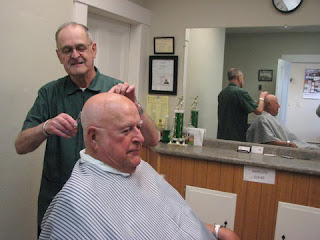
Paul Tetreault had a barber shop in Woodsville for 60 years.  He was described as "always ready to cut hair and always up to date and ready to discuss all the local happenings."  He closed his shop due to the pandemic and passed away in 2021.  This 2014 photograph show him with customer George Pratt of Bradford. (JO file photo)


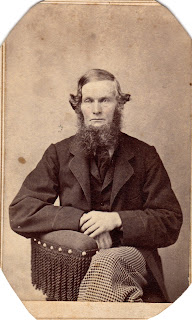
Unshorn Orford sheep farmer Benjamin Franklin, whose farm was near Orford's Sunday Mountain, reflects the beard movement of the period from 1860 to 1912.  During that period, beards were associated with manly dignity, authority and good health. (Courtesy photo/ Priscilla Franklin Harrington)

Journal Opinion  March 9, 2022

“Not many years ago it was hardly respectable to wear a beard; but the beard movement is in, resisted and ridiculed at first, has conquered, and it grows more and more the fashion to grow on the face as full a covering of hair as can be coaxed out.” Burlington Weekly Free Press, April 11, 1879

This column explores how American men cared about beards and hairstyles over the years.. Vintage newspapers, the internet, and local interviews provided material for this piece.  Christopher Oldstone-Moore’s book Of Beards and Men provided me a valuable insight into the topic’s history. 

 While the men of the earliest colonial period often wore heavy beards, they cut their hair short as it was considered “safe and godly.”  

In the 18th century, the colonial elite often wore elaborate wigs or powdered their hair.  Ordinary men rarely did either and, if they kept their hair longer, it was pulled back and tied.

In the new century, President Thomas Jefferson set a new standard avoiding the wig. This casual style and shorter hair was adopted widely. Men of fashion kept shorter cropped hair, often using an oil or pomade to create a look of “tamed wildness.” As hair was washed infrequently, housewives began to create covers to protect furniture from staining. 

By the late colonial period, beards had disappeared in settled areas.  Beards and long hair were considered signs of uncouth backwoodsmen and ran counter to community norms. 

Leaders such as Ethan Allen, Jacob Bayley and Thomas Chittenden all of Vermont, and John Stark and John Langdon both of New Hampshire were all clean-shaven. At least as far as shaving was concerned, they shared in “the code of gentlemanly good manners.” 

Most U.S. Presidents and the governors of New Hampshire and Vermont before the 1850s did not sport beards. In 1834, one magazine published, “An unshorn chin has a degenerating aspect, is only, if at all, excusable in the lowest laborer and mechanic.”  

Few men dared to wear a beard.  For some there were severe consequences. When Joseph Palmer of Fitchburg, Massachusetts, went to church with a beard in 1830, he was denied communion. He was determined to assert his right to be contrary. Later, he was assaulted by a group of men equally determined to shave him forcibly.  He resisted but was charged with unprovoked assault.

Shaving was performed by straight or cut-throat steel razors. Men would sometimes go to a barber for shaves as those that tried it for themselves often suffered cuts. In the 1830s, advertisements appeared for personal razors, razor strops to keep instruments sharp, shaving brushes, and soaps.

In the 1850s, there was a new beard movement.  The New York “Home Journal” observed, “Go where you will, the full, flourishing, ferocious beard presents itself!”

The beard was associated with manly dignity, authority, and good health. Some believed that the beard and mustache filtered bad air, “helped the body maintain its electrical balance,” and retained “vital energy.”

There was some opposition to this beard movement. In 1860 the St. Johnsbury Caledonian carried the story of one woman’s crusade against bearded men. She said the idea of kissing one was disgusting and that “only brigands, pirates, filibusters, and professional executionists” wore beards. 

The political and military stereotypes of the rest of the 19th century reflected this beard movement.  Virtually every President from Lincoln to Wilson sported a beard, mustache, or bushy sideburns.  Every officer in both armies in the Civil War displayed the same. Union General Ambrose Burnside’s great whisker-mustache combination is the basis for the term “sideburn.”

During the period, governors in New Hampshire and Vermont mirrored the beard movement. This included Bradford’s Roswell Farnham, governor in 1880-1882. The Caledonian suggested that bearded men were “more likely to be trusted.” There were suggestions that the popularity of the manly beard was a reaction to the women’s rights’ movement.

In the 1890s, Bradford’s Union Opinion featured special illustrated editions on local communities. Of the three dozen local business leaders pictured, all had facial hair.  There is no doubt that they felt full beards gave men increased status, respect, and power over non-bearded men. 

In addition to following fashion trends, there were men who grew beards to provide warmth to their face during winter months, hide a receding chin, an overly youthful countenance, counterbalance a receding hairline or other facial feature, or because of lack of access to shaving implements or services. Shaving is painful for some men and growing a beard gives an excuse for not shaving.

One person told me her grandfather shaved with a straight razor until his hands became so shaky that he had to give it up and grow a beard.

There were also different norms among ethnic groups regarding hair.  Native Americans were genetically pre-disposed against heavy beards. How hair was worn often distinguished one tribe from another. For religious or cultural reasons, Jewish, Sikh and Muslim men may follow rules regarding their hair and beards. Amish men let their beards grow once they are married, but do not grow mustaches.

These differences from the white majority have, over the years, led to discrimination and bias. When, in the 19th century, Chinese male immigrants arrived with their traditional queue or pigtail, it was a source of ridicule and regulation.  

Prior to the 20th century, barbers learned their trade by being an apprentice to a master barber.  The first barber school opened in 1893, and, in 1897, Minnesota became the first state to license barbers.  That same year, an act to regulate the practice of tonsures, i.e. barbering,  in New Hampshire was considered “inexpedient to legislate.” No similar law was discussed in Vermont for decades. Now, both barbers and barbershops are licensed by state governments.

Barbershops were primarily male bastions. Usually one or two chair operations, with customers thumbing through magazines or newspapers while waiting their turn. It was not unusual for the walls to be hung with photos of sports or war heroes or prized hunting trophies. Conversation included talk of sports, politics, and local gossip. If your barber didn’t know what was going on, it probably wasn’t worth talking about.

 Men often had their favorite barber who knew how they liked their hair cut and kept a standing appointment.  When shaving was common, there might be racks of personal shaving mugs. Bottles of bay rum or other aftershave lotions were available.  In the 1880s, haircuts were5 or 10 cents and a shave for 3. One towel might be used repeatedly, resulting in a concern over the transmission of diseases.

At first, barbershops were open every day. Around 1880, pressure against Sunday businesses increased and both states passed Sunday closure legislation. 

The role of barbers changed with the invention of the safety razor, first as a single-edge and then, in 1904, as a Gillette double-edge. It promised one could “save time and money by shaving yourself.”

Cakes of shaving soaps were replaced by tubes of soft soap for home use. In 1919, shaving cream became available and was obtainable in pressured cans in 1949. Some men no longer needed shaving cream.  In 1930, Joseph Schick offered the first electric or dry razor.

The history of local barbers includes the names of scores of men.  As they were rarely included among the lists of prominent businessmen, it is difficult to know exactly how long a particular barber practiced or how popular they were. Still, a few stalwart examples emerge.

 Fred Kenyon purchased a shop in Bradford in 1876 and practiced until his death in 1898. He advertised that he also cut ladies’ and children’s hair. When he was suffering from la grippe or influenza, it was reported, “the appearance of the male portion of the community shows Fred’s sickness in their faces very plainly.” 

Frank P. Sherwell had a shop in Well River as early as 1900 and was still barbering in 1930.  H.E. Prescott operated “Bradford’s Old Established Barber Shop in the early 1900s.  His shop was adorned with the doe’s head, “a beautiful example of taxidermy.”  

 Clifford Bassett’s barber career began on Woodsville’s Central Street in 1914.  He took over the shop in 1917 and continued until 1954.  Over the years, he employed other men in his shop.  He also sold washing machines and appliances.  Upon his retirement, John Avila brought him out. 

Elmer “Bus” Flanders opened a shop in East Corinth in 1939 and one in Fairlee in 1953.  He operated both until 1981, a year before his death.  As a young man, I was one of his faithful customers.

 I switched my loyalty to George Hinman who operated a shop in Bradford’s Chimes Building. It was there that I was informed that Carolyn Martin, who worked in the dental office across the street, was a sweetheart and should be married.  I followed my barber’s advice.

Lawrence Clark had a barbershop in Bradford for 28 years. He had taken over from Frank DeCosta, who ran a shop on the south side of the Bliss Hotel building. In 1978, he moved his shop near his home in Bradford Center.  His son, Larry has been a barber in Wells River for 27 years. 

Often as a cost-saving measure, family members provided haircuts for loved ones of all ages. I have heard seniors say that a parent cut their hair throughout their childhood. Through the 40s and 50s, my Dad cut the hair of the four Coffin boys. Songwriter Michael Kelly Blanchard’s song captured that practice.

“Daddy cut my hair.  Didn’t care for style.  He’d just snip and snip, then sweep it in a pile. I could not keep still, but he would understand.  Some things are just known between a boy and a man. Right there in the middle of our kitchen’s cluttered floor.”   

Some children got to go to a real barber. The late Richard Miller of Topsham recalled a 1924 trip to East Corinth’s barber Antony Foisy. The barber had migrated from French Canada in 1918 and owned his own shop overlooking the Tabor branch.

 A board was placed across the arms of the barber chair, and little Richard was lifted up and draped in an “itchy piece of cloth.” Foisy chewed tobacco and, occasionally, sent a stream of brown juice toward a cuspidor in the corner. “He would pick up a comb and shears and very businesslike would get on with the cutting of my hair.”  

At the beginning of the 20th century, the beard movement began to wane. After 1903, there were repeated references in Vermont newspapers to a handsome man as one who was clean-shaven.  As there were shifts among business and community leaders, other men began to abandon their beards for economic or social advantages.

In 1912, one article raised the health concern that “every curl and wave of the beard has bacilli.”  It was suggested that men with beards should avoid kissing babies and that doctors with beards were a possible danger to patients.

Between that time and the mid-1960s American men were clean-shaven. With the exception of the Clark Gable type mustaches, facial hair was uncommon. Short haircuts like the crew cut were common.  In the main stream, there was a deliberate campaign against beards, including in hiring practices.     

However, some groups began to use hairstyles to express rebellion against prevailing cultural standards.  The long, loose hippie style, afros of the Civil Rights movement, skinheads, and punks with spiked mohawks all defied the mainstream’s neatly groomed styles. 

Resisting their Dad’s haircut, younger men began to have their hair styled longer. They were more likely to have that done by women hairdressers. There were men who clung to their beard throughout the period, but they were in the minority. 

Now, everywhere I look, I see men with beards. From mustaches and mutton chops to long beards, men are sporting facial hair. Once again, three-day stubble seems to be fashionable. That same spirit of individual freedom is reflected in hairstyle from shaved heads to manbuns.

The totalitarian regime of North Korea has ordered that all men must sport an approved hairstyle. Little variation is allowed. While I have never sported any but a traditional hairstyle, it’s great to live in a nation where variety reflects personal style and freedom.

If readers have a favorite barber who is not mentioned or a good barber story, they may use this site’s comment function and submit it. 

Saturday, January 29, 2022

The Endangered Child

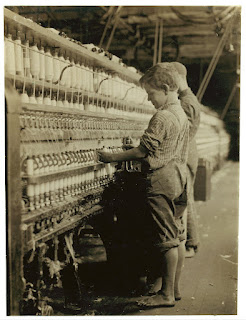
WEAPON OF PERSUASION.  In 1909-1910, photographer Lewis Hines visited New Hampshire and Vermont to document child labor in factories, on farms and on streets.  Photographs such as this, taken at a North Pownal, Vermont cotton mill, helped to focus on the issue and encourage measures to correct it. (Library of Congress)


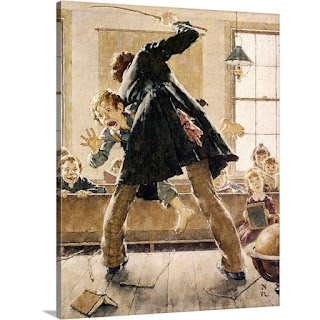
RODS RULE THE CLASSROOM. Many early school teachers believed that corporal punishment was necessary to manage a classroom even if it resulted in "blistered hands, swollen ears and smarting limbs." This Norman Rockwell illustration captured a youngster getting "a good thrashing." 

Journal Opinion Jan 26, 2022.

From corporal punishment to intentional neglect, children are too often subject to cruelty.

This column reviews child abuse and intentional neglect before 1930. Included is information from New Hampshire and Vermont history, using examples from vintage newspapers and online sources. Newspapers usually covered only the most egregious cases. Early local historians did not mention these issues.

This column does not cover the typical interactions between adults and children that result in mild punishment.  A swat with an open hand, depriving a child of a desired pleasure, or sending a child to bed without supper are not the type of examples covered. Parents are not given a manual of instruction when given the care of children, especially when dealing with a willful child. 

Instead, it deals with examples of ongoing physical or emotional abuses. History recognizes that some adults are not fit emotionally, physically, or psychologically to be in charge of children and take advantage of their vulnerability. 

These abuses are sometimes perpetrated by an adult who, when intoxicated or incensed, becomes a brute. In that case, the switch, belt, or fist becomes a weapon. It often occurs when the perpetrator is not the natural parent of the child involved.

Until the latter part of the 19th century, children were their father’s property. Even though the government had the ultimate role of protecting children, it rarely restricted household authority.

Parents were expected to raise children with a moral character and a strong work ethic. “Spare the rod and spoil the child” was the rule. Disobedient children, it was thought, needed to have “the devil beaten out of them.” Local governments were more likely to remove children from a family that did not provide the proper life lessons than one that physically abused them.

Craftsmen frequently took boys as young as eight as apprentices. Girls were assigned to families to learn housekeeping. Apprentices were often orphans or children abandoned by their natural families. Their treatment varied from caring to cruel. Local governments did intervene in severe abuse or neglect cases and would assign the child to a new master.

 Frequently, children who were adopted as orphans or lived with stepparents were vulnerable to abuse. In 1831, a New Hampshire minister beat his adopted son almost to death when the child had difficulty pronouncing difficult words. This is an example of some adults’ lack of understanding of child development. 

If physical or emotional abuse was secretive, sexual abuse of children was even more so. Authorities   were unwilling to admit that it could even possibly exist. Not until the 1920s was the study of child molestation recognized. The practice of allowing older men to marry girls as young as 13 sometimes circumvented charges of abuse.  

Local governments often placed orphans or neglected children with other families, often without ongoing supervision or consideration given to the child itself.  Corinth was one town that “bid off” such individuals to the lowest bidder. That bidder was supposed to provide necessities, but that was sometimes not the case.

 In the early 1800s, Corinth bid off the two children of Jonas Taplin who could not care for them. Tragically, the two children were locked by their caretaker in an unheated shed where they died of starvation and exposure.

Children orphaned or taken from families were sometimes placed in the town poor farm by the Overseer of the Poor. The discipline there was often harsh with whipping and solitary confinement used. 

Private and public orphanages were created in both states in mid-19th century. Many “orphans” actually had one or both parents unable to care for them. Many children were placed in orphanages for just short periods. Discipline was described as rigid. The rise of foster care in the late 19th century caused children to be “placed out,” often as workers.  

Early orphan asylums in the two states included the St. Joseph’s Orphanage (1854) and the Home for Destitute Children (1866), both in Burlington. The Orphans Home and School for Industry in Franklin, NH, and Spaulding Youth Center of Northfield, NH, were both opened in 1871. Given recent charges of abuse in institutions such as these, perhaps these abuses were systematic. 

After the Civil War, two cases highlighted the abuse of children. In 1869, Samuel Fletcher, a blind youngster from Illinois, was locked in a cellar by his parents. When he escaped and reported the abuse, his parents were fined $300 in one of the first court rulings recognizing children’s right to be protected against abuse.   

In 1866, Mary Ellen Wilson of New York was placed in a foster home with Francis and Mary McCormack. Over the next several years, the youngster was severely physically abused, malnourished, and neglected. The widely publicized trial of the McCormacks led to the establishment of the New York Society for the Prevention of Cruelty to Children, the first such organization. 

The following abuse cases were reported in Vermont newspapers. While neighbors often declined to intervene, concerned neighbors eventually led authorities to investigate. In some cases, the perpetrator’s punishment did not seem appropriate to the crime.

In 1879, 9-year old Alice Meaker of Duxbury was sent to live with her half-brother.  Over the next year, his wife Emeline severely abused the child. In 1880, Emeline and her son Almon poisoned the child. Both were found guilty of murder. Both died in Windsor state prison.     

In 1906, a Vershire man took charge of a 9-year old boy from the Children’s home in Burlington.  He was charged with cruelty after the horrible treatment of the youngster. The child was forced to work in the woods for long hours, was ill-clothed, and forced to sleep in an unheated attic. 

In 1913, a Waterbury man was imprisoned in Windsor Prison for whipping a little child.

In 1915, a Brattleboro woman was fined $10 for publically assaulting a child of eight with a whip, leaving marks on her legs.

In 1919, a well-known farmer from Walden was tried for breach of peace for whipping a 12-year old disabled orphan in his charge. After a highly publicized trial, he was found guilty and fined $50 and costs.


Underage runaways experienced abuse or neglect. This was sometimes due to harsh work conditions. The number usually increased during tough economic times. On the street, underage runaways and homeless children were especially vulnerable.

Several examples of runaways that received newspaper notice included an offering of a five cent reward for information on a 14-year old apprentice from Sherburn, VT who ran away from his master in 1836.

Then there is the story of Charlotte Parkhurst.  She was born in Sharon in 1812 and, after the death of her mother, was placed in a foster home, perhaps in Lebanon.  She ran away, adopted a masculine identity, became known as Charley, and became one of the top stagecoach drivers on the West Coast. 

Articles mentioned runaways from the State Reform School in Waterbury and the State School for the Feeble Minded in Brandon. The latter led to charges of abuse.  In 1921, a 15-year old lad from Wells River ran away from home after “a sound thrashing.”

The number of children who ran away from home varied with economic conditions. The number significantly increased during the economic depressions. On the street, underage runaways were especially vulnerable. 

Juvenile offenders were another group of youngsters who faced abuse or neglect. This was especially true when they were incarcerated in prisons, jails, or workhouses. In the 1850s, officials in both New Hampshire and Vermont raised concerns about the imprisonment of children “confined with hackneyed and callous malefactors.”

In 1852, New Hampshire established a state reform school in Manchester, and in 1865, Vermont opened one in Waterbury.  In 1912, Vermont began to deal with youthful offenders in a juvenile court system.  

A history of early New Hampshire schools recalls severe abuse by schoolmasters. The frequent use of rods and ferules left “blistered hands, swollen ears, and smarting limbs.”  A ferule was a flat ruler used to punish children. The History of Canaan, NH, mentioned: “most children got whipped every day, either at home or at school, sometimes at both.”

“Faced with reckless wretches,” a Vermont teacher in 1845 felt that “rough means became fair.” Many teachers felt there was “an irresistible persuasiveness” in applying the ruler.  

Born in 1810, Eliza White Root recalled abuse in Burlington schools. “I thought the teacher very cruel, as he would often ferule the boys, gag them and make them stand and hold their arms upright.” Parents generally accepted corporal punishment, and sometimes, a second at-home punishment followed.

 “Good order is the jewel of the schoolroom” wrote one editor. He criticized those parents who threatened a teacher who applied the rod to their child and further blamed them when they could not control their children at home but expected the teacher to manage a whole classroom of children.

Often corporal punishment became actual abuse when the adult involved allowed emotions to overwhelm the situation. In 1867, a Springfield teacher applied a rawhide whip to an 11-year old boy. Described as an “outrageous child,” his body was bruised and discolored. 

In 1883, a suit was brought against a Pittsfield teacher who thrashed a boy. “The jury decided she did the proper thing.” A few years later, an article on why female teachers should be paid less included: A male teacher “can trash an unruly boy into obedience, she can’t.”

There was a belief that corporal punishment was not only necessary but had a lasting positive impact.  In 1875, the Vermont Phoenix carried the following: “The birch rod, too, has much to do with our public schools, and most of our great men have been soundly thrashed with it while boys.” In 1914, that attitude continued: “A good thrashing has saved many a boy,” making “them a better man.” 

While naughty boys might be physically punished, girls were more likely to be just reprimanded. A  West Randolph newspaper suggested that boys preferred a trashing to a girly punishment such as standing in the corner. 

Schoolroom discipline in the decades that followed was “abrupt and absolute.”  Paddles gave new meaning to the term “board of education.”  Sometimes being sent to the Principal’s office resulted in more of the same.  

In 1867, New Jersey was the first state to prohibit corporal punishment in schools, but it was more than one hundred years before another state would follow. In 1974, federal legislation required states to establish child abuse reporting procedures and investigation systems.  New Hampshire and Vermont took steps to implement these requirements.  

There were changes in attitudes toward corporal punishment from 1880 to 1920. Adults in charge of children were advised to avoid chastisement when hot-tempered. In 1895, an article in Bradford’s United Opinion suggested, “While with a firm hand you administer parental discipline, also administer it very gently.” In 1909, the newspaper further suggested, “Think twice before raising your hand to hit a child.”

With industrialization in the 19th century, there was concern over the employment of children in mills and factories. Children were often employed to supplement family income. Many believed that it was morally desirable for children to be employed rather than “lazy or wild.”  Employers often wanted children for their lower wages and because their small size was sometimes an advantage, something that labor unions disputed.

The woolen industry in both states employed young children. The Winooski Woolen Factory employed some children under the age of 12 at low wages and for workdays of up to 14 hours. 

In 1867, Vermont was the last New England state to limit the number of hours children could work in factories. But these early laws only applied to children under 12. There were cases where these laws or the school attendance requirements were ignored. In 1911, the Vermont Child Labor Committee was established to combat child labor exploitation.

At the turn of the 20th century, the child-saving movement included the creation of child protection societies. The New Hampshire Children’s Aid and Protection Society was formed in 1914 to deal with child abuse and neglect in that state. Vermont’s Children’s Aid Society was established in 1919 with a special charge to deal with the problems of children orphaned by the Spanish flu epidemic.

While laws have been changed to protect endangered children, for some, this is still a hidden family secret. Professionals are required to report suspected cases. Neighbors who notice abuse and neglect are under no legal obligation to report but may report anyway.  We can only hope that the cry of the abused will be heard by those who can answer it.


Monday, December 20, 2021

How Sweet It Is

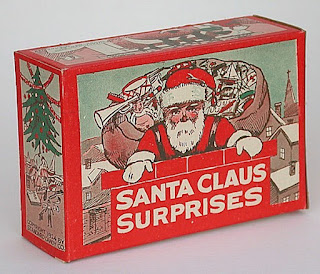
SANTA'S SWEET GIFT. Individual boxes of hard Christmas candy were distributed by Santa Claus at the conclusion of school and church Christmas programs in area towns.  In the late 1940s and '50s, the Orford school held their holiday program at the Orford Congregational Church and, at the end, the long-anticipated visitor arrived with boxes of candy for each child. 

YOUNG COOKIE MAKER. Thirteen-year-old Madi Benjamin of Bradford shows off her Christmas cookie creations.  She lives with her grandparents, Bob and Pat Benjamin, and is an accomplished baker with her own baking tools.  She shares her cookies with family and friends, especially those wo are housebound due to Covid. (Courtesy photo Pat Benjamin) 
 

Journal Opinion Dec 15, 2021

We are in the season of sweet tooth cravings! For many, Christmas sweets are a significant part of the memories of years past. They, like the gifts and traditional foods, reflect the bounteous joy of the season.

This column describes how some sweets become traditional holiday treats. Stories submitted by area residents, internet sites, and newspaper archives provided background. 

This is the fifth in a series on the history of the holiday season. For those interested, the following can be found by using the search feature at “In Times Past” larrycoffin.blogspot.com.  Christmas Memories 1659-1959; Cooking Up a Christmas Storm; The Best Christmas Gift Ever and Old New Year’s Ways.

The much-maligned fruit cake is one of the oldest examples of sweets connected to the holiday season.  The tradition of giving cakes made with dried fruit and seeds goes back to a Roman winter festival.

Immigrants from European nations brought their versions of holiday fruit cakes to the New World. The English style of dark cake, the Italian panettone, Scottish Dundee cake, and the German stollen are just four Christmas cakes. Before 1900, these cakes were considered both a luxury and a way of preserving expensive ingredients.

It was the English version that Bradford’s United Opinion was referring to in 1888: “Good fruit cake, like fine wine, grows better with age; the cake concocted before Christmas so far from deteriorating, will become richer and more melting as it and the holiday season together draws to a close.”

In the early 1900s, ingredients were more accessible, and fruit cakes were mass- produced.  As the quality was reduced, one source referred to them as a “dry lump of disappointment.”

Some love fruit cake and others pass it up. Bradford’s Penny Perryman shared that her mother made fruit cakes to great reviews. She mentioned that she was “very confused as I got older and heard jokes” about fruit cake. 

Other traditional holiday cakes included the alcohol-laden tipsy cake, the torte-fruit Christmas cake, and the nutty New Year’s Cake. In 1876, the Bradford Opinion mentioned eating the latter ensured happiness in the new year.

Akin to these cakes were the traditional holiday baked or boiled puddings. Stir-up Sunday was a day in the late fall when puddings were boiled and put away “to mellow and ripen.” The term plum was a generic term for dried fruits. For some families, plum pudding was as “important to Christmas as the lights in the tree.”

Figgy puddings are better known as Christmas puddings in America. In 1888, Bradford’s United Opinion featured a recipe made from suet, raisins, currants, and citron and steamed for five to eight hours. Carolers asking for a figgy pudding is mentioned in the 1939 carol “We Wish You a Merry Christmas.” 

Christmas pies were standard desserts for the holidays.  One Vermont editor ranked mince pie as the top standard Christmas dessert. Another suggested all any man needed for Christmas was a mince pie and a new pair of slippers.  Mince pies are made from apples, raisins and suet, although there is also a recipe for green tomato mincemeat. Preparations were often made well in advance.

While apple pie is a favorite dessert for Christmas, pumpkin is not far behind. At least three favorite Christmas carols link pumpkin pie with the happiness of home and holiday celebrations. Some sweet enthusiasts list raspberry, cherry or pecan pie as their favorite Christmas dessert memory.

The holiday would not be complete without cookies. A recipe for Christmas cookies was included in the first American cookbook published in 1796.  Coriander sugar cookies could be made six months beforehand and stored in earthenware jars in the cellar.

In the late 19th century, cookie cutters became available, and cookies were made in the shape of bells, stars, and reindeer. Gingerbread cookies had been baked before, but now they were created in shapes such as decorated men, dogs, and horses. Some were eaten, while others became Christmas tree decorations.

In the 1930s, children began leaving cookies and milk for Santa.  About that same time, Christmas cookie exchanges became popular. 

Bakeries and stores also offered cookies for Christmas.  A 1932 ad for Darling’s store in Fairlee featured Sunshine Cabinet Cookies for “Kiddies’ Xmas Tree” That edition of Bradford’s United Opinion reflected the economic hardships by encouraging its readers to “make [their] dollars count.” It added, “Don’t let adult cares be reflected in Children’s Christmas happiness.”

Fairlee’s Marjorie Green recalled the wonderful ginger St. Nicholas-shaped decorated cookies made around 1948 by her local New Jersey bakery. Buying several was a holiday treat. She said she has tried to duplicate these cookies in Vermont. 

The Bradford Public Library currently has a display of wooden molds used in the making of Springeles, a traditional Christmas cookie of Europe’s German-speaking region. These molds have been collected by Anita Fahrni of West Newbury and will be on display for the next month.   

I received several emails from area residents that spoke of the role of candy in their Christmas memories.  For them, “visions of sugar plums” did actually dance in their heads. 

Sugar plums are pieces of candy made with hardened sugar in a small round shape. Plum refers to the shape. They can be made with dried fruit, nuts and spices. In 1802, Confectioner Stephen Delaney of Portsmouth offered commercially made sugar plums. In the mid-19th century, sugar plums were often used as tree decorations.

Clyde Watson of Etna recalled her older sister making sugar plums from large red grapes dipped in egg whites and sugar and used as decorations.

Other candy associated with the holidays included homemade fudge, peanut brittle, molasses taffy, maple candy, and bourbon balls. Charlotte Williams of Fairlee recalled a late 1950s memory of family- made bourbon balls. She described them “as a not-too-sweet mix of baking cocoa, a little flour, a little sugar, and plenty of chopped walnuts.” Doled out on Christmas morning for “a delightful sweet/bitter bite, and what a lovely fiery warmth in the pit of my tummy afterward!”

Several recalled commercially-made candy, including Peach Blossoms. The New England Confectionery Company of Revere, Massachusetts, made these peanut butter candies wrapped in a crunchy shell.

Florence Welch of Newbury said her mom would always purchase a can of Peach Blossoms, even on a tight budget. Patsy Belknap of Bradford said her mom’s first present for her dad every Christmas was a can of the candy. “He savored them well into the New Year.” She said.

Ribbon candy was another popular choice. This sticky wavy candy was made for years by hand by formed strips around the maker’s thumb. In 1886, dentist Dr. P. B. Laskey, a Massachusetts inventor, patented a mechanical candy crimper.

Candy canes are the number one non-chocolate holiday candy. Many of them are purchased first as tree decorations. These sugar sticks were introduced into America around 1847. Until they were made by machine, they were entirely white.

Living in a candy store may be a dream for some kids, but “it’s lots of work,” said 89-year old Phidias Dantos of Hanover. He was born into a family that operated a general store in Andover, Massachusetts. When they made their annual supply of Christmas candies, it was “full gear ahead” for all.

 Dantos recalled how the candy room had to be refurbished before beginning the production. He described how they made ribbon candy by preparing the sugar mixture in large copper kettles. They used up to 1000 pounds of sugar annually.

Wearing heavy gloves, they poured the hot candy slurry onto a large marble-covered bench. After passing through a machine his father had made, it was curled by hand. Broken pieces were saved to be made into peanut brittle.

They also produced candy canes. When his father died in 1952, Dantos worked alongside his Uncle Pete until 1960. He said in the 60 years since,  he has only enjoyed ribbon candy once.  

Donna Garone of Orford said her favorite memory about Christmas sweets was tied to the candy display at Hill’s Five & Ten in Bradford. To great joy, her Dad brought home chocolate covered peanuts, malted milk balls and non-pareil. She carried that tradition until Hill’s no longer sold penny candy.

At festive events such as school or church programs, Santa distributed small boxes of hard candy and candy canes. His appearance was a highly anticipated event and usually occurred at the conclusion of the program.

 I am told by my Jewish connections that a few sweets are specifically connected to the Jewish winter festival of Hanukkah. The most specific is chocolate gelts. These are foil wrapped candy coins given as presents, especially to children. They are often used in conjunction with the Hanukkah game of dreidel.

Jewish families might also enjoy the following sufganiyot (jelly donuts), hamantaschen (small filled cookies), and halvah (sesame fudge-like candy). These, along with sugar or honey cookies in the shape of stars or dreidels, cheesecake, and filled chocolates, might be purchased or made at home.

Wars had a significant impact on Christmas sweets. During the Civil War, men received boxes of candy, cookies, and warm socks.  In 1862, George Benedict of the 12th Vermont Regiment wrote in his diary about boxes of goodies including “raisins, apples and coco-nut cake just sent from home.” He went on, “some soldiers received no special treats.”

Similar packages of homemade goodies were sent to troops in France during World War I.  Companies created special packages containing fruit cake and other treats that could be mailed to service members. One company’s ad mentioned “Send Your Soldier Boy a Liberty Cake,” For $1, including postage, a 24 oz. fruit cake could be sent abroad.

While sugar was not rationed during World War I, there was great pressure to conserve. In November 1917, candy makers were feeling the sugar shortage and they reduced their offerings. There were ads from confectioners in Vermont newspapers that year. The sentiment was “children should have candy!”

In 1942, sugar was the first food to be rationed, and chocolate followed. Service members received hard chocolate in their government rations. In 1941, the Mars Candy Company created M & M’s based on a similar product supplied to troops during the Spanish Civil War. They were heat-resistant and easy to transport and were exclusively produced for military rations. 

As a result, there was a severe shortage of chocolate on the home front. The emphasis on a homemade Christmas extended to making, as nearly as possible, traditional Christmas sweets.  A December 1943 United Opinion edition offered candy recipes to “S-t-r-e-t-c-h” rations points. They included recipes for Christmas fruit balls and marshmallow prunes.         

 When in 1823, Clement Clarke Moore wrote “the stockings were hung by the chimney with care…,” children had been hanging stockings for Santa for some time.

For many years, Christmas presents consisted only of what would fit in a stocking. That might include an apple or orange, some nuts, and hard candy. By 1884, oranges from Florida began to appear in Vermont. In 1888, Christmas oranges were being offered for sale at Beiley’s Store in Newbury. About that same time, boxes of California crystalized fruit were also available.  

 A 1912 article in The Country Gentleman described the contents of a common stocking: “homemade candy tied up in bright paper, a few sugar cookies and an orange.”  

About 1908, the California Fruit Growers Association began a mass marketing campaign to link their oranges with Santa Claus. During the Great Depression, many families could not afford to buy holiday presents. An orange was an exotic treat. 

Another exotic treat was dried dates. Dean Whitlock of Thetford wrote, “My favorite holiday sweet treats were stuffed dates.” They were made by filling pitted dates with shelled walnuts or pecans and sugar.  

For many years, “chestnuts roasting on an open fire” produced “the smell of Christmas in America.” In urban areas, street peddlers roasted chestnuts. Eaten warm, they are described as sweet and buttery.  Chestnuts were also used in cakes and as stuffing for the Christmas turkey. Mixed nuts along with roast cashews were also available at holiday time. 

From Thanksgiving through New Year’s Day, many people feel they gain weight due to the sweets consumed. The despair prompts many New Year’s resolutions. With best intentions under siege, Christmas cookies, pies and other treats are challenging to resist. Despite that, how sweet it is.