Popular Posts

Statcounter

Tuesday, March 15, 2022

Yesterday's Manly Hair


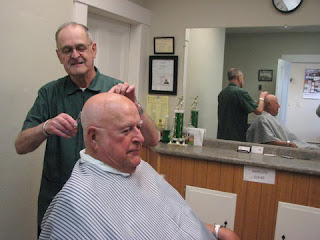
Paul Tetreault had a barber shop in Woodsville for 60 years.  He was described as "always ready to cut hair and always up to date and ready to discuss all the local happenings."  He closed his shop due to the pandemic and passed away in 2021.  This 2014 photograph show him with customer George Pratt of Bradford. (JO file photo)


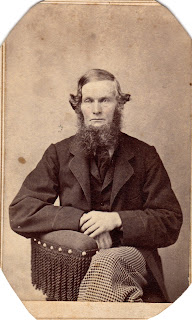
Unshorn Orford sheep farmer Benjamin Franklin, whose farm was near Orford's Sunday Mountain, reflects the beard movement of the period from 1860 to 1912.  During that period, beards were associated with manly dignity, authority and good health. (Courtesy photo/ Priscilla Franklin Harrington)

Journal Opinion  March 9, 2022

“Not many years ago it was hardly respectable to wear a beard; but the beard movement is in, resisted and ridiculed at first, has conquered, and it grows more and more the fashion to grow on the face as full a covering of hair as can be coaxed out.” Burlington Weekly Free Press, April 11, 1879

This column explores how American men cared about beards and hairstyles over the years.. Vintage newspapers, the internet, and local interviews provided material for this piece.  Christopher Oldstone-Moore’s book Of Beards and Men provided me a valuable insight into the topic’s history. 

 While the men of the earliest colonial period often wore heavy beards, they cut their hair short as it was considered “safe and godly.”  

In the 18th century, the colonial elite often wore elaborate wigs or powdered their hair.  Ordinary men rarely did either and, if they kept their hair longer, it was pulled back and tied.

In the new century, President Thomas Jefferson set a new standard avoiding the wig. This casual style and shorter hair was adopted widely. Men of fashion kept shorter cropped hair, often using an oil or pomade to create a look of “tamed wildness.” As hair was washed infrequently, housewives began to create covers to protect furniture from staining. 

By the late colonial period, beards had disappeared in settled areas.  Beards and long hair were considered signs of uncouth backwoodsmen and ran counter to community norms. 

Leaders such as Ethan Allen, Jacob Bayley and Thomas Chittenden all of Vermont, and John Stark and John Langdon both of New Hampshire were all clean-shaven. At least as far as shaving was concerned, they shared in “the code of gentlemanly good manners.” 

Most U.S. Presidents and the governors of New Hampshire and Vermont before the 1850s did not sport beards. In 1834, one magazine published, “An unshorn chin has a degenerating aspect, is only, if at all, excusable in the lowest laborer and mechanic.”  

Few men dared to wear a beard.  For some there were severe consequences. When Joseph Palmer of Fitchburg, Massachusetts, went to church with a beard in 1830, he was denied communion. He was determined to assert his right to be contrary. Later, he was assaulted by a group of men equally determined to shave him forcibly.  He resisted but was charged with unprovoked assault.

Shaving was performed by straight or cut-throat steel razors. Men would sometimes go to a barber for shaves as those that tried it for themselves often suffered cuts. In the 1830s, advertisements appeared for personal razors, razor strops to keep instruments sharp, shaving brushes, and soaps.

In the 1850s, there was a new beard movement.  The New York “Home Journal” observed, “Go where you will, the full, flourishing, ferocious beard presents itself!”

The beard was associated with manly dignity, authority, and good health. Some believed that the beard and mustache filtered bad air, “helped the body maintain its electrical balance,” and retained “vital energy.”

There was some opposition to this beard movement. In 1860 the St. Johnsbury Caledonian carried the story of one woman’s crusade against bearded men. She said the idea of kissing one was disgusting and that “only brigands, pirates, filibusters, and professional executionists” wore beards. 

The political and military stereotypes of the rest of the 19th century reflected this beard movement.  Virtually every President from Lincoln to Wilson sported a beard, mustache, or bushy sideburns.  Every officer in both armies in the Civil War displayed the same. Union General Ambrose Burnside’s great whisker-mustache combination is the basis for the term “sideburn.”

During the period, governors in New Hampshire and Vermont mirrored the beard movement. This included Bradford’s Roswell Farnham, governor in 1880-1882. The Caledonian suggested that bearded men were “more likely to be trusted.” There were suggestions that the popularity of the manly beard was a reaction to the women’s rights’ movement.

In the 1890s, Bradford’s Union Opinion featured special illustrated editions on local communities. Of the three dozen local business leaders pictured, all had facial hair.  There is no doubt that they felt full beards gave men increased status, respect, and power over non-bearded men. 

In addition to following fashion trends, there were men who grew beards to provide warmth to their face during winter months, hide a receding chin, an overly youthful countenance, counterbalance a receding hairline or other facial feature, or because of lack of access to shaving implements or services. Shaving is painful for some men and growing a beard gives an excuse for not shaving.

One person told me her grandfather shaved with a straight razor until his hands became so shaky that he had to give it up and grow a beard.

There were also different norms among ethnic groups regarding hair.  Native Americans were genetically pre-disposed against heavy beards. How hair was worn often distinguished one tribe from another. For religious or cultural reasons, Jewish, Sikh and Muslim men may follow rules regarding their hair and beards. Amish men let their beards grow once they are married, but do not grow mustaches.

These differences from the white majority have, over the years, led to discrimination and bias. When, in the 19th century, Chinese male immigrants arrived with their traditional queue or pigtail, it was a source of ridicule and regulation.  

Prior to the 20th century, barbers learned their trade by being an apprentice to a master barber.  The first barber school opened in 1893, and, in 1897, Minnesota became the first state to license barbers.  That same year, an act to regulate the practice of tonsures, i.e. barbering,  in New Hampshire was considered “inexpedient to legislate.” No similar law was discussed in Vermont for decades. Now, both barbers and barbershops are licensed by state governments.

Barbershops were primarily male bastions. Usually one or two chair operations, with customers thumbing through magazines or newspapers while waiting their turn. It was not unusual for the walls to be hung with photos of sports or war heroes or prized hunting trophies. Conversation included talk of sports, politics, and local gossip. If your barber didn’t know what was going on, it probably wasn’t worth talking about.

 Men often had their favorite barber who knew how they liked their hair cut and kept a standing appointment.  When shaving was common, there might be racks of personal shaving mugs. Bottles of bay rum or other aftershave lotions were available.  In the 1880s, haircuts were5 or 10 cents and a shave for 3. One towel might be used repeatedly, resulting in a concern over the transmission of diseases.

At first, barbershops were open every day. Around 1880, pressure against Sunday businesses increased and both states passed Sunday closure legislation. 

The role of barbers changed with the invention of the safety razor, first as a single-edge and then, in 1904, as a Gillette double-edge. It promised one could “save time and money by shaving yourself.”

Cakes of shaving soaps were replaced by tubes of soft soap for home use. In 1919, shaving cream became available and was obtainable in pressured cans in 1949. Some men no longer needed shaving cream.  In 1930, Joseph Schick offered the first electric or dry razor.

The history of local barbers includes the names of scores of men.  As they were rarely included among the lists of prominent businessmen, it is difficult to know exactly how long a particular barber practiced or how popular they were. Still, a few stalwart examples emerge.

 Fred Kenyon purchased a shop in Bradford in 1876 and practiced until his death in 1898. He advertised that he also cut ladies’ and children’s hair. When he was suffering from la grippe or influenza, it was reported, “the appearance of the male portion of the community shows Fred’s sickness in their faces very plainly.” 

Frank P. Sherwell had a shop in Well River as early as 1900 and was still barbering in 1930.  H.E. Prescott operated “Bradford’s Old Established Barber Shop in the early 1900s.  His shop was adorned with the doe’s head, “a beautiful example of taxidermy.”  

 Clifford Bassett’s barber career began on Woodsville’s Central Street in 1914.  He took over the shop in 1917 and continued until 1954.  Over the years, he employed other men in his shop.  He also sold washing machines and appliances.  Upon his retirement, John Avila brought him out. 

Elmer “Bus” Flanders opened a shop in East Corinth in 1939 and one in Fairlee in 1953.  He operated both until 1981, a year before his death.  As a young man, I was one of his faithful customers.

 I switched my loyalty to George Hinman who operated a shop in Bradford’s Chimes Building. It was there that I was informed that Carolyn Martin, who worked in the dental office across the street, was a sweetheart and should be married.  I followed my barber’s advice.

Lawrence Clark had a barbershop in Bradford for 28 years. He had taken over from Frank DeCosta, who ran a shop on the south side of the Bliss Hotel building. In 1978, he moved his shop near his home in Bradford Center.  His son, Larry has been a barber in Wells River for 27 years. 

Often as a cost-saving measure, family members provided haircuts for loved ones of all ages. I have heard seniors say that a parent cut their hair throughout their childhood. Through the 40s and 50s, my Dad cut the hair of the four Coffin boys. Songwriter Michael Kelly Blanchard’s song captured that practice.

“Daddy cut my hair.  Didn’t care for style.  He’d just snip and snip, then sweep it in a pile. I could not keep still, but he would understand.  Some things are just known between a boy and a man. Right there in the middle of our kitchen’s cluttered floor.”   

Some children got to go to a real barber. The late Richard Miller of Topsham recalled a 1924 trip to East Corinth’s barber Antony Foisy. The barber had migrated from French Canada in 1918 and owned his own shop overlooking the Tabor branch.

 A board was placed across the arms of the barber chair, and little Richard was lifted up and draped in an “itchy piece of cloth.” Foisy chewed tobacco and, occasionally, sent a stream of brown juice toward a cuspidor in the corner. “He would pick up a comb and shears and very businesslike would get on with the cutting of my hair.”  

At the beginning of the 20th century, the beard movement began to wane. After 1903, there were repeated references in Vermont newspapers to a handsome man as one who was clean-shaven.  As there were shifts among business and community leaders, other men began to abandon their beards for economic or social advantages.

In 1912, one article raised the health concern that “every curl and wave of the beard has bacilli.”  It was suggested that men with beards should avoid kissing babies and that doctors with beards were a possible danger to patients.

Between that time and the mid-1960s American men were clean-shaven. With the exception of the Clark Gable type mustaches, facial hair was uncommon. Short haircuts like the crew cut were common.  In the main stream, there was a deliberate campaign against beards, including in hiring practices.     

However, some groups began to use hairstyles to express rebellion against prevailing cultural standards.  The long, loose hippie style, afros of the Civil Rights movement, skinheads, and punks with spiked mohawks all defied the mainstream’s neatly groomed styles. 

Resisting their Dad’s haircut, younger men began to have their hair styled longer. They were more likely to have that done by women hairdressers. There were men who clung to their beard throughout the period, but they were in the minority. 

Now, everywhere I look, I see men with beards. From mustaches and mutton chops to long beards, men are sporting facial hair. Once again, three-day stubble seems to be fashionable. That same spirit of individual freedom is reflected in hairstyle from shaved heads to manbuns.

The totalitarian regime of North Korea has ordered that all men must sport an approved hairstyle. Little variation is allowed. While I have never sported any but a traditional hairstyle, it’s great to live in a nation where variety reflects personal style and freedom.

If readers have a favorite barber who is not mentioned or a good barber story, they may use this site’s comment function and submit it. 

Saturday, January 29, 2022

The Endangered Child

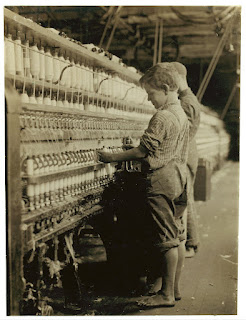
WEAPON OF PERSUASION.  In 1909-1910, photographer Lewis Hines visited New Hampshire and Vermont to document child labor in factories, on farms and on streets.  Photographs such as this, taken at a North Pownal, Vermont cotton mill, helped to focus on the issue and encourage measures to correct it. (Library of Congress)


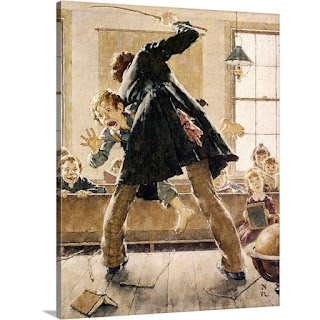
RODS RULE THE CLASSROOM. Many early school teachers believed that corporal punishment was necessary to manage a classroom even if it resulted in "blistered hands, swollen ears and smarting limbs." This Norman Rockwell illustration captured a youngster getting "a good thrashing." 

Journal Opinion Jan 26, 2022.

From corporal punishment to intentional neglect, children are too often subject to cruelty.

This column reviews child abuse and intentional neglect before 1930. Included is information from New Hampshire and Vermont history, using examples from vintage newspapers and online sources. Newspapers usually covered only the most egregious cases. Early local historians did not mention these issues.

This column does not cover the typical interactions between adults and children that result in mild punishment.  A swat with an open hand, depriving a child of a desired pleasure, or sending a child to bed without supper are not the type of examples covered. Parents are not given a manual of instruction when given the care of children, especially when dealing with a willful child. 

Instead, it deals with examples of ongoing physical or emotional abuses. History recognizes that some adults are not fit emotionally, physically, or psychologically to be in charge of children and take advantage of their vulnerability. 

These abuses are sometimes perpetrated by an adult who, when intoxicated or incensed, becomes a brute. In that case, the switch, belt, or fist becomes a weapon. It often occurs when the perpetrator is not the natural parent of the child involved.

Until the latter part of the 19th century, children were their father’s property. Even though the government had the ultimate role of protecting children, it rarely restricted household authority.

Parents were expected to raise children with a moral character and a strong work ethic. “Spare the rod and spoil the child” was the rule. Disobedient children, it was thought, needed to have “the devil beaten out of them.” Local governments were more likely to remove children from a family that did not provide the proper life lessons than one that physically abused them.

Craftsmen frequently took boys as young as eight as apprentices. Girls were assigned to families to learn housekeeping. Apprentices were often orphans or children abandoned by their natural families. Their treatment varied from caring to cruel. Local governments did intervene in severe abuse or neglect cases and would assign the child to a new master.

 Frequently, children who were adopted as orphans or lived with stepparents were vulnerable to abuse. In 1831, a New Hampshire minister beat his adopted son almost to death when the child had difficulty pronouncing difficult words. This is an example of some adults’ lack of understanding of child development. 

If physical or emotional abuse was secretive, sexual abuse of children was even more so. Authorities   were unwilling to admit that it could even possibly exist. Not until the 1920s was the study of child molestation recognized. The practice of allowing older men to marry girls as young as 13 sometimes circumvented charges of abuse.  

Local governments often placed orphans or neglected children with other families, often without ongoing supervision or consideration given to the child itself.  Corinth was one town that “bid off” such individuals to the lowest bidder. That bidder was supposed to provide necessities, but that was sometimes not the case.

 In the early 1800s, Corinth bid off the two children of Jonas Taplin who could not care for them. Tragically, the two children were locked by their caretaker in an unheated shed where they died of starvation and exposure.

Children orphaned or taken from families were sometimes placed in the town poor farm by the Overseer of the Poor. The discipline there was often harsh with whipping and solitary confinement used. 

Private and public orphanages were created in both states in mid-19th century. Many “orphans” actually had one or both parents unable to care for them. Many children were placed in orphanages for just short periods. Discipline was described as rigid. The rise of foster care in the late 19th century caused children to be “placed out,” often as workers.  

Early orphan asylums in the two states included the St. Joseph’s Orphanage (1854) and the Home for Destitute Children (1866), both in Burlington. The Orphans Home and School for Industry in Franklin, NH, and Spaulding Youth Center of Northfield, NH, were both opened in 1871. Given recent charges of abuse in institutions such as these, perhaps these abuses were systematic. 

After the Civil War, two cases highlighted the abuse of children. In 1869, Samuel Fletcher, a blind youngster from Illinois, was locked in a cellar by his parents. When he escaped and reported the abuse, his parents were fined $300 in one of the first court rulings recognizing children’s right to be protected against abuse.   

In 1866, Mary Ellen Wilson of New York was placed in a foster home with Francis and Mary McCormack. Over the next several years, the youngster was severely physically abused, malnourished, and neglected. The widely publicized trial of the McCormacks led to the establishment of the New York Society for the Prevention of Cruelty to Children, the first such organization. 

The following abuse cases were reported in Vermont newspapers. While neighbors often declined to intervene, concerned neighbors eventually led authorities to investigate. In some cases, the perpetrator’s punishment did not seem appropriate to the crime.

In 1879, 9-year old Alice Meaker of Duxbury was sent to live with her half-brother.  Over the next year, his wife Emeline severely abused the child. In 1880, Emeline and her son Almon poisoned the child. Both were found guilty of murder. Both died in Windsor state prison.     

In 1906, a Vershire man took charge of a 9-year old boy from the Children’s home in Burlington.  He was charged with cruelty after the horrible treatment of the youngster. The child was forced to work in the woods for long hours, was ill-clothed, and forced to sleep in an unheated attic. 

In 1913, a Waterbury man was imprisoned in Windsor Prison for whipping a little child.

In 1915, a Brattleboro woman was fined $10 for publically assaulting a child of eight with a whip, leaving marks on her legs.

In 1919, a well-known farmer from Walden was tried for breach of peace for whipping a 12-year old disabled orphan in his charge. After a highly publicized trial, he was found guilty and fined $50 and costs.


Underage runaways experienced abuse or neglect. This was sometimes due to harsh work conditions. The number usually increased during tough economic times. On the street, underage runaways and homeless children were especially vulnerable.

Several examples of runaways that received newspaper notice included an offering of a five cent reward for information on a 14-year old apprentice from Sherburn, VT who ran away from his master in 1836.

Then there is the story of Charlotte Parkhurst.  She was born in Sharon in 1812 and, after the death of her mother, was placed in a foster home, perhaps in Lebanon.  She ran away, adopted a masculine identity, became known as Charley, and became one of the top stagecoach drivers on the West Coast. 

Articles mentioned runaways from the State Reform School in Waterbury and the State School for the Feeble Minded in Brandon. The latter led to charges of abuse.  In 1921, a 15-year old lad from Wells River ran away from home after “a sound thrashing.”

The number of children who ran away from home varied with economic conditions. The number significantly increased during the economic depressions. On the street, underage runaways were especially vulnerable. 

Juvenile offenders were another group of youngsters who faced abuse or neglect. This was especially true when they were incarcerated in prisons, jails, or workhouses. In the 1850s, officials in both New Hampshire and Vermont raised concerns about the imprisonment of children “confined with hackneyed and callous malefactors.”

In 1852, New Hampshire established a state reform school in Manchester, and in 1865, Vermont opened one in Waterbury.  In 1912, Vermont began to deal with youthful offenders in a juvenile court system.  

A history of early New Hampshire schools recalls severe abuse by schoolmasters. The frequent use of rods and ferules left “blistered hands, swollen ears, and smarting limbs.”  A ferule was a flat ruler used to punish children. The History of Canaan, NH, mentioned: “most children got whipped every day, either at home or at school, sometimes at both.”

“Faced with reckless wretches,” a Vermont teacher in 1845 felt that “rough means became fair.” Many teachers felt there was “an irresistible persuasiveness” in applying the ruler.  

Born in 1810, Eliza White Root recalled abuse in Burlington schools. “I thought the teacher very cruel, as he would often ferule the boys, gag them and make them stand and hold their arms upright.” Parents generally accepted corporal punishment, and sometimes, a second at-home punishment followed.

 “Good order is the jewel of the schoolroom” wrote one editor. He criticized those parents who threatened a teacher who applied the rod to their child and further blamed them when they could not control their children at home but expected the teacher to manage a whole classroom of children.

Often corporal punishment became actual abuse when the adult involved allowed emotions to overwhelm the situation. In 1867, a Springfield teacher applied a rawhide whip to an 11-year old boy. Described as an “outrageous child,” his body was bruised and discolored. 

In 1883, a suit was brought against a Pittsfield teacher who thrashed a boy. “The jury decided she did the proper thing.” A few years later, an article on why female teachers should be paid less included: A male teacher “can trash an unruly boy into obedience, she can’t.”

There was a belief that corporal punishment was not only necessary but had a lasting positive impact.  In 1875, the Vermont Phoenix carried the following: “The birch rod, too, has much to do with our public schools, and most of our great men have been soundly thrashed with it while boys.” In 1914, that attitude continued: “A good thrashing has saved many a boy,” making “them a better man.” 

While naughty boys might be physically punished, girls were more likely to be just reprimanded. A  West Randolph newspaper suggested that boys preferred a trashing to a girly punishment such as standing in the corner. 

Schoolroom discipline in the decades that followed was “abrupt and absolute.”  Paddles gave new meaning to the term “board of education.”  Sometimes being sent to the Principal’s office resulted in more of the same.  

In 1867, New Jersey was the first state to prohibit corporal punishment in schools, but it was more than one hundred years before another state would follow. In 1974, federal legislation required states to establish child abuse reporting procedures and investigation systems.  New Hampshire and Vermont took steps to implement these requirements.  

There were changes in attitudes toward corporal punishment from 1880 to 1920. Adults in charge of children were advised to avoid chastisement when hot-tempered. In 1895, an article in Bradford’s United Opinion suggested, “While with a firm hand you administer parental discipline, also administer it very gently.” In 1909, the newspaper further suggested, “Think twice before raising your hand to hit a child.”

With industrialization in the 19th century, there was concern over the employment of children in mills and factories. Children were often employed to supplement family income. Many believed that it was morally desirable for children to be employed rather than “lazy or wild.”  Employers often wanted children for their lower wages and because their small size was sometimes an advantage, something that labor unions disputed.

The woolen industry in both states employed young children. The Winooski Woolen Factory employed some children under the age of 12 at low wages and for workdays of up to 14 hours. 

In 1867, Vermont was the last New England state to limit the number of hours children could work in factories. But these early laws only applied to children under 12. There were cases where these laws or the school attendance requirements were ignored. In 1911, the Vermont Child Labor Committee was established to combat child labor exploitation.

At the turn of the 20th century, the child-saving movement included the creation of child protection societies. The New Hampshire Children’s Aid and Protection Society was formed in 1914 to deal with child abuse and neglect in that state. Vermont’s Children’s Aid Society was established in 1919 with a special charge to deal with the problems of children orphaned by the Spanish flu epidemic.

While laws have been changed to protect endangered children, for some, this is still a hidden family secret. Professionals are required to report suspected cases. Neighbors who notice abuse and neglect are under no legal obligation to report but may report anyway.  We can only hope that the cry of the abused will be heard by those who can answer it.


Monday, December 20, 2021

How Sweet It Is

SANTA'S SWEET GIFT. Individual boxes of hard Christmas candy were distributed by Santa Claus at the conclusion of school and church Christmas programs in area towns.  In the late 1940s and '50s, the Orford school held their holiday program at the Orford Congregational Church and, at the end, the long-anticipated visitor arrived with boxes of candy for each child. 

YOUNG COOKIE MAKER. Thirteen-year-old Madi Benjamin of Bradford shows off her Christmas cookie creations.  She lives with her grandparents, Bob and Pat Benjamin, and is an accomplished baker with her own baking tools.  She shares her cookies with family and friends, especially those wo are housebound due to Covid. (Courtesy photo Pat Benjamin) 
 

Journal Opinion Dec 15, 2021

We are in the season of sweet tooth cravings! For many, Christmas sweets are a significant part of the memories of years past. They, like the gifts and traditional foods, reflect the bounteous joy of the season.

This column describes how some sweets become traditional holiday treats. Stories submitted by area residents, internet sites, and newspaper archives provided background. 

This is the fifth in a series on the history of the holiday season. For those interested, the following can be found by using the search feature at “In Times Past” larrycoffin.blogspot.com.  Christmas Memories 1659-1959; Cooking Up a Christmas Storm; The Best Christmas Gift Ever and Old New Year’s Ways.

The much-maligned fruit cake is one of the oldest examples of sweets connected to the holiday season.  The tradition of giving cakes made with dried fruit and seeds goes back to a Roman winter festival.

Immigrants from European nations brought their versions of holiday fruit cakes to the New World. The English style of dark cake, the Italian panettone, Scottish Dundee cake, and the German stollen are just four Christmas cakes. Before 1900, these cakes were considered both a luxury and a way of preserving expensive ingredients.

It was the English version that Bradford’s United Opinion was referring to in 1888: “Good fruit cake, like fine wine, grows better with age; the cake concocted before Christmas so far from deteriorating, will become richer and more melting as it and the holiday season together draws to a close.”

In the early 1900s, ingredients were more accessible, and fruit cakes were mass- produced.  As the quality was reduced, one source referred to them as a “dry lump of disappointment.”

Some love fruit cake and others pass it up. Bradford’s Penny Perryman shared that her mother made fruit cakes to great reviews. She mentioned that she was “very confused as I got older and heard jokes” about fruit cake. 

Other traditional holiday cakes included the alcohol-laden tipsy cake, the torte-fruit Christmas cake, and the nutty New Year’s Cake. In 1876, the Bradford Opinion mentioned eating the latter ensured happiness in the new year.

Akin to these cakes were the traditional holiday baked or boiled puddings. Stir-up Sunday was a day in the late fall when puddings were boiled and put away “to mellow and ripen.” The term plum was a generic term for dried fruits. For some families, plum pudding was as “important to Christmas as the lights in the tree.”

Figgy puddings are better known as Christmas puddings in America. In 1888, Bradford’s United Opinion featured a recipe made from suet, raisins, currants, and citron and steamed for five to eight hours. Carolers asking for a figgy pudding is mentioned in the 1939 carol “We Wish You a Merry Christmas.” 

Christmas pies were standard desserts for the holidays.  One Vermont editor ranked mince pie as the top standard Christmas dessert. Another suggested all any man needed for Christmas was a mince pie and a new pair of slippers.  Mince pies are made from apples, raisins and suet, although there is also a recipe for green tomato mincemeat. Preparations were often made well in advance.

While apple pie is a favorite dessert for Christmas, pumpkin is not far behind. At least three favorite Christmas carols link pumpkin pie with the happiness of home and holiday celebrations. Some sweet enthusiasts list raspberry, cherry or pecan pie as their favorite Christmas dessert memory.

The holiday would not be complete without cookies. A recipe for Christmas cookies was included in the first American cookbook published in 1796.  Coriander sugar cookies could be made six months beforehand and stored in earthenware jars in the cellar.

In the late 19th century, cookie cutters became available, and cookies were made in the shape of bells, stars, and reindeer. Gingerbread cookies had been baked before, but now they were created in shapes such as decorated men, dogs, and horses. Some were eaten, while others became Christmas tree decorations.

In the 1930s, children began leaving cookies and milk for Santa.  About that same time, Christmas cookie exchanges became popular. 

Bakeries and stores also offered cookies for Christmas.  A 1932 ad for Darling’s store in Fairlee featured Sunshine Cabinet Cookies for “Kiddies’ Xmas Tree” That edition of Bradford’s United Opinion reflected the economic hardships by encouraging its readers to “make [their] dollars count.” It added, “Don’t let adult cares be reflected in Children’s Christmas happiness.”

Fairlee’s Marjorie Green recalled the wonderful ginger St. Nicholas-shaped decorated cookies made around 1948 by her local New Jersey bakery. Buying several was a holiday treat. She said she has tried to duplicate these cookies in Vermont. 

The Bradford Public Library currently has a display of wooden molds used in the making of Springeles, a traditional Christmas cookie of Europe’s German-speaking region. These molds have been collected by Anita Fahrni of West Newbury and will be on display for the next month.   

I received several emails from area residents that spoke of the role of candy in their Christmas memories.  For them, “visions of sugar plums” did actually dance in their heads. 

Sugar plums are pieces of candy made with hardened sugar in a small round shape. Plum refers to the shape. They can be made with dried fruit, nuts and spices. In 1802, Confectioner Stephen Delaney of Portsmouth offered commercially made sugar plums. In the mid-19th century, sugar plums were often used as tree decorations.

Clyde Watson of Etna recalled her older sister making sugar plums from large red grapes dipped in egg whites and sugar and used as decorations.

Other candy associated with the holidays included homemade fudge, peanut brittle, molasses taffy, maple candy, and bourbon balls. Charlotte Williams of Fairlee recalled a late 1950s memory of family- made bourbon balls. She described them “as a not-too-sweet mix of baking cocoa, a little flour, a little sugar, and plenty of chopped walnuts.” Doled out on Christmas morning for “a delightful sweet/bitter bite, and what a lovely fiery warmth in the pit of my tummy afterward!”

Several recalled commercially-made candy, including Peach Blossoms. The New England Confectionery Company of Revere, Massachusetts, made these peanut butter candies wrapped in a crunchy shell.

Florence Welch of Newbury said her mom would always purchase a can of Peach Blossoms, even on a tight budget. Patsy Belknap of Bradford said her mom’s first present for her dad every Christmas was a can of the candy. “He savored them well into the New Year.” She said.

Ribbon candy was another popular choice. This sticky wavy candy was made for years by hand by formed strips around the maker’s thumb. In 1886, dentist Dr. P. B. Laskey, a Massachusetts inventor, patented a mechanical candy crimper.

Candy canes are the number one non-chocolate holiday candy. Many of them are purchased first as tree decorations. These sugar sticks were introduced into America around 1847. Until they were made by machine, they were entirely white.

Living in a candy store may be a dream for some kids, but “it’s lots of work,” said 89-year old Phidias Dantos of Hanover. He was born into a family that operated a general store in Andover, Massachusetts. When they made their annual supply of Christmas candies, it was “full gear ahead” for all.

 Dantos recalled how the candy room had to be refurbished before beginning the production. He described how they made ribbon candy by preparing the sugar mixture in large copper kettles. They used up to 1000 pounds of sugar annually.

Wearing heavy gloves, they poured the hot candy slurry onto a large marble-covered bench. After passing through a machine his father had made, it was curled by hand. Broken pieces were saved to be made into peanut brittle.

They also produced candy canes. When his father died in 1952, Dantos worked alongside his Uncle Pete until 1960. He said in the 60 years since,  he has only enjoyed ribbon candy once.  

Donna Garone of Orford said her favorite memory about Christmas sweets was tied to the candy display at Hill’s Five & Ten in Bradford. To great joy, her Dad brought home chocolate covered peanuts, malted milk balls and non-pareil. She carried that tradition until Hill’s no longer sold penny candy.

At festive events such as school or church programs, Santa distributed small boxes of hard candy and candy canes. His appearance was a highly anticipated event and usually occurred at the conclusion of the program.

 I am told by my Jewish connections that a few sweets are specifically connected to the Jewish winter festival of Hanukkah. The most specific is chocolate gelts. These are foil wrapped candy coins given as presents, especially to children. They are often used in conjunction with the Hanukkah game of dreidel.

Jewish families might also enjoy the following sufganiyot (jelly donuts), hamantaschen (small filled cookies), and halvah (sesame fudge-like candy). These, along with sugar or honey cookies in the shape of stars or dreidels, cheesecake, and filled chocolates, might be purchased or made at home.

Wars had a significant impact on Christmas sweets. During the Civil War, men received boxes of candy, cookies, and warm socks.  In 1862, George Benedict of the 12th Vermont Regiment wrote in his diary about boxes of goodies including “raisins, apples and coco-nut cake just sent from home.” He went on, “some soldiers received no special treats.”

Similar packages of homemade goodies were sent to troops in France during World War I.  Companies created special packages containing fruit cake and other treats that could be mailed to service members. One company’s ad mentioned “Send Your Soldier Boy a Liberty Cake,” For $1, including postage, a 24 oz. fruit cake could be sent abroad.

While sugar was not rationed during World War I, there was great pressure to conserve. In November 1917, candy makers were feeling the sugar shortage and they reduced their offerings. There were ads from confectioners in Vermont newspapers that year. The sentiment was “children should have candy!”

In 1942, sugar was the first food to be rationed, and chocolate followed. Service members received hard chocolate in their government rations. In 1941, the Mars Candy Company created M & M’s based on a similar product supplied to troops during the Spanish Civil War. They were heat-resistant and easy to transport and were exclusively produced for military rations. 

As a result, there was a severe shortage of chocolate on the home front. The emphasis on a homemade Christmas extended to making, as nearly as possible, traditional Christmas sweets.  A December 1943 United Opinion edition offered candy recipes to “S-t-r-e-t-c-h” rations points. They included recipes for Christmas fruit balls and marshmallow prunes.         

 When in 1823, Clement Clarke Moore wrote “the stockings were hung by the chimney with care…,” children had been hanging stockings for Santa for some time.

For many years, Christmas presents consisted only of what would fit in a stocking. That might include an apple or orange, some nuts, and hard candy. By 1884, oranges from Florida began to appear in Vermont. In 1888, Christmas oranges were being offered for sale at Beiley’s Store in Newbury. About that same time, boxes of California crystalized fruit were also available.  

 A 1912 article in The Country Gentleman described the contents of a common stocking: “homemade candy tied up in bright paper, a few sugar cookies and an orange.”  

About 1908, the California Fruit Growers Association began a mass marketing campaign to link their oranges with Santa Claus. During the Great Depression, many families could not afford to buy holiday presents. An orange was an exotic treat. 

Another exotic treat was dried dates. Dean Whitlock of Thetford wrote, “My favorite holiday sweet treats were stuffed dates.” They were made by filling pitted dates with shelled walnuts or pecans and sugar.  

For many years, “chestnuts roasting on an open fire” produced “the smell of Christmas in America.” In urban areas, street peddlers roasted chestnuts. Eaten warm, they are described as sweet and buttery.  Chestnuts were also used in cakes and as stuffing for the Christmas turkey. Mixed nuts along with roast cashews were also available at holiday time. 

From Thanksgiving through New Year’s Day, many people feel they gain weight due to the sweets consumed. The despair prompts many New Year’s resolutions. With best intentions under siege, Christmas cookies, pies and other treats are challenging to resist. Despite that, how sweet it is.

Sunday, November 14, 2021

Five Who Served

THEY CALLED "STEVE." During the 1945 battle for Okinawa, wounded Marines were told to yell "Steve" to summon corpsman Steven Seminerio. Japanese soldiers were calling "corpsman" and then shooting the responding Americans. (Courtesy photo) 

LIBERTY SHIP GUNNER.  During World War II, Haverhill's Earl Aremburg served aboard Liberty-class ships making several transatlantic passages transporting soldiers, equipment and supplies.  Attacks by German submarines and planes made the trips extremely dangerous. (Courtesy photo)

 Journal Opinion  Nov 10, 2021

Thursday, Nov 11 is Veterans Day. It was initially established as Armistice Day to commemorate the end of World War One on the same day in 1918. In 1954, the observance was renamed and expanded to honor all who have served in our nation’s military.   

In observance of this day, five veterans were interviewed for this column. They all served in the nation’s military between 1943 and 1953.   They are all in their nineties. They all have ties to this area. Their service details exemplify the varied experiences of many other veterans. They all participated by sharing their stories which are presented in chronological order.  

Ninety-five-year-old Earl Aremburg, of North Haverhill, recalled he and his friend Joe Dyke joined the Navy right after his 17th birthday in Sept 1943. He trained as a gunner in Norfolk, Virginia and, was assigned to a 35-man unit on the SS Hannis Taylor, a Liberty-class cargo ship.

Aremburg’s first transatlantic trip was in a convoy of 100 ships carrying troops, equipment, and supplies to the Mediterranean. During the 30-day trip, the ever-present danger from German submarines was significant and the convoy lost a number of ships. Liberty ships, he recalled, “sunk like a stone” with considerable loss of life. Especially dangerous was when the convoy went through the Strait of Gibraltar as it had to go single file.

The Hannas Taylor was assigned to carry cargo around the Mediterranean from North Africa to Naples and at least one trip back to the States. On that trip the ship’s cargo was largely damaged equipment that he referred to as “junk.”

He recalled that perhaps some of the older men suffered more from homesickness and fear than he did. But he did remember experiencing fear during the German nighttime bombings of the port of Naples in the spring of 1944. The vulnerable ships were under total blackout. He recalled the Army’s response with searchlights spotting the enemy bombers overhead.  

Returning to Baltimore, Aremburg was transferred to a second Liberty ship whose mission was refueling ships enroute to North Africa. After the end of the war in the European theater, he was shipped to the Pacific in anticipation of the invasion of Japan.  He was transferred from gunner to machinist aboard the aircraft carrier USS Manila Bay.

 After the Japanese surrender, the carrier was used to return troops to the States for discharge. Because of his low point score, Aremburg was not discharged until Jan 1946.  The Adjusted Service Rating Score was used by the services to determine the order in which service members would be discharged.  Points were granted based on a number of factors, including length of service.

Upon discharge Aremburg traveled by train from San Francisco to Boston, arriving back in Haverhill in April, 1946, just 20 years old. He remained in the Marine Reserve, but was not called for further duty.

Post-war, Aremburg  and his son Ray were well-known for their co- ownership of Blackmount Equipment in North Haverhill and for his activities in the local veterans’ post.      

Jan 31, 1944 was Steven Seminero’s 18th birthday and the day he enlisted in the Navy. As he had been a  pre-med student at Boston University, he was assigned as a corpsman with the 6th Marine Division. That June, he was shipped to Guadalcanal to prepare for the invasion of the Japanese island of Okinawa.

Seminero recalled, “We invaded Okinawa on Easter Sunday, April 1, 1945. I was in the first wave that landed. At first, there was no combat, but as we moved south, it became more difficult. Four thousand of our men were killed and many more wounded.” 

He said that three corpsmen sent in before him were killed. “The Japanese were calling ‘corpsman’ to lure them and then kill them.  So my platoon leader ordered the men to call ‘Steve’ if they needed me. I was told later that while I was crawling uphill toward a wounded man, bullets were flying all around me, but I was totally unaware of this.” During combat, Seminero was promoted to Pharmacist Mate 2nd Class.

The division was in Guam preparing for the invasion of Japan when the atomic bombs were dropped. “As we thought of the invasion as a suicide mission, we were most relieved.”  The division was then assigned to Tsingtao, China, to process surrendering Japanese forces. 

Upon discharge, Seminero returned to Boston University under the GI Bill. Upon graduation, he married his wife Marilyn and entered seminary.  For 42 years, he served Methodist churches in Massachusetts, retiring to Marilyn’s family home in East Haverhill in 1992.  He is well known in the area, having served as interim minister in several area churches.  They now divide their time between East Haverhill and Concord, MA.   

Seminero said that after discharge, he tried “to forget the war and get on with my life. I never talked about it until the fifty-year observance of the end of the war.” At a program on the Okinawa battle in 1995, he responded to an invitation from the speaker to share his experiences. This interview continues that sharing. 

In 1944, 17-year old Alan Stahl answered his nation’s call and joined the Navy.  He was sent to school to train as a motor machinist. He was assigned to the newly-minted LST 900, a 328-foot tank landing ship.

After amphibious landing exercises in Hawaii, the ship sailed in convoy to Okinawa in June 1945. When asked about the impact of the extreme heat of a Pacific summer, Stahl recalled that as machinists, they were able to get some relief by rerouting some of the air conditioning meant for the officers.

As a Machinist’s Mate, his duties included checking equipment such as the ramp doors and generators. During the invasion of the Japanese-held island, he and his fellows shipmates  were involved in unloading Marines along with their equipment.  One of his duties was to operate the smoke machine that helped provide cover from enemy fire. Something went wrong, and the machine blew up. “It went straight up into the air…I got hell from the Captain.” he recalled.

After Okinawa, the ship prepared for the invasion of the Japanese homeland.  When asked about the use of the atomic bombs to end the war, Stahl said most of the men he knew at the time thought it was “the right thing to do.”  In October 1945, his ship sailed to Tokyo Bay to discharge occupation troops.

Subsequently, he was transferred to the USS LST 875. At this point, the thought uppermost in the minds of most of his buddies was how many points they had accumulated.

After being discharged in 1946, he and his new wife Barbara drove to Oklahoma, where he attended the engineering program at Oklahoma State under the GI Bill. Most of his working experience was for AT &T.  They purchased a farm on South Road in Bradford in 1961, using it first as a vacation spot and then as a retirement home. They now live in Savannah, GA, near their family. 

Hans “Buck” Trede of South Ryegate was born in Germany in 1929. Two years later, his family migrated to America and settled on Long Island. He left the horticulture program at Farmingdale State College in 1950 to join the Marines. After training, he was assigned to the aircraft carrier USS Philippines Sea as part of a contingency of 80 Marines. The carrier task force was ordered to the Pacific in response to the North Korean invasion of South Korea. 

In Dec. 1950, the United Nations forces at Chosin, North Korea, were in retreat as the Chinese entered the conflict. The Philippines Sea was at Hungnam to assist with the evacuation of troops and civilians.  Trede was assigned to a launch to go ashore.  During one sortie, he suffered a non-combat injury to his leg that sent him to the sick bay. There he developed pneumonia and was treated with penicillin, to which he suffered a severe reaction. 

After recuperating at the naval hospital in Beaufort, SC, Trede was reassigned at the sea rescue naval base in Bermuda. His duties there were varied, from security on the Tender Pier and main gate to guarding the ammo dump. Additionally, in dress blues, he escorted officers to ceremonies and social events.

Trede wanted an early discharge to return to college, but the appropriate date would be three weeks after the start of the semester.  Luckily, Trede had a sympathetic sergeant who  arranged for him to remain in the Corps for those three weeks and still begin college in the horticulture program. 

Trede moved to South Ryegate about three years ago to live with his daughter. In his retirement, he crafts beautiful furniture. “There is no such thing as an ex-Marine,” he says and proudly carries his Marine identification card in his wallet. Thinking back over his military service, he stated, “They were the best experiences I ever had.”

Bradford’s Leonard Dobbins was drafted into the Army in 1951, at age 21. He was assigned to the 141st Light Tank Battalion and trained at Fort Hood and in the Mojave Desert. In 1952, his portion of the battalion left New Orleans for an army base in Hanau, Germany.  Dobbins recalled that another portion was sent to the war in Korea.  It was just “chance” that gave him the European assignment. 

The battalion was located in the American Sector of what became West Germany. Their presence was part of the American response to the developing threat of Soviet expansion. As it was assumed that tanks would be part of any action, maneuvers were held regularly to keep them battle-ready. But Dobbins concluded that his peaceful tour “was a very safe assignment.”

 Hanau had been almost totally destroyed by Allied bombing during the war. Dobbins recalled that while there was a great deal of reconstruction going on, there was still evidence of the economic repercussions of WW II on the civilian population. 

He remembered seeing a German woman using a horse and cow to plow her field. At night, he would see kids going through the garbage from the mess hall, searching for food. 

While relations between the military and the local population were generally good. However, Dobbins recalled the damage the battalion’s large tanks did to roads and buildings at civilian crossroads when the tanks were unable to maneuver the sharp corners easily.

Dobbins had been a carpenter prior to being drafted and was assigned to be a battalion carpenter. After returning to Bradford, he used his enhanced skills as a local carpenter/contractor and continues to do at age 91. He married his wife Evelyn in 1954, and they still live on Dobbins Lane in Bradford. 

As with the other veterans interviewed, he mentioned the excellent care he has received at local VA hospital and of the many veterans met through American Legion functions.      

 In 1995, Oxbow High commemorated the 50th anniversary of the end of World War Two by inviting over 50 local speakers to recall their experiences for the students.  Speakers included soldiers, airmen and sailors, factory workers, a UFO entertainer, a German civilian who recalled Allied bombing, and a man dropped behind the lines in Southeast Asia with the task of organizing locals against the Japanese.

As that generation was aging, that was about the last decade in which such a collection of such locals could be held. We owe a lot to that generation, especially to those who served in the military.      

Several years ago, my wife and I were having lunch with Alan and Barbara Stahl at a local dinner on Tybee Island, GA.  When I went to pay the tab, I was told that a stranger had paid for their lunch in gratitude for Alan’s service. Earl Aremburg recalled similar incidents at local restaurants and the young people who asked about his service. 

“Thank you for your service.” On Veterans Day, 2021, that message continues to be appropriate not only for those who served in World War II, Korea, and during the Cold War, but for the many who followed as well.


Monday, October 11, 2021

Fruits of the Harvest


(Courtesy: Vermont Tree Fruit Growers Association)

Journal Opinion 10/6/2021

“How many farmers go to the store or tavern and spend their leisure time talking about their neighbors and cursing the book farming.  How much better it would be for them to stay at home and cultivate their apple trees.” Noah W. Hardy, Granite Farmer, 1851.

This column explores the history of wild and domesticated fruits, berries and nuts in New Hampshire and Vermont. It will not deal with garden crops such as potatoes or squash, or field crops such as wheat, oats, and corn.   

I draw on the observations of those who have written, on the subject in newspapers and agricultural reports in times past especially prior to 1930.

Both wild and domesticated plants are climate dependent. In New Hampshire, the growing season is longest in the southern section, especially near the Seacoast. Southern Vermont, as well as the Champlain Valley, have more frost-free days and are more likely to see expanded fruit and berry production. 

Even within local areas, there are microclimate zones that have somewhat different growing season. As cold air is heavier it tends to settle in the valleys whereas warmer, lighter air rises. Hillside farms were often a better location for fruit crops that required a somewhat longer season. 

One of the most important fruit crops in the area has been apples. With only crabapples native to North America, larger apples were brought to North America by European migrants. From the earliest settlement, apple trees and orchards were planted. According to The History of Newbury, apple trees were planted in Newbury and Haverhill in 1763 and, by 1770, “their fruit had become quite plentiful, while as yet there were not trees in bearing elsewhere, nearer than sixty miles.” 

Zadock Thompson’s 1842 review of Vermont horticulture reported that apples were the “most important and abundant fruit, and is found to flourish in all parts of the state.” Farmers in both states experimented with different types of apples, often grafting new varieties to old stock. Apples were often grown specifically for eating, cooking, drying or cider-making.

 The extensive orchards produced an immense quantity of apples. Most of these were made into cider and cider brandy. Prior to 1840, Daniel Eastman of West Newbury owned an orchard as well as a distillery. He produced up to 1,200 bushels of apples and 30 barrels of cider brandy. In the 1880s, James Hunter of Ryegate operated an apple jelly mill producing over 5 tons of jelly and other products. 

The value of apple orchard products in New Hampshire doubled between 1850 and 1860. The New Hampshire Board of Agriculture promoted the planting of apple trees in the belief that the state was just right for them.

 Charles E. Hardy of Hollis, NH, is an example of an apple producer who followed their advice. He began to market Baldwin apples, with each individual fruit wrapped in paper and packaged in air-tight barrels. AT the height of his production, he sold 1,150 barrels of apples for $2,500. 

By the 1860s, there may have been as many as 600 varieties of apples grown in Vermont.  My 2nd great grandfather Clark Harris of Wilmington, VT, won repeated prizes at the Windham County Fair for exhibiting the largest variety. In the 1870s, he entered up to 46 varieties of grafted apples.  

Many of those older varieties have disappeared. There are groups in both states actively looking for any remaining heirloom apple trees. Janice Brown’s blog on New Hampshire history has an extensive article on missing New Hampshire heirloom apples. The list includes Granite Beauty, Dinsmore, Jewett’s Red, and Lafayette.  The latter was developed in Chester, NH in 1824, to recognize General Lafayette’s triumphant return tour of the nation. 

One of the earliest hill town orchards was begun in East Corinth in 1870.  By 1920 it belonged to Julian Dimock, who through new plantings and grafting of old ones, had enlarged it to 1,600 trees. His fruit became well known in part because of aggressive advertising. One example: “Dimock Apples: You can eat them in the dark!”

The orchards of Bennington’s Edward Hamlin Everett overshadowed all others. A wealthy entrepreneur, Everett established Southern Vermont Orchards in 1910.  The orchards included 75,000 apple trees with 65 varieties, 3,000 plum trees and 2,000 quince trees. It is reported that his orchards were the largest privately owned orchards in the world.  Everett died in 1929.  A modern Southern Vermont Orchards now has 300 acres of the site.   

While apples grew abundantly, there has been questions about the growing of peaches outside of the warmer parts of the region. In 1842, Zadock Thompson, using his Lake Champlain garden as an example, wrote that while little attention had been paid to peaches, “good ones could be raised.” 

In 1869, a report in the New England Farmer suggested peaches were an unreliable crop, with New Hampshire coastline growers getting just one good season in three. As hardier varieties were developed it was reported that “peaches are hard to grow as far north as the Green Mountains, but if they will grow at all they are the very best.” Ads for those hearty varieties began to appear in Brattleboro and Burlington newspapers around 1870.

In 1916, future Senator George Aiken of Putney wrote, “It is not generally known that peaches can be grown in Vermont, yet in Windham Country there at several orchards of a few hundred trees each.”

I placed a question online inquiring about growing local peaches. There were a several positive responses and an invitation from Jean Carlan to taste some of the 150 pieces of fruit she had gathered from her two trees on Bradford’s Main Street.     

Wild grapes were another fruit that grew in abundance and gathered in late September. Known for their “piquancy of flavor,” they had a low sugar content and a sour taste. Early settlers used them for jellies and preserves.

In 1849, the wild grapes were so prolific, “when the season arrived, it was as common occurrence for boys to take a basket on their arm and go out a graping, as it is to go after blackberries.“ noted one contemporary.

In 1850, an article in the Granite Farmer stated, “A little attention to our wild grapes may discover some new variety that could prove to be valuable.”  Actually, the year before a nurseryman in Concord, MA, had taken a wild grape variety and crossed it with an established grape to produce the Concord grape.  This technique helped the delicate variety to evolve into a hardy one, adapted to colder climates.

Growing up in Orford in the 1950s, there were “wild” Concord grapes on our boundary trees.  Perhaps a bird had dropped a seed years before. In addition to swinging on the large vines, we enjoyed the fresh fruit and the grape conserve jelly my Mom made.  

If space allowed, this column could have described other fruits, including wild red and black cherries and pears, found in warmer sections. Improved varieties of these fruits were later available commercially, as were plums, quince and currants. 

The history of strawberries in the area is significant. Wild strawberries are native to the area and both indigenous people and European settlers found them to be a special treat as they are among the first fruits to ripen.

Between 1834 and 1851, nurserymen in New England developed berries that are the ancestors of most modern varieties. About 1875, William Smalley of Bradford experimented with a quarter acre of strawberries on his Lower Plain farm. His experiment was successful and, by 1884, he was producing 1,000 bushes of the fruit annually.

By 1888, the number of growers in Bradford had increased to 11. Maitland Jenkins purchased his father’s farm on the Lower Plain in 1893 and became known as the Strawberry King.  Strawberries were shipped by train to the White Mountains, Boston and New York. Even strawberries produced in neighboring towns were often advertised as “Bradford strawberries.”

Those interested in a more complete history of local strawberries can access a 2007 article on my blog at larrycoffin.blogspot.com. 

As early settlers cleared the forest, wild berry bushes grew up in thickets and along woodland borders, providing a “plethora of free berries.”  These included red and black raspberries, elderberries, gooseberries, thimbleberries, high bush cranberries, blueberries, teaberries or perhaps even the elusive checkerberry.

Picking wild blackberries became a rewarding pastime for many. The bushes were often in the most unexpected and neglected locations. The picker who found these locations while “aberrying” would often keep them a personal secret. 

 In Corinth’s so-called  South America district, there was great blackberry country. The town history mentions that Corinth people went there to pick bushels of blackberries for home use and sale. 

“It is ridiculous to be shipping blackberries into Vermont in carload lots,” one 1899 observer wrote, “when they grow well all over the hills and can be raised in the garden almost without effort.”

Wild blueberries have been harvested by indigenous people for centuries. New settlers found these berries in both states.  Wild berries were referred to as low blueberries or low bush blueberries. 

By 1913, wild blueberries had been over picked. This led the US Department of Agriculture to encourage the cultivation of high bush berries.  Around 1916, wild blueberries and wild currants were destroyed in many places as they were thought to be contributors to white pine blister, a disease that endangered the forestry industry.  

In 1864, an article in The Vermont Transcript had reported, “Our country farms are the best gooseberry growers.”  The berries were used for pies, chutney, jams, and cordials.

By 1878, improved specie were being planted in home gardens.  Vermonters were advised that gooseberries were easily grown, required little attention, and produced quantities of fruit “no matter how much they were neglected.”

But by 1907, when gooseberries were thought to contribute to white pine blister,  New Hampshire state foresters were given the authority to remove gooseberries and wild currents from private property to avoid the white pine blister.  Gooseberries are still illegal in New Hampshire.        

While many of the fruits mentioned above are currently grown commercially in New Hampshire and Vermont, nuts are not. These include walnuts, chestnuts, butternuts, beech-nuts, acorns, and hazelnuts. These were found wild in various amounts with acorns being the most plentiful.

Indigenous people relied on these nuts as an important source of protein. Settlers followed their examples, except that they often used wild nuts as feed for pigs. Pigs were often allowed to roam free during the fall to root for the fallen nuts. Nut-finishing gives pork a sweeter taste.

The meat of butternuts is hard to access, but their sweetness compensates for the difficulty of cracking them and the “untidy nature” of the trees. Butternut trees were quite common in the two states. In 1917, The Caledonian reported that the largest butternut tree in Vermont was found at the Doe residence in Bradford village.  It was reported to have a circumference of 11 feet and its 76-foot crown reach half way across the adjacent main street. 

This “backyard delicacy” was especially tasty when used in maple fudge. In the 1950’s, my Uncle Elroy Coffin of West Brattleboro was a major commercial producer of this delicacy. After 1978, a butternut canker began to infect trees in both states and the trees suffered high mortality rates, especially in Vermont.

All of the trees and plants mentioned above were susceptible to the yearly variations of the weather. Exceptionally cold winters, such as that of 1816, killed them. June frosts in 1859 killed the apple crop with almost one-half of the orchards in Vermont either dead or dying. Hurricanes, such as the one in 1938, caused widespread destruction of fruit trees.

Climatologists and horticulturists are warning of the impact of climate change on traditional fruit growing practices. Warmer winters do not produce the “chill” that is essential for apple production.  An extremely hot day can cause burn on sensitive fruit. Extreme variations in rain fall also impact the growth of fruit. Changing climate can also encourage invasive diseases, plants, and pests that can harm orchards and wild plants.

But for now, whether foraging for wild treats, picking in commercial orchards, or gathering that which you have grown in your back yard, the fruit  of the harvest is something to treasure. Enjoy. 

Saturday, August 28, 2021

Late Summer Fun

MOUNTAIN HIKING:  In the mid-1890s, this group of local residents prepared to climb Mt. Moosilauke.  Several trails and a carriage road made this a popular hiking location. The Prospect Hose on the summit was built in 1860. Late renamed the Tip Top House, it was destroyed in fire in 1942. (Bradford Historical Society)
 

CROQUET SET MILL: Croquet was introduced in the United States in the mid-1860s and became very popular. In 1888, the Roy Bros woodworking mill was established in East Barnet and at its height manufactured 40,000 croquet sets annually.  The mill was damaged by several floors and fires and ceased production in 1938.


For many years, Bradford's swimming hole was located at the Baldwin Bridge and the Waits River. Swimming lessons were a popular feature of this community pool.  
 

A month or so is left of official summer, less so if you are looking to a new school year. Still time for a column on the history of summer and fall activities. Not all seasonal activities are included.  Baseball, softball, summer fairs and auto racing will be dealt with at another time.

Early New England residents brought their recreational activities and attitudes from Europe. Summer activities included foot racing, nine-pin lawn bowling, and games that were forerunners of modern shuffleboard and baseball. Recreation, such as husking bees combined work and play.

The Puritan ethic considered play and idleness “the devil’s workshop.” Except for the youngest, there was little time for play. Leisure was a privilege of the upper classes. Farmers who toiled from first light to dark in the summer had little time, energy, or inclination for leisure activities.

The introduction of labor-saving machines in shops and on farms reduced the number of hours in the average workweek. These changes reduced the 1860 average workweek of 70 hours to 62 by 1890, 55 by 1910 and 43 by 1940. Shortened hours meant that adults had the time for involvement in fun activities. These advances did not always apply to farmers who to this day often toil 80 hours a week during harvest.

Many of those initially involved in the listed activities were likely to be tourists or residents in the middle and upper classes, especially when expensive equipment or fees were involved.  Golfing and cycling are examples of these.  When the activity did not require elaborate equipment, others were more likely to be involved.

When Americans began to have more leisure time, they often engaged in recreation that could be described as working at play. Just sitting around doing nothing was often equated with laziness. 

Golf was introduced into New Hampshire and Vermont in the late 19th century, with the Dorset VT club opening in 1886 and the Hanover Golf Club opening in 1899.  In 1929, the United Opinion reported, “Vermont, like Scotland, is a country built for golf.  Vermont is the Golfer’s Country.”

Locally, there have been nine golf courses, some public, others private.  Some were closely connected with tourism and others involved community interests. They were both designer courses and just pastures that doubled as links. Three remain open, including Bradford and Lake Morey, both established in the early 1920s.  Blackmount Golf Club opened in 1996.

The six that have disappeared include the Pike Manufacturing Company course which opened in 1900; Lake Tarleton Club, 1909: Mt. Moosilauke Golf Club in Warren, early 1900s; Shanty Shane on Lake Fairlee, 1911: Wells-Wood Golf Club in Wells River, 1925: and Bonnie Oakes Resort on Lake Morey established in the early 1960s.

At one time or another, all of these courses have been open for local golfers.  Details on these courses can be found on my blog at larrycoffin.blogspot.com.

For the young caddies, playing mumblety-peg in the caddy shack while waiting for an assignment, golfing was work. Sometimes, caddies, such as those at Lake Tarleton, had a chance to get in a round in the evening or going for a swim on a hot day. 

Swimming has been a traditional summer activity since the earliest settlers.  Swimming for recreation rather than just a way to bathe became more popular in the 18th century, especially among men and boys. 

By the latter part of the 19th century, women and girls were increasingly allowed to swim in mixed company. Their outfits consisted of long dresses or bathing gowns. Men wore wool shorts and tops, and only in the 1930s did men start to go topless.

It was not uncommon for boys to dam up the local brook for swimming. In 1897, Frank West Rollins recalled his New Hampshire youth when, as boys, “we divested ourselves of every stitch as we ran, and with a yell of delight, disappeared in the soft waters of the swimming hole.”

Swimming was also a major activity at the many youth camps and hotels that offered urban residents a respite from the summer heat. Swimming lesson programs became more common in the 1950s for local children.   

Hall’s Pond, Baldwin Bridge, Flat Rock, Ticklenaked Pond, and Lake Morey are among the swimming locations that called young and old alike for refreshment from the summer heat.    

With hundreds of ponds, lakes, and rivers, the two states are a mecca for other water-borne sports.  Fishing and boating are two of those. Fishing for food by local residents has existed for centuries, beginning with our Native Americans predecessors.

As early as 1837, the sport of trout fishing was tempted rural and urban fishermen alike. In 1842 Vermont historian Zadock Thompson wrote, “when the country was new all our waters swarmed with fish of various kind.’” Fish such as salmon and shad were so abundant in the Connecticut River, “they could be taken in any quantities desired.”  He went on to warn that while still plentiful, the erection of dams, pollution and reckless fishing was having an impact on the fish population.

In 1867, the local newspaper reported that four persons from Bradford took about 400 pounds of fish from Fairlee Pond.  In the years that followed, Lake Morey had a reputation for being able to catch “boatloads of suckers” with horned pout being so plentiful that “anyone can catch as many as he wishes for in an hour or two on a summer evening.” By 1898, Lake Morey was depleted of game fish, a situation also true of Hall’s Pond.

Both states passed legislation establishing fish commissions, and regulations and fish hatcheries to deal with this depletion. In 1907, with millions of trout and salmon fries released, it was reported, “when it comes to fishing, New Hampshire is emphatically in the front ranks.”

About that same time, there was news of the Wells River Fish and Game League. This group owned three nearby well-stocked ponds from which, on one morning, a small group caught 40 pounds of trout. 

In the 1950s, the fish taken from the Connecticut River were impacted by the river’s pollution. The efforts to reduce pollution in the two states made waterways better fishing locations. One only has to drive near local lakes and rivers to notice the number of fishing activities.         

Recreational boating and camping have also been a prominent local summertime activity. From 1892 until his death in 1930, Capt. Edgar Lucas and his steamboats provided tours and other services to the cottages and camps on Lake Morey and Lake Fairlee.   Similar steamboats plied Lake Groton to service local camps. These lakes celebrated boating with an annual boat parade. 

Youths from area camps were a significant portion of early boating on area lakes and rivers. For many years, the late Lloyd and Lucy Bugbee maintained a free canoeist camping site near their Bradford home at the Connecticut’s Eel Pot Ledge. Most of the patrons of that site were from youth camps or vacationing tourists. The site was later moved to Bradford’s Memorial Field’s Waits River access.

The building of Wilder Dam has enhanced opportunities for both canoeing and powerboating on the Connecticut River.

Summer fun has included bicycling since the 1870s. Cycling clubs began with the Vermont Wheel Club in 1884.  Bicycle shops began to open locally in the 1890s to meet “the desire among the youth and older ones to own a wheel.”

Bike touring became popular in both states, with some residents taking extended bicycling vacations. For many, a day-tour was enough. Cycling had a liberating impact on many women, giving them “a feeling of freedom and self-reliance.” Youngsters also experienced freedom as bicycles allowed trips for adventure.

 Young boys were more likely to take to village streets. Bradford historian Harold Haskins recalled “boys, whose only desire was to ride as fast as possible, regardless of the safety of pedestrians.” Several locals shared their own “dare-devil antics” in my blog article entitled “Pedaling Along.” 

One activity that required only minimum equipment was the game of horseshoes. Derived from the ancient game of guoits, it involved pitching horseshoes approximately 40 feet toward a rod in order to score points. 

Introduced into New England by English settlers, this game of skill “requires a good eye, an intuitive sense of direction and the knack of giving the shoe a spin that holds it flat when landing.” Success is a “ringer” with a “leaner” getting partial credit in points.

Competitions using mule shoes were played in Union camps during the Civil War.  Returning soldiers brought the game home. This game was played in the backyard for fun or in serious competition on a prepared court.

Especially after 1920, horseshoes became a regular part of local celebrations. Women sometimes participated.  Leagues were established, and teams travelled to competitions. Obituaries of many local residents mention a life-long interest in this sport.

There are other summer lawn games that were played locally in times past. The very social game of croquet was introduced into Vermont during the mid-1860s. In 1865, one Vermont newspaper mentioned that the game was “making rapid progress in the affections of the community.” The following year croquet sets were offered for sale. The game was especially popular in situations that allowed the mingling of young couples.      

The game saw a resurgence in the 1930s and was played on many local lawns. Since the late 1970s, it has been played competitively at tournaments in both states. 

The Roy Brothers’ mill of East Barnet became known for the hundreds of thousands of croquet sets it manufactured. Beginning in 1888, this river-side mill manufactured sets from birch, maple, and other local hardwoods and sold them through national catalogs. In 1924, the mill employed 50 local workers and manufactured 40,000 sets.  Fires and floods brought an end to the enterprise.  

Lawn tennis was introduced into the United States in 1881.  In 1884, Frederick Billings set up a tennis court at his Woodstock property. That same year, New Hampshire’s first tennis court was built in Waterville Valley.  By 1894, an annual Vermont lawn tennis tournament was held, and local clubs were being established.  Many of the first state tournaments were held in St. Johnsbury.

Players in the early years of the game competed with white balls, wooden racquets, long shirts for the women and long pants and ties for the men.

In the 1880s, Italian immigrants introduced New England to the Italian lawn bowling game of bocce. Italian clubs in cities such as Rutland, Barre, and Manchester had bocce courts. The Burlington’s club bocce courts drew families on Sunday afternoons for pleasure and competition.  Because of its varied ability level appeal and minimum equipment required, bocce remains one of the most widely played games in the world. 

The first badminton club was established in America in 1878. It became especially popular in the 1930s.  Badminton clubs were established in both states and offered the game for both recreation and competition. Inexpensive sets allowed families to set up the game in local backyards.

More recently, volleyball, corn hole, and Frisbee could be added to this list of summer lawn games. The Valley News recently had an article on the British game of cricket being played in the Upper Valley. 

Hiking and walking for pleasure was “a relatively new concept” in the late 19th century. Local hikers have been drawn to local mountains in both states for excursions since then. In 1886, it was reported that a large local group climbed Mt. Moosilauke. “This mountain,” the report concluded, “is gaining a deserved notoriety as a popular resort.” In 1860, a small hotel was constructed on the summit and groups accessed it by several trails. 

In 1910, the newly-formed Green Mountain Club began the construction of a hiking trail along the ridges of the Green Mountains.  The 270-mile Long Trail, completed in 1930, was the “first long-distance wilderness hiking trail in America.”

In 1921 the Appalachian Trail was proposed. Composed of existing trails and new paths, it was completed in 1937.  The 2,190 mile trail includes 151 miles in Vermont and 160 miles in New Hampshire and bisects our area on its way from Maine to Georgia. 

More could be listed as seasonal recreation activities. In addition to what might appear to be work-like activities, there are always lounge chairs and good books.  Whatever your passion, play on. Winter is coming.