Popular Posts

Statcounter

Wednesday, April 30, 2014

"Wilderness of Woe"


Journal Opinion

April 30 , 2014


This map shows the location of the Vermont Brigade under the command of  Lewis Grant at the crossroads of the Brock Road and the Orange Plank Road.  Face with overwhelming odds the Vermonters suffered 1,000 casualties that day.  (Courtesy Gary Gallagher)


Many of the deaths at the Battle of the Wilderness were caused by the fires that 
broke out.  Many of those who died were burned beyond recognition.

An Incident at the Battle of the Wilderness.  In late May 1864 Frank Leslie's Illustrated published
this woodcut of Union generals George Meade (left) and Ulysses S. Grant (right) in an article describing the recent successes of the Union forces in the Overland Campaign.

 Vermont Monument at the Wilderness.  On Sept. 16, 2006 a ceremony dedicated this monument to Vermont's sacrifice at the Battle of the Wilderness.  Designed by Vermont Civil War Historian Howard Coffin, the Barre granite was etched in the shape of Camel's Hump.  Coffin also led the effort to preserve 500 acres of the battlefield endangered by development. (Courtesy of Stonesentinels.com)     

“Yet it is to the Wilderness that one must go to find the place where the soldiers from Vermont made their greatest sacrifice for the cause of the American Union.  Around that historic and unlovely place where two country roads still meet, Vermonters by the hundreds fell bleeding…. The Brock-Orange Plank roads intersection is Vermont’s great Civil War battle scene.”  Howard Coffin, Full Duty: Vermonters in the Civil War

     This is the fourth column in my observance of the 150th anniversary of the Civil War and the role of local men in that conflict. The first described the response of the Bradford Guard to Lincoln’s call for troops. This was followed by a column on the Sept. 2, 1862 battle at Antietam, the single bloodiest day in American warfare and then one on the July 1863 battle at Gettysburg, the single greatest battle in our history.  These three columns can be found on my blog at larrycoffin.blogspot.com.

     This column describes the May 5-6, 1864 Battle of the Wilderness, the 150th anniversary of which will be observed next week. The first day of the Battle of the Wilderness was the bloodiest day in the history of Vermont. In this two-day battle, Vermont lost over 1420 of its soldiers, killed, wounded or missing.  Local soldiers from both Vermont and New Hampshire were among those who participated in the battle and sacrificed their lives. 

     The sources used include  Coffin’s book mentioned above, The Wilderness Campaign, edited by Gary Gallagher, Duane Shaffer’s Men of Granite: New Hampshire Soldiers in the Civil War as well as regimental and town histories.  

      By the spring of 1864 the Civil War was entering its fourth year of terrible conflict. Seeking a more aggressive military leader, President Lincoln appointed Ulysses S. Grant as the commander of Union forces. Using the Union’s superior numbers of troops and resources, Grant planned to destroy the economy of the South, defeat the Confederate forces and capture Richmond in a strategy that today might be called “shock and awe.” 

     With George Meade in direct command of the Union’s Army of the Potomac, Grant began his Overland Campaign. Union troops, including many from our area, moved out of winter encampments on May 3, 1864. Their objectives were to seize the fords on the Rapidan River, march through the area known as the Wilderness and confront Robert E. Lee’s Army of Northern Virginia.  As they marched, soldiers discarded many of the items they had accumulated during the winter lull, leaving the roads littered with extra clothing and other supplies.

     The Wilderness was a heavily-wooded area with thick tangled undergrowth crisscrossed by narrow country roads.  Although he lost some initiative by failing to move quickly, Lee moved his forces into the region with the goals of seizing the strategic roads, dividing the Federal army and driving them back across the river. The Confederates’ familiarity with the territory gave them an advantage over the superior numbers and firepower of the Federals and created “the impression of a much larger attacking force than really existed.”    

     At about noon on May 5 the shooting began. Confederate troops moved to seize the key Brock-Orange Plank roads intersection and sever the Federal forces. Meade sent George Getty’s division of the 6th Corps under Gen. John Sedgwick to hold that position. This included the Vermont Brigade under the command of Col. Lewis A. Grant. There they were joined by a portion of Gen. Winfield Hancock’s Second Corps and for hours took “terrible fire from a concealed foe at a distance of less than 75 yards.” 

      Wilbur Fisk of Tunbridge, a private in the 2nd Vermont Regiment wrote: “Here was a high point of land where the roads cross at right angles, and it is in the midst of an endless wilderness, ‘a wilderness of woe,’ as the boys call it.” He went on “the rebs gave us a warm welcome. We were under fire for over three hours before we were relieved.  Our regiment lost 264 killed and wounded.”

     Joining the 2nd were the other elements of the Vermont Brigade, the 1st, 3rd, 4th, 5th, 6th  Regiments, as well as the 17th Vermont Regiments.  The Vermont Brigade of about 3,000 men held of an enemy force of about 14,000 for four hours.  Thee were 1,000 casualties in those regiments included many officers and a number of local men, killed or wounded.  They include Charles Burbank  of West Fairlee, Reuben Goodwin of Groton and Darling Jones of Topsham.   

     The nature of the two days of battle was captured in the following by Frank Wilkeson a New Yorker artilleryman who left his company and fought alongside Hancock’s 2nd Corp. “The uproar was deafening; the bullets flew through the air thickly. Now our line would move forward a few yards, now fall back…blazing away at an indistinct, smoke-and-tree obscured line of men in gray and slouch-hatted.” Coffin writes “Two great armies groped, advanced, and retreated in confusion, yet in unrelenting determination.”

     Pvt. Seth Eastman of Topsham, of the 3rd Vermont Regiment recalled that his comrades built low breastworks out of logs and loose fences.  He said that when other Union troops came up as reinforcements, the confusion, thick underbrush and powder smoke led to crossfire and resulted in the death of some of his comrades. The 3rd suffered 239 casualties, “losing one in three of its rank and file.” Benjamin Homer of Groton and Martin Brock of Lyme were among those wounded. Morris Page of Groton was killed and his brother Leverett was wounded. 

      At the end of the day, Eastman recalled “We were as tired and sorry a lot of fellows as were ever known. Most all of my friends lay dead or wounded, scattered in the field somewhere. Two of my comrades fell dead at my side—Moody Martin and Asa Whitcomb. They were killed instantly—they never spoke a word or uttered a groan.”

     Moody Martin was one of three brothers in Company B of the 6th Regiment, the other two being Remembrance and Harrison. Twenty-five-year-old Moody was the oldest of the three and had reenlisted in November 1863 to be with his two younger brothers.   During the battle Remembrance was wounded.  He was my wife’s great grandfather. Moody’s body was never recovered and is probably one of thousands of unknowns buried in the national cemetery at nearby Fredericksburg, VA. A cenotaph headstone in Bradford’s Upper Plain Cemetery memorializes his life and contribution to the Union cause. 

     There were 216 casualties of the 6th Regiment at the Wilderness.  It was said that they “fought desperately and suffered enormously.  Of the 441 that went into battle, 69 were killed including Henry Wright of Ryegate and 127 were wounded.  A number of men were taken prisoner including Franklin Bixby of Topsham, Moses Stratton of Bradford and Gilbert Clifford of Fairlee. George Whitehill and Daniel Miller were both taken prisoner and sent to Andersonville Prison and died as a result of conditions there.  

     Another cenotaph, this one in Oxbow cemetery in Newbury, is that of  Pvt. William Heath of Newbury, a member of the 4th Vermont Regiment.  By the end of the battle the 4th had suffered more casualties than any other regiment in the Vermont Brigade, with 257 of its 600 men killed, wounded or missing.

      Others from that regiment that were killed include: William Aiken of Corinth, Louis Paquette of Newbury, Bryon Wilson and Daniel Skinner of Bradford, Thomas Lowler of West Fairlee and John Wilmot of Thetford.  Moses Stratton of Bradford was taken prisoner and died soon after release the following year. 

     The 17th Regiment was the newest Vermont regiment. The members had been recruited during the early months of 1864 and included men from Thetford and West Fairlee.  In the fighting on May 5, this untested regiment was “hotly engaged “and lost more men than any other regiment in the 2nd Brigade.  It was not uncommon for there to be a higher casualty count among untested troops such as this.  

       The 1st Vermont Calvary Regiment was also involved and penetrated within the enemy lines. When their commander was killed, Lt. Col. John Bennett of Newbury assumed command.  Brothers Edwin and Henry Cilley of Thetford were among the members of this regiment wounded in the fighting.

     A number of local men were among the two regiments of sharpshooters that were “engaged in some of the hardest fighting.”  William Humphrey of the 2nd US recalled: “We thought we had seen hard fighting and hardships before, but this was war twice told.”  Daniel Davis of Fairlee was one of those who died of their wounds received during the battle and James Guthrie of Ryegate was taken prisoner.

     On the second day of the battle men of New Hampshire’s 6th, 9th and 11th Regiments became fully engaged in the “bloody brawl in the tangled undergrowth.” These regiments included a number of men from Grafton County as well as neighboring states and foreign countries.  Sixty percent of the members of the 6h Regiment were foreign born, indicative of the migration of the early 19th century.   

     The 6h was among those that charged forward on the afternoon of May 6. Company B was under the command of Capt. Samuel Adams of Haverhill.  They were successful in capturing a number of prisoners.  However, Priv. Kund Olson of Piermont was taken prisoner during the action and held at Andersonville Prison. Forty-five members of the regiment were killed or wounded.  Among the wounded were George Smith and Joseph Weed, both of Haverhill.

     The 11th had only recently completed an overland march from Eastern Tennessee and had arrived at the battle after a 50-mile forced march. Colonel Walter Harriman recalled that while the 11th charged the enemy lines “under the fiercest musketry fire that this war has known,” they found themselves without support and 40 including Harriman were taken captive. Nine men of the 11th were killed and 30 were wounded.  Included among those killed was Arthur Hutchins of Bath.  Many of those who survived the Wilderness would go on to significantly less luck in the ensuing battles at Spotsylvania and Petersburg later that year.      

      In the late morning of May 6, 7,000 Confederate troops under the command of Gen. James Longstreet charged the Union line in a flanking attack. The Vermont Brigade was isolated, but stood their ground until their position became untenable and then retreated, returning fire as they went.

      New Hampshire’s only light battery company, under the command of Capt. Frederick Edgell of Orford, was positioned at one of the few accessible places for artillery.  It was guarding the Plank Road and confronted the “shock” of Longstreet’s flanking action. Firing double charges of canister from its 12 cannons, the company inflicted severe losses on the enemy while sustaining only the loss of a few horses.  

     Not only was the Confederate attack repulsed, Longstreet was critically wounded by friendly fire.  Later in the afternoon the attack was resumed and came very close to overrunning the Union positions.  But, as it had on the previous day, the undergrowth caught fire and that, along with the resolve of the Federals, caused the Confederates to withdraw.

      Many of the wounded lay helpless, “haunted with the dread of fire.”  “Smoke was at time blinding and the air was sickening, with the smell of the burning bodies” both of the dead and the severely wounded. It was reported that some committed suicide in the face of the fire.    

     When the Confederates were repulsed the inconclusive Battle of the Wilderness came to an end.  Gallagher writes “The maelstrom in the Wilderness yielded no clear-cut winners.  Neither side was driven from the field and a majority of the soldiers in both armies probably believed they had bested their opponents.”

     The Union suffered 17,666 casualties from among the 101,895 troops in Grant’s forces. Lee had entered the battle with 60,000 and suffered about 8,000 losses.  Every community in our region felt the weight of these losses for their men were among the hundreds of Vermont and New Hampshire troops killed, wounded or missing. 

      Rather than “skedaddling” as other earlier Union commanders had done, Grant turned his forces south, staying on the offensive.  Within days, the two forces met again in nearby Spotsylvania in the most costly battle of the campaign.  In April 1865, Grant’s Overland Campaign achieved success with the fall of Richmond and Lee’s surrender at Appomattox Court House.

     In 2006, the 500 acres of the Wilderness where Vermont soldiers fought was in danger of being developed.  Vermont’s premier Civil War historian Howard Coffin, with the assistance of Senator James Jeffords, secured Congressional funding for the purchase of the property. With financing from the Vermont Legislature, Coffin designed a monument in the shape of Camel’s Hump.  The monument was dedicated on September 16, 2006. 

     As we approach the 150th anniversary of this battle that involved so many from this area of Vermont and New Hampshire, Coffin’s remarks at that ceremony seems appropriate to recall: “Vermont remembers that the ancient causes of freedom and unity to which our existence as a state were pledged long before 1864, were magnificently defended here amid horror, smoke and thunder.”


Tuesday, April 29, 2014

Do You Think You Know Bradford History?


YOU KNOW BRADFORD HISTORY IF YOU KNOW: (Taken From the Bradford Historical Society 2014 Newsletter)    Answers below:

1.     Who are the authors of the two Bradford histories (1876 & 1967)?

2.     What is one of the names for Bradford before it became Bradford.

3.     What happens after the golf course floods three times?

4.     Where was the building that is now the Old Church Theatre originally located?

5.     What was the name of the sea captain whose home was on the site of the present Merchant’s Bank

6.     Where was the armory for the Bradford Guard prior to the building of the 3rd floor armory in the present Richardson Office Building?

7.     What was the name of the garage/auto dealership located in the building that is now the Bottle Shoppe?

8.     What building is featured on the town seal, now part of the official Bradford250 logo?

9.     Who/what is the Waits River named for?  

10.   Who was the man who donated funds to building the Bradford Academy and the building that houses the Bradford Public Library?

11.   Who is the man whose statute is in the park in front of the Bradford Public Library?

12.   What is the name of the early business leader who built the Brick Mill, the former Legion Hall and a large paper mill above the present dam?


  1. Rev. Silas McKeen and Harold Haskins
  2. Waits Town, Mooretown (in honor of N.Y. Royal Governor S. Henry Moore), Salem, and by Act of the General Assembly of the Republic of Vermont in 1788, Bradford.
  3. Spring (or at least that is the common lore).
  4. Town Church was located on the Upper Plain
  5. Capt. William Trotter who retired to Bradford with his wife in 1804 and built a home that after his death in 1822 became the Trotter House. It burned in 1887.
  6. Located just behind the Legion Hall. 
  7. Perry’s Garage
  8. Brick Mill
  9. Capt. Joseph Wait of the Rogers Rangers who shot a deer on the meadow in 1759.
  10.  John L. Woods
  11. Admiral Charles E. Clark, hero of the Spanish American War
  12. Asa Low


Wednesday, March 19, 2014

Sugarin' Time

 
Sugaring 1880s style 


 While it is not, this could be a Coffin boy collecting
sap for sugaring operation in Archertown in the 1950s.


Family patriarch Jerry Pease of Pease's Scenic Valley Farm in
East Orford boils sap on a wood-fired rig in the annual
tradition begun by his great grandfather and described in Toni
Pease's recent publication:  Maple Sugar and Me: 150 Years of the Pease
Family Maple Sugaring in New Hampshire. (Courtesy Wes Lavin)


While the 150-year tradition of sugaring at Pease's Scenic Valley Farm
will continue in 2014 with about one-half of the 1,200 taps still
hung with buckets, the recent snowstorms will delay scenes such as
the one shown in this 2012 "early spring" photograph. (Courtesy Wes Lavin)

Spring of 2014 is much different from 2012 with deep snow and cooler temperatures
delaying the beginning of the sugaring season.  Wes Lavin returned to the Pease's sugar house
to take this photo.

Using oxen, sap is gathered at the Chandler Pond Farm in South Wheelock, VT.  This 600-acre family farm is operated by my nephew Rob Martin and his wife Tamara using organic practices.


“In the maple groves of Warren, and on all the hill-sides around the quiet valley, sugar fires were smoking, for it was charming sugar weather; bland and sunny overhead, frosty under foot, the sap racing up from the roots every morning and running back at night for fear of a freeze.”

William Little, History of Warren, 1870


     It’s time for making maple. Area sugar makers are participating in a tradition that reaches back hundreds of years. Many local sugar makers in both Vermont and New Hampshire will host open houses during the weekend of March 22-23. Guests will be treated to a taste of maple and a sample of the hard work that it takes to make it.


     This column repeats stories about this tradition, familiar to many, new to some. The sources are Maple Sugar: From Sap to Syrup by Tim Herd, articles from earlier editions of this newspaper, local town histories, websites devoted to the maple industry and interviews with local producers. 


     I first read the Native American legend of the origin of maple syrup from the side of a 1950s gallon syrup can. It was one of the various legends passed down from native peoples of eastern North America. One says the Creator (called by different names by different tribes) gave the people the sweetness of the maple tree. Lest they get fat and lazy if the gift came too often and was too pure, the maple sap was only useful during a short time of the year and required considerable work to obtain. Another legend tells of its accidental discovery when a native woman cooked a piece of venison in the maple sap. 


     Whether gained by gift or accident, Native Americans were well aware of the sap of the maple tree gathered during the “Maple Moon.” They used it to sweeten food and fermented the sap into alcohol.  When European settlers arrived the natives introduced them to this sweet harvest of spring. 


     Early spring warm temperatures caused the sap of the maple to rise from the roots to nourish new growth. Freezing temperatures reverse this process. The rapidity with which winter transitions into spring determines the length of the sap run and varies from year to year. The sap gathered early generally produces a milder flavored product. The quality of the product is also determined by the methods used by the producers. 


     At first, trees were tapped using wooden spiles made from hollowed softwood twigs with sap collected in wooden troughs. Small pieces of the sumac bush were often used until metal spouts were invented.  Gathered using shoulder yokes, the sap was boiled down in large iron kettles hung from poles out of doors. Within several years of the settlement of area towns, residents were following these procedures for making maple sugar.  


     There is a tale of early sugar makers in Corinth described in Zadock Thompson’s 1824 Gazetteer of Vermont. In the early spring of 1777, three men from Newbury trekked 12 miles through the snow to the wilderness of unsettled Corinth, becoming the first white inhabitants of the town. Each carried a heavy kettle along with the necessary provisions to spend several weeks making maple sugar. The authors of the 1964 History of Corinth, Vermont refute this myth and suggest that if the sugar makers had made that trip they would have been met by a number of well-established settlers.   


     Maple sugar had its place in the economic and political issues of the day. In the 1790s there was a “Maple Sugar Bubble” as some national leaders hoped that it could become an alternative to the cane sugar produced by slave labor on British plantations in the Caribbean. It was reported that one Dutch company purchased 23,000 acres in Vermont and attempted to hire locals to make sugar. Leaders such as Thomas Jefferson attempted to create maple groves in Virginia. Both plans failed.


      Abolitionists continued to urge the use of maple sugar in place of cane sugar, which was “boiled down by the heat of misery.” The 1844 Vermont Almanac urged readers to “Stick to the maple; and so long as the maple forest stand, suffer not your cup to be sweetened by the blood of slaves!”


     Cane sugar was expensive and many families used maple sugar as a sweetener. In 1814 it was reported that a producer with 360 trees “could make a ton of sugar and sixty gallons of molasses” for a profit of $325 per season. By 1818 maple sugar sold for about half the price of imported cane sugar and did not become equal in price until 1880. Hardened and with a long shelf life, maple sugar became a cash crop, exported to markets in eastern cities. In the 1850s Vermont produced over six million pounds of maple sugar annually.


     Then a series of inventions transformed sugar making.  Metal sap spouts and evaporating pans were patented. The shallower flat-bottomed pans offered quicker evaporation and higher quality control.  In 1875 metal sap buckets with lids began to replace wooden buckets.


      In 1884 G. H. Grimm of Ohio patented the sugar evaporator. The company became a major supplier of sugar making equipment and in 1890 relocated to Rutland. In 1888 the Leader Evaporator Co. of Enosburg Falls was established and became the dominant U.S. supplier of maple making equipment. 


     Most maple producers were farmers who used the downtime between seasons to tap. Often on snowshoes they collected the sap using a drawing tub mounted on a sled pulled by oxen or horses. The sap was then hauled to the sugarhouse and boiled down on a wood-burning arch, using fuel harvested from the place. Having a number of strong sons or handymen was especially helpful.  As one Lyme elder stated “the sap run does not wait for man’s convenience.”


     Until the tin syrup can came into use in the 1860s, relatively little syrup was made as there was no way to store it for an extended time. Once syrup could be made as a commercial product, many farmers found it to be more profitable than sugar. Between 1890 and 1920 the amount of sugar produced in both Vermont and New Hampshire dropped significantly and the amount of syrup increased by over 300 percent.


     The United Opinion reported in April 1897 that the season had been more successful than any in recent memory and “nearly forty tons of sugar and syrup have been shipped from here.” Some of that sugar was shipped in boxes manufactured at Page’s Box Shop in East Corinth.


     One factor that endangered the sugar maples was the demand for open fields and the ready cash that lumber provided. While some farmers took measures to protect healthy maples, other cut them away in areas suitable for other crops. In 1885 one Vermonter observed, tongue in cheek, there was such a shortage of sugar maples that producers had to turn to raspberry bushes for syrup. In 1922 Hazel Abbott of Cabot expressed concern for the destruction of both trees and traditions in the published poem “The Maples Not For Sale.” Storms, such as the Hurricane of 1938, damaged some sugar groves beyond restoration. Reports of the possible impact of invasive species are among the current concerns of many sugar makers.  


     The 1913 Vermont Commissioner of Agriculture Report mentioned that Corinth producers led the county by tapping 43,505 trees resulting in 90,685 pounds of sugar. Fairlee was at the lower end of the county with only 2,880 trees tapped and 5,470 pounds of sugar made. 


      One of the most anticipated events of the sugaring season was the “sugaring off” party with its sugar on snow.  Sometimes referred to as “leather britches,” this treat would be served with raised donuts, pickles and warm beverages. If held at the sugar house, it might also include hard boiled eggs, cooked in the rolling sap of the evaporator. Some made maple sap beer from the final run.   


     Both Vermont and New Hampshire have state maple organizations. The Vermont Sugar Makers Association, formed in 1893, is one of the nation’s oldest agricultural organizations. The New Hampshire Maple Producers Association was organized in 1943.  Both are active in helping to establish and recognize high standards, and improved techniques in the industry. It is these organizations that are promoting the open house weekend mentioned above. UVM’s Proctor Maple Research Center at Underhill continues to explore new methods of sugaring and uses for the resulting products. 


      After a disappointing early spring season in 2012, New Hampshire produced 124,000 gallons in 2013. Vermont led the nation with 1,320,000 gallons.  Producers face competition from other states and Canada as well as so-called “maple-flavored” products and even fake maple syrup.  Changes in the grading system, instituted to give consumers more helpful information, have created some concern among more traditional producers.


     Changes in the climate have also encouraged many producers to begin sugaring before Town Meeting rather than after.  Records from 1938 to 1959 written on the wall of the Munn sugar house on Wild Hill in West Fairlee show that first runs were later with a record last run of April 28, 1939.

Since this article was published I had a chance to review five farm pocket notebooks rescued from the abandoned sugarhouse of the Harry Franklin family on Indian Pond Road in Orford.  I was told that the Franklin sugarbush was the sweetest one around. The records carefully chronicle the dates of first and last runs, the amount of syrup “taken up” each day, the amount of time Harry spend boiling on the large and small rigs and who came to help or just observe the process from 1957 to 1988.

 Ruby Franklin, my wife’s aunt, made what she called “boy and girl” raised donuts.  The “boy” donuts were shaped like crullers.  Sons Lewis and Walter were the most frequent helpers, but during at least one very snowy March, brother-in-law Bill Pierson shoved through snow so deep to make paths for the the horses. The records indicated that the amount of syrup produced varied during those years from a low of 96 gals to a high of 207.

Several people have shared sugaring stories with me since reading the article.  One of the best involves two boys who were gathering sap, but not fast enough for their father who was boiling.  They apparently got the bad end of their father’s temper over their lack of speed.  “I fix father.” one of the boys said and promptly took the gathering tub to a local brook and filled it with new “sap” and delivered it to the sugarhouse. He didn’t divulge that youthful prank until his father was 83 or so.       
    My great grandparents, Lyman Moore Tuttle Randall or Ida (Rice) Randall made and sold maple products at a roadside stand in the West River town of Newfane around 1930.  My grandfather Elroy Nelson Coffin began selling maple products from his farm in Guilford in the 1930s, a tradition carried on by three of his children for decades.  My Dad and two of his siblings each operated Vermont roadside gift shops selling maple products along with other Vermont souvenirs. My Aunt Florence Henry and Uncle Elroy Coffin were major syrup producers and marketers in the Brattleboro area.  


     As a child I helped my family sugar in the Archertown section of Orford.  We tromped through deep snow, knocked the ice from overflowing sap buckets and hauled the sap to the sugarhouse at our nearby farm.  I learned how to read a hydrometer and know when it was time to draw off the finished syrup into a heavy felt filter. My wife Carolyn also helped in her family’s sugaring on the Martin farm in Fairlee.  She says that even now just going into the steamy interior of an operating sugar house brings back good memories.


     Since those times sugaring has undergone major transformations. Most producers now use plastic sap-gathering pipelines left in the woods year-round, vacuum collection system, reverse osmosis for concentrating sugar content before boiling, sap pre-heaters and oil-fueled evaporators.  


     There are many sugar makers in our area, some of whom continue traditions established by family members over the decades. One of the most impressive operations is the Limlaw Family Maple Farm with its state-of-the-art operation. Located in West Topsham it is operated by Bruce and Ruth Limlaw.  They reportedly made 4,300 gallons of syrup in 2013 and have 13,000 taps ready for 2014.


     Paul and Betty Messer of Orford’s Sunday Mountain Maple Farm have been involved since Paul operated the FFA sugar house at Orford High School in 1956. Betty helped to keep the fires stoked.

They operated the Sunday Mountain operation from the yard of their home, starting first with a more traditional operation. They have introduced many of the new techniques mentioned above, had 3,200 taps and produced 776 gallons of syrup in 2013. Twice they have received the New Hampshire Producers’ Carlisle Trophy for the state’s best syrup, an award given for outstanding taste, color and clarity.


     The Messers also manager the Dr. Blaisdell Maple Museum at the North Haverhill Fair. They tell me that they have decided to retire from sugaring and are in the process of selling their remaining supply of syrup. When asked what advice they would give to a young person interested in sugaring, they said “go slow and steady.”  The day I called, Paul was helping set up the operation at Thomson’s Mt. Cube Farm and, I suspect, from what Betty said, that retirement may be only partial.  


     A more traditional operation can be found at Pease’s Scenic Valley Farm in East Orford.  Family patriarch Jerry Pease recently told me that there are currently four generations of the family continuing a tradition started by his great-grandfather and continued by his grandfather and father. His wife Toni has recently published a book entitled Maple Sugar and Me: 150 Years of the Pease Family Maple Sugaring in New Hampshire. Jerry said they have about 1,200 taps, with half still hung with buckets and produced 175 gallons of syrup and a small amount of sugar. They boil on a wood-fired arch in a sugarhouse hung with antique tools. He admitted that, at 82, he has had to give up the heavy work, but does, with some pride, hold “a heavy-looking on, advice-giving, story-telling role.”        


     I am proud to say that no artificial “maple” syrup has ever adorned my table. Like many, I prefer the stronger flavor of what use to be called “Grade B.” When my daughters were young, we had a small backyard operation for a couple of years using an old wood-burning end stove. The limited product was not high grade, but could not have been sweeter. So, I am sure, are the memories of anyone who had the luck to participate in this “sweet good-bye” to winter.


Thursday, January 30, 2014

Decades of Change: 1985-1989


Journal Opinion, January 29, 2014

     “Today’s news is tomorrow’s history.”
 
This statement was part of a Journal-Opinion promotion during the last half of the 1980s. The staff probably did not anticipate that someone would re-read the major articles years later and write a series on the history contained in their regional coverage. But I have, and this is the sixth chapter in a series that began with the events of 1960 and continues in five-year increments. The first five chapters can be found at “Decades of Change” at larrycoffin.blogspot.com.  As the coverage get closer to the 21st century, more and more of the readers will recall the events and people described. I encourage them to share those memories with those who do not.

     Vermont and New Hampshire experienced double-digit population growth every decade from 1960 to 1990. Grafton and Orange counties shared in the growth that impacted local communities in various ways and to varied degrees. The area continued to be largely rural, a characteristic that was treasured by residents, old and new. 

     One of the most significant impacts of the growth was an increased student population. During the period from 1985 to 1989, many communities in the region struggled with the pressure for additional space to accommodate the new students.  Bradford, West Fairlee and Union 36 remodeled their elementary schools and Haverhill bought a modular classroom. Orford built a new elementary school. Fairlee, Warren, Thetford and Lyme had proposals rejected, but later reconsidered.

     Teaching techniques, state and federal standards, teacher contractual issues and staff changes featured significantly in the news. Teachers at Oxbow and Haverhill Co-operative flirted with strikes in response to stalled negotiations. The membership and administration of supervisory unions were constant issues.  School districts without high schools wondered where to send their older students, but no major changes were implemented. 

     It was not uncommon for there to be double-digit increases in school and town budgets. Many cried “our taxes are too high.” Those increases were sometimes accepted and just as often reduced. The use of the Australian ballot for budgets was implemented by Oxbow voters.

      Student activities were given considerable newspaper space. In 1988, the Woodsville girls’ varsity cross-country team became the first girls’ team to win a state championship in the school’s history. Thetford Academy’s baseball team won their first state championship. The BMU boys won basketball state championships in 1985 and 1986.  The female athletes at Oxbow were consistently outstanding.  Their field hockey teams won championships three years in a row and the girls’ basketball teams coached by Mona Garone won 74 consecutive games and three state championships. 

     Milestones were achieved by individuals. In basketball, Orford’s Adam Dyke, Woodsville’s Jamie Walker and Oxbow’s Betsy Burnham all reached 1,000 points whereas Orford’s Cynthia Thomson achieved 1,500 and Oxbow’s Jade Huntington excelled at 2,000.  BMU’s Ron Brown coached his 300th basketball victory.
     Student athletes were not the only ones who excelled. Jasper and Jean Putnam of Piermont and Orman and Isabelle Thayer of North Haverhill won NH Dairyman of the Year in 1985 and 1986 respectfully. In 1988 Dr. Harry Rowe of Wells River was Vermont’s Family Doctor of the Year and Joel Moore of Bradford was Vermont’s Outstanding Vocational Educator.

     Communities honored those who observed significant birthdays, wedding anniversaries and other milestones. With sadness they observed the passing of many including four important area businessmen and civic leaders: T. Borden Walker and Charles Butson of Woodsville and John Gibbs and Morris Perry of Bradford.

     In the business community there were comings and goings. While Gove and Morrill Hardware of Bradford, Colby’s Department Store of Fairlee and Brundy’s Manufacturing of North Haverhill closed, there were a number of new or significantly remodeled facilities. 

      Those included Groton’s Marrow Research, Fairlee’s Cumberland Farms and Conval Home Building Center; Bradford’s Brookside Nursing Home, Wells River Savings Bank Branch, Valley Floors, Gove and Bancroft Pharmacy, the Mills Restaurant, Oakes Bros., and Stephens Precision; Woodsville’s Railyard Health Club and Ames department store; and  the Dodge’s Falls dam and Decker’s wood-burning energy plant in Ryegate.

     That plant, the subject of considerable discussion in Ryegate, was just one of the environmental issues facing area residents during the late 1980s. In 1987, Vermont’s new “trash tax” caused considerable argument. With increased dumping costs and landfill regulations, towns on both sides of the Connecticut had to find new arrangements to answer the question “Where will the garbage go?”  

     Composting and recycling became more popular. Some chose rural roadsides for illegal dumping. The most egregious example of illegal dumping was the discovery in 1989 that debris was being trucked in from out of state to a secret dump at Stonecliff Farm in Bradford.   

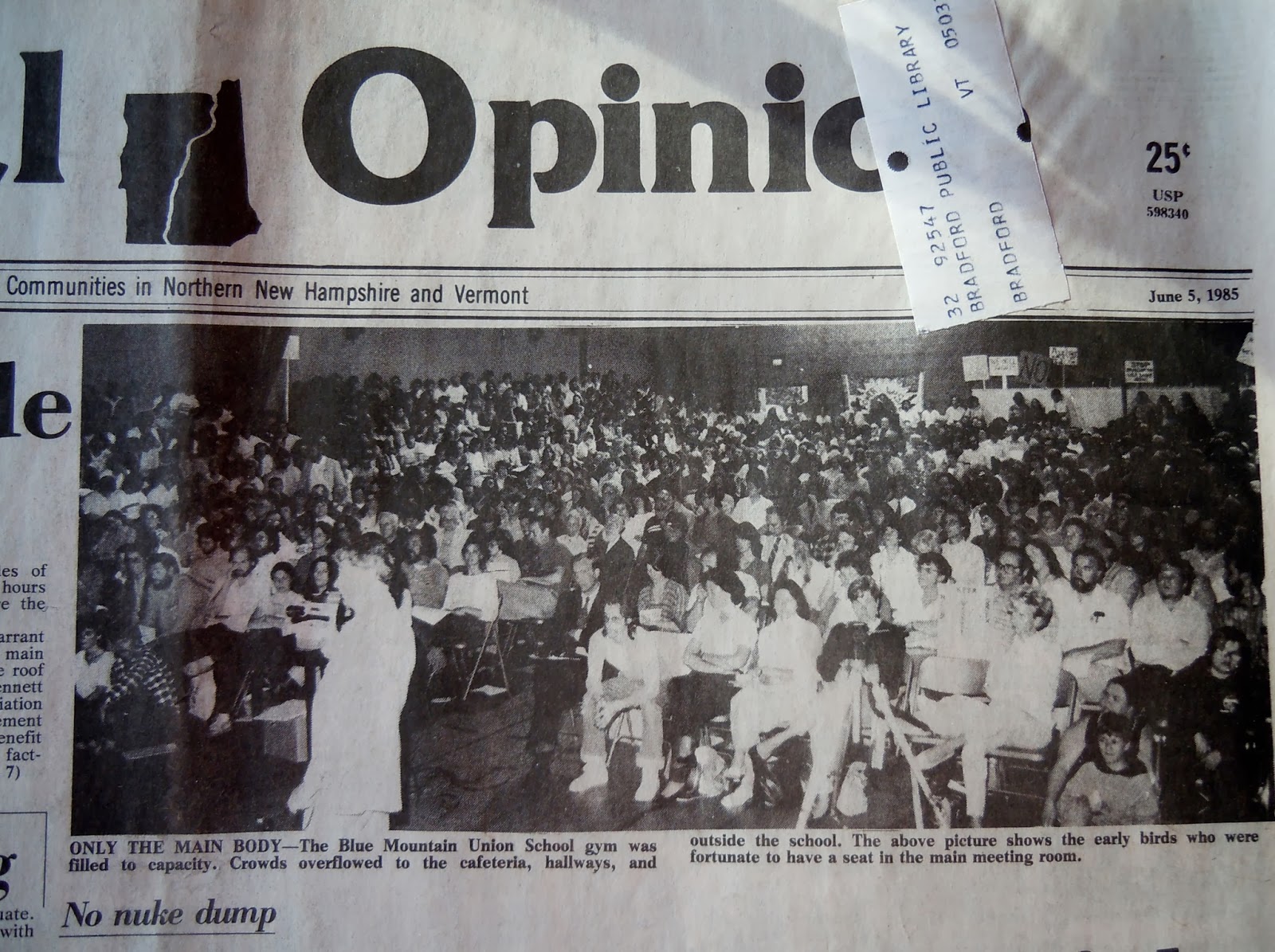
      Realizing that their environment made the area a “rural paradise,” residents were quick to protest the “radioactive horror” suggested by the federal authorities suggestion that Groton’s Knox Mountain might be designated as a nuclear dump site. “We will resist” was the response. The proposal went away.

    Protests against the building of a 121-mile high voltage line from Quebec to Massachusetts that would run through area towns were less successful.  The line was built.

      Jenny Nelson of Ryegate initiated a successful nation-wide boycott against the candy maker Hershey for its efforts to keep milk prices low.  Hershey’s actions were not the only threat to area farmers. Lower milk prices brought on by over production caused local farmers to dump milk in a staged protest in 1986. That same year the Federal government implemented a whole herd buy-out program that some farmers accepted.

       Farmers were driven to even consider collective bargaining, a course that ran contrary to traditional independence. Exceptionally dry weather in 1989 only added to farmers’ plight and farm auctions were common.

     State and Federal regulations also had an impact on town governments. Vermont’s passage of Act 200 with its regional planning heightened the fear that local control was being lost. Many opposition meetings were held. Some suggested that northern Vermont should secede and join New Hampshire where “local integrity” was honored. Opposition to town zoning was still strong and efforts to implement or alter existing plans received mixed responses.

      Other Vermont state actions that prompted local debate were a mandatory seatbelt law, smoking regulations, a state Equal Right Amendment and new state regulations on the appraisal of private property. That caused a small-scale revolt as town reappraisals were undertaken. At one point landowners around Lake Groton threatened to secede from Groton.

     Another issue was the raising of the legal drinking age from 18 to 21, done at the insistence of the federal government. In Vermont it was adopted in 1986, but with a grandfather clause that staggered its implementation. The use of alcohol continued to be a problem, especially when coupled with driving, and changing the age made little difference. Local high schools had active SADD groups and Project Graduations and worked to reduce students’ use of alcohol.

   The region was “a garden spot for marijuana cultivation.”  Local and state police in both states made major seizures of large-scale pot operations in almost every local town and burned the seized harvest.    Other drugs filtered into the area and led to several deaths and a rash of burglaries in homes and businesses.

      At one point there were a series of break-ins that occurred when residents in my neighborhood were asleep. Fearful, several of them bought barking dogs. Those thieves were soon caught but the neighborhood was filled with barking dogs for the next decade. In 1989, Haverhill police reported that the crime statistics for Haverhill were “scary.” Neighborhood watch programs were explored and implemented in several communities.

     Residents banding together to deal with a problem was not limited to dealing with crime. Towns had a heritage of community and individual generosity. Carole and Walter Young of Haverhill donated a new firehouse in Haverhill Corner and a scholarship program for local students.

      Residents supported replacing budget cuts to student activities in Woodsville, the creation of Lebanon’s David’s House, the building of Memorial Park in Bradford and the purchase of Nautilus equipment for Oxbow. At least three seriously ill youngsters were the center of efforts to raise funds and donate blood.

     When Bradford’s young Elizabeth Claflin died, a children’s park was suggested as a fitting memorial. In a two-year effort, involving hundreds of volunteers and capped by a five-day intense building project, Elizabeth’s Park was created. At first Bradford voters refused to make it a municipal facility to facilitate grant applications. A $50,000 private donation made the playground a reality. 

      The area drew the attention of the national media. Groton State Forest was so “natural and wholesome” a Grape-Nuts commercial was filmed there. Corinth was the location for a Quaker Oats commercial and the filming of Beetlejuice, a box office smash. Locals filled in as extras in this film as well as the horror film Return To Salem’s Lot that used Newbury’s common for its filming.

       CBS’s 60 Minutes filmed Bernie Sanders on a tour of the area. In 1987 Orford was hit by “Magnum mania” as rumors spread that Tom Selleck was purchasing property locally. He did not, but television personality Jameson Parker did.

     So did numerous “newcomers.” Frank Bryan spoke the fear of many that the area was becoming “too gentrified.” These “strangers” brought new ideas and needs and challenged traditional leaders and ways of doing things. The conflict of philosophies rubbed some “natives” raw and led to an unusual amount of friction.   

    In Corinth this sparring often took place at Selectboard meetings where even the contents of meeting minutes led to personal clashes. In Thetford the strong differences of opinion over the creation of a veterans memorial was just one example of community rankling.  As a result of changing voting patterns, candidates from the Democratic Party were more commonly elected.

     The Journal Opinion reported on all of the events mentioned above. It also featured lengthy “Town Topics” describing neighborhood activities and community social events. Bruce Bishop’s “Racing Currents”, Gary Moore’s “Thoughts on the Out of Doors” and Vid Roe’s “Between the Stripes” sports column were weekly regulars. The newspaper also ran a high school equivalency series, hosted homemaking expositions and, in response to higher food prices, created a budget recipe contest.    

    The more than 4500 pages of the newspaper printed in this five-year period described numerous other events and happenings not mentioned above. These included two plane crashes, several murders, numerous automobile mishaps, fires and floods.  Local issues included stray dogs, sewage pollution, the increased number of mobile homes, plantings on Newbury’s common, early discussion of the merger of Bradford town and village and the expansion of Woodsville Fire District.

     It chronicled the closing of the East Topsham Post Office, the razing of Bradford’s stately Low Mansion, the expansion of several area churches and the introduction of satellite and cable television, automobile leasing and round hay bales. It reported on the building of a new wing at Cottage Hospital and the Newbury Elderly Housing project, the refurbishing of several neighborhoods using federal grants, the establishment of Upper Valley Services serving handicapped adults and the need for a new regional ambulance service. Orange Arts programs, regional fairs and festivals and the productions of the new Old Church Theatre were described in detail. 

     Stories and advertisements informed readers about the awards won by super Electrolux salesman Joe DePalo, fair contestants and lottery winners. One ad was a memorial to Jiggs, a beloved Lab from Woodsville. There were articles about a rare document found at the Bradford Public Library and a strange tunnel found on the lawn of a Newbury village home. Initial mentions of AIDS brought letters of concern for individual safety.  A two-part article about Solomon “Lucky” Kubheka, a visiting student from South Africa, made area residents more aware of apartheid. “Wacky” weather was frequently described. The paper devoted space to those who wrote letters about the issues the writers felt were important.


     If today is the tomorrow the newspaper referred to in its 1980s promotion, than it is also true that “Today is the tomorrow you worried about yesterday.” Younger or newer residents who read the history of this period should realize that many of the problems facing the area today are not new.

     Writer John T. Tindsley’s complete thought is “Today is the tomorrow you worried about yesterday, and all is well.” While it would be dreaming to say that “all is well” in our neighborhoods today, it is safe to conclude that many of the problems that did materialize in the past have been solved by thoughtful actions by local residents. Because of these efforts, much is better.
 

School overcrowding faced every town in the region. Bradford, West Fairlee and Union 36 remodeled their elementary schools and Orford built a new one.
 
 
The federal proposal to consider Groton's Knox Mountain as a possible site
 for a nuclear dump brought a strong reaction from residents.


 In 1985 the gutted ruins of the once beautiful Low Mansion overlooking the
village of Bradford were removed. 
 
Arguments were not limited to just fishing.
 
 
 In the summer of 1986, a young cousin from California (l) join Melissa Munson,
 Nichole Marsh and Jennifer Munson to sell the blueberries they picked. The fruit of
their labors was a quick sell.  
 
Beetlejuice, filmed in East Corinth in June, 1987 was just one of several movies,
 television segments and commercials created using local residents and sites. 
 
 
 Executive Councilor Raymond Burton at just one of the hundreds of visits
to events he made during his long career. Here he presents a New Hampshire flag to the new Haverhill Corner Fire Station, donated by Walter and Carole Young of the community. Receiving the
flag is Fire Chief Michael Lavoie.


After two years of planning and a five-day building project, Elizabeth's Park in Bradford
 opened in the fall of 1988 as a memorial to Elizabeth Claflin. 


 In October, 1986 police officers burned pot plants seized in Corinth Corner.  This was just one of a number of large seizures in the area aka "a garden spot for marijuana cultivation."
 
 
On May 19, 1989 two planes collided over Bradford village.  Dozen of spectators
rushed to aid those trapped in a submerged plane in the Waits River.