Popular Posts

Statcounter

Wednesday, March 19, 2014

Sugarin' Time

 
Sugaring 1880s style 


 While it is not, this could be a Coffin boy collecting
sap for sugaring operation in Archertown in the 1950s.


Family patriarch Jerry Pease of Pease's Scenic Valley Farm in
East Orford boils sap on a wood-fired rig in the annual
tradition begun by his great grandfather and described in Toni
Pease's recent publication:  Maple Sugar and Me: 150 Years of the Pease
Family Maple Sugaring in New Hampshire. (Courtesy Wes Lavin)


While the 150-year tradition of sugaring at Pease's Scenic Valley Farm
will continue in 2014 with about one-half of the 1,200 taps still
hung with buckets, the recent snowstorms will delay scenes such as
the one shown in this 2012 "early spring" photograph. (Courtesy Wes Lavin)

Spring of 2014 is much different from 2012 with deep snow and cooler temperatures
delaying the beginning of the sugaring season.  Wes Lavin returned to the Pease's sugar house
to take this photo.

Using oxen, sap is gathered at the Chandler Pond Farm in South Wheelock, VT.  This 600-acre family farm is operated by my nephew Rob Martin and his wife Tamara using organic practices.


“In the maple groves of Warren, and on all the hill-sides around the quiet valley, sugar fires were smoking, for it was charming sugar weather; bland and sunny overhead, frosty under foot, the sap racing up from the roots every morning and running back at night for fear of a freeze.”

William Little, History of Warren, 1870


     It’s time for making maple. Area sugar makers are participating in a tradition that reaches back hundreds of years. Many local sugar makers in both Vermont and New Hampshire will host open houses during the weekend of March 22-23. Guests will be treated to a taste of maple and a sample of the hard work that it takes to make it.


     This column repeats stories about this tradition, familiar to many, new to some. The sources are Maple Sugar: From Sap to Syrup by Tim Herd, articles from earlier editions of this newspaper, local town histories, websites devoted to the maple industry and interviews with local producers. 


     I first read the Native American legend of the origin of maple syrup from the side of a 1950s gallon syrup can. It was one of the various legends passed down from native peoples of eastern North America. One says the Creator (called by different names by different tribes) gave the people the sweetness of the maple tree. Lest they get fat and lazy if the gift came too often and was too pure, the maple sap was only useful during a short time of the year and required considerable work to obtain. Another legend tells of its accidental discovery when a native woman cooked a piece of venison in the maple sap. 


     Whether gained by gift or accident, Native Americans were well aware of the sap of the maple tree gathered during the “Maple Moon.” They used it to sweeten food and fermented the sap into alcohol.  When European settlers arrived the natives introduced them to this sweet harvest of spring. 


     Early spring warm temperatures caused the sap of the maple to rise from the roots to nourish new growth. Freezing temperatures reverse this process. The rapidity with which winter transitions into spring determines the length of the sap run and varies from year to year. The sap gathered early generally produces a milder flavored product. The quality of the product is also determined by the methods used by the producers. 


     At first, trees were tapped using wooden spiles made from hollowed softwood twigs with sap collected in wooden troughs. Small pieces of the sumac bush were often used until metal spouts were invented.  Gathered using shoulder yokes, the sap was boiled down in large iron kettles hung from poles out of doors. Within several years of the settlement of area towns, residents were following these procedures for making maple sugar.  


     There is a tale of early sugar makers in Corinth described in Zadock Thompson’s 1824 Gazetteer of Vermont. In the early spring of 1777, three men from Newbury trekked 12 miles through the snow to the wilderness of unsettled Corinth, becoming the first white inhabitants of the town. Each carried a heavy kettle along with the necessary provisions to spend several weeks making maple sugar. The authors of the 1964 History of Corinth, Vermont refute this myth and suggest that if the sugar makers had made that trip they would have been met by a number of well-established settlers.   


     Maple sugar had its place in the economic and political issues of the day. In the 1790s there was a “Maple Sugar Bubble” as some national leaders hoped that it could become an alternative to the cane sugar produced by slave labor on British plantations in the Caribbean. It was reported that one Dutch company purchased 23,000 acres in Vermont and attempted to hire locals to make sugar. Leaders such as Thomas Jefferson attempted to create maple groves in Virginia. Both plans failed.


      Abolitionists continued to urge the use of maple sugar in place of cane sugar, which was “boiled down by the heat of misery.” The 1844 Vermont Almanac urged readers to “Stick to the maple; and so long as the maple forest stand, suffer not your cup to be sweetened by the blood of slaves!”


     Cane sugar was expensive and many families used maple sugar as a sweetener. In 1814 it was reported that a producer with 360 trees “could make a ton of sugar and sixty gallons of molasses” for a profit of $325 per season. By 1818 maple sugar sold for about half the price of imported cane sugar and did not become equal in price until 1880. Hardened and with a long shelf life, maple sugar became a cash crop, exported to markets in eastern cities. In the 1850s Vermont produced over six million pounds of maple sugar annually.


     Then a series of inventions transformed sugar making.  Metal sap spouts and evaporating pans were patented. The shallower flat-bottomed pans offered quicker evaporation and higher quality control.  In 1875 metal sap buckets with lids began to replace wooden buckets.


      In 1884 G. H. Grimm of Ohio patented the sugar evaporator. The company became a major supplier of sugar making equipment and in 1890 relocated to Rutland. In 1888 the Leader Evaporator Co. of Enosburg Falls was established and became the dominant U.S. supplier of maple making equipment. 


     Most maple producers were farmers who used the downtime between seasons to tap. Often on snowshoes they collected the sap using a drawing tub mounted on a sled pulled by oxen or horses. The sap was then hauled to the sugarhouse and boiled down on a wood-burning arch, using fuel harvested from the place. Having a number of strong sons or handymen was especially helpful.  As one Lyme elder stated “the sap run does not wait for man’s convenience.”


     Until the tin syrup can came into use in the 1860s, relatively little syrup was made as there was no way to store it for an extended time. Once syrup could be made as a commercial product, many farmers found it to be more profitable than sugar. Between 1890 and 1920 the amount of sugar produced in both Vermont and New Hampshire dropped significantly and the amount of syrup increased by over 300 percent.


     The United Opinion reported in April 1897 that the season had been more successful than any in recent memory and “nearly forty tons of sugar and syrup have been shipped from here.” Some of that sugar was shipped in boxes manufactured at Page’s Box Shop in East Corinth.


     One factor that endangered the sugar maples was the demand for open fields and the ready cash that lumber provided. While some farmers took measures to protect healthy maples, other cut them away in areas suitable for other crops. In 1885 one Vermonter observed, tongue in cheek, there was such a shortage of sugar maples that producers had to turn to raspberry bushes for syrup. In 1922 Hazel Abbott of Cabot expressed concern for the destruction of both trees and traditions in the published poem “The Maples Not For Sale.” Storms, such as the Hurricane of 1938, damaged some sugar groves beyond restoration. Reports of the possible impact of invasive species are among the current concerns of many sugar makers.  


     The 1913 Vermont Commissioner of Agriculture Report mentioned that Corinth producers led the county by tapping 43,505 trees resulting in 90,685 pounds of sugar. Fairlee was at the lower end of the county with only 2,880 trees tapped and 5,470 pounds of sugar made. 


      One of the most anticipated events of the sugaring season was the “sugaring off” party with its sugar on snow.  Sometimes referred to as “leather britches,” this treat would be served with raised donuts, pickles and warm beverages. If held at the sugar house, it might also include hard boiled eggs, cooked in the rolling sap of the evaporator. Some made maple sap beer from the final run.   


     Both Vermont and New Hampshire have state maple organizations. The Vermont Sugar Makers Association, formed in 1893, is one of the nation’s oldest agricultural organizations. The New Hampshire Maple Producers Association was organized in 1943.  Both are active in helping to establish and recognize high standards, and improved techniques in the industry. It is these organizations that are promoting the open house weekend mentioned above. UVM’s Proctor Maple Research Center at Underhill continues to explore new methods of sugaring and uses for the resulting products. 


      After a disappointing early spring season in 2012, New Hampshire produced 124,000 gallons in 2013. Vermont led the nation with 1,320,000 gallons.  Producers face competition from other states and Canada as well as so-called “maple-flavored” products and even fake maple syrup.  Changes in the grading system, instituted to give consumers more helpful information, have created some concern among more traditional producers.


     Changes in the climate have also encouraged many producers to begin sugaring before Town Meeting rather than after.  Records from 1938 to 1959 written on the wall of the Munn sugar house on Wild Hill in West Fairlee show that first runs were later with a record last run of April 28, 1939.

Since this article was published I had a chance to review five farm pocket notebooks rescued from the abandoned sugarhouse of the Harry Franklin family on Indian Pond Road in Orford.  I was told that the Franklin sugarbush was the sweetest one around. The records carefully chronicle the dates of first and last runs, the amount of syrup “taken up” each day, the amount of time Harry spend boiling on the large and small rigs and who came to help or just observe the process from 1957 to 1988.

 Ruby Franklin, my wife’s aunt, made what she called “boy and girl” raised donuts.  The “boy” donuts were shaped like crullers.  Sons Lewis and Walter were the most frequent helpers, but during at least one very snowy March, brother-in-law Bill Pierson shoved through snow so deep to make paths for the the horses. The records indicated that the amount of syrup produced varied during those years from a low of 96 gals to a high of 207.

Several people have shared sugaring stories with me since reading the article.  One of the best involves two boys who were gathering sap, but not fast enough for their father who was boiling.  They apparently got the bad end of their father’s temper over their lack of speed.  “I fix father.” one of the boys said and promptly took the gathering tub to a local brook and filled it with new “sap” and delivered it to the sugarhouse. He didn’t divulge that youthful prank until his father was 83 or so.       
    My great grandparents, Lyman Moore Tuttle Randall or Ida (Rice) Randall made and sold maple products at a roadside stand in the West River town of Newfane around 1930.  My grandfather Elroy Nelson Coffin began selling maple products from his farm in Guilford in the 1930s, a tradition carried on by three of his children for decades.  My Dad and two of his siblings each operated Vermont roadside gift shops selling maple products along with other Vermont souvenirs. My Aunt Florence Henry and Uncle Elroy Coffin were major syrup producers and marketers in the Brattleboro area.  


     As a child I helped my family sugar in the Archertown section of Orford.  We tromped through deep snow, knocked the ice from overflowing sap buckets and hauled the sap to the sugarhouse at our nearby farm.  I learned how to read a hydrometer and know when it was time to draw off the finished syrup into a heavy felt filter. My wife Carolyn also helped in her family’s sugaring on the Martin farm in Fairlee.  She says that even now just going into the steamy interior of an operating sugar house brings back good memories.


     Since those times sugaring has undergone major transformations. Most producers now use plastic sap-gathering pipelines left in the woods year-round, vacuum collection system, reverse osmosis for concentrating sugar content before boiling, sap pre-heaters and oil-fueled evaporators.  


     There are many sugar makers in our area, some of whom continue traditions established by family members over the decades. One of the most impressive operations is the Limlaw Family Maple Farm with its state-of-the-art operation. Located in West Topsham it is operated by Bruce and Ruth Limlaw.  They reportedly made 4,300 gallons of syrup in 2013 and have 13,000 taps ready for 2014.


     Paul and Betty Messer of Orford’s Sunday Mountain Maple Farm have been involved since Paul operated the FFA sugar house at Orford High School in 1956. Betty helped to keep the fires stoked.

They operated the Sunday Mountain operation from the yard of their home, starting first with a more traditional operation. They have introduced many of the new techniques mentioned above, had 3,200 taps and produced 776 gallons of syrup in 2013. Twice they have received the New Hampshire Producers’ Carlisle Trophy for the state’s best syrup, an award given for outstanding taste, color and clarity.


     The Messers also manager the Dr. Blaisdell Maple Museum at the North Haverhill Fair. They tell me that they have decided to retire from sugaring and are in the process of selling their remaining supply of syrup. When asked what advice they would give to a young person interested in sugaring, they said “go slow and steady.”  The day I called, Paul was helping set up the operation at Thomson’s Mt. Cube Farm and, I suspect, from what Betty said, that retirement may be only partial.  


     A more traditional operation can be found at Pease’s Scenic Valley Farm in East Orford.  Family patriarch Jerry Pease recently told me that there are currently four generations of the family continuing a tradition started by his great-grandfather and continued by his grandfather and father. His wife Toni has recently published a book entitled Maple Sugar and Me: 150 Years of the Pease Family Maple Sugaring in New Hampshire. Jerry said they have about 1,200 taps, with half still hung with buckets and produced 175 gallons of syrup and a small amount of sugar. They boil on a wood-fired arch in a sugarhouse hung with antique tools. He admitted that, at 82, he has had to give up the heavy work, but does, with some pride, hold “a heavy-looking on, advice-giving, story-telling role.”        


     I am proud to say that no artificial “maple” syrup has ever adorned my table. Like many, I prefer the stronger flavor of what use to be called “Grade B.” When my daughters were young, we had a small backyard operation for a couple of years using an old wood-burning end stove. The limited product was not high grade, but could not have been sweeter. So, I am sure, are the memories of anyone who had the luck to participate in this “sweet good-bye” to winter.


Thursday, January 30, 2014

Decades of Change: 1985-1989


Journal Opinion, January 29, 2014

     “Today’s news is tomorrow’s history.”
 
This statement was part of a Journal-Opinion promotion during the last half of the 1980s. The staff probably did not anticipate that someone would re-read the major articles years later and write a series on the history contained in their regional coverage. But I have, and this is the sixth chapter in a series that began with the events of 1960 and continues in five-year increments. The first five chapters can be found at “Decades of Change” at larrycoffin.blogspot.com.  As the coverage get closer to the 21st century, more and more of the readers will recall the events and people described. I encourage them to share those memories with those who do not.

     Vermont and New Hampshire experienced double-digit population growth every decade from 1960 to 1990. Grafton and Orange counties shared in the growth that impacted local communities in various ways and to varied degrees. The area continued to be largely rural, a characteristic that was treasured by residents, old and new. 

     One of the most significant impacts of the growth was an increased student population. During the period from 1985 to 1989, many communities in the region struggled with the pressure for additional space to accommodate the new students.  Bradford, West Fairlee and Union 36 remodeled their elementary schools and Haverhill bought a modular classroom. Orford built a new elementary school. Fairlee, Warren, Thetford and Lyme had proposals rejected, but later reconsidered.

     Teaching techniques, state and federal standards, teacher contractual issues and staff changes featured significantly in the news. Teachers at Oxbow and Haverhill Co-operative flirted with strikes in response to stalled negotiations. The membership and administration of supervisory unions were constant issues.  School districts without high schools wondered where to send their older students, but no major changes were implemented. 

     It was not uncommon for there to be double-digit increases in school and town budgets. Many cried “our taxes are too high.” Those increases were sometimes accepted and just as often reduced. The use of the Australian ballot for budgets was implemented by Oxbow voters.

      Student activities were given considerable newspaper space. In 1988, the Woodsville girls’ varsity cross-country team became the first girls’ team to win a state championship in the school’s history. Thetford Academy’s baseball team won their first state championship. The BMU boys won basketball state championships in 1985 and 1986.  The female athletes at Oxbow were consistently outstanding.  Their field hockey teams won championships three years in a row and the girls’ basketball teams coached by Mona Garone won 74 consecutive games and three state championships. 

     Milestones were achieved by individuals. In basketball, Orford’s Adam Dyke, Woodsville’s Jamie Walker and Oxbow’s Betsy Burnham all reached 1,000 points whereas Orford’s Cynthia Thomson achieved 1,500 and Oxbow’s Jade Huntington excelled at 2,000.  BMU’s Ron Brown coached his 300th basketball victory.
     Student athletes were not the only ones who excelled. Jasper and Jean Putnam of Piermont and Orman and Isabelle Thayer of North Haverhill won NH Dairyman of the Year in 1985 and 1986 respectfully. In 1988 Dr. Harry Rowe of Wells River was Vermont’s Family Doctor of the Year and Joel Moore of Bradford was Vermont’s Outstanding Vocational Educator.

     Communities honored those who observed significant birthdays, wedding anniversaries and other milestones. With sadness they observed the passing of many including four important area businessmen and civic leaders: T. Borden Walker and Charles Butson of Woodsville and John Gibbs and Morris Perry of Bradford.

     In the business community there were comings and goings. While Gove and Morrill Hardware of Bradford, Colby’s Department Store of Fairlee and Brundy’s Manufacturing of North Haverhill closed, there were a number of new or significantly remodeled facilities. 

      Those included Groton’s Marrow Research, Fairlee’s Cumberland Farms and Conval Home Building Center; Bradford’s Brookside Nursing Home, Wells River Savings Bank Branch, Valley Floors, Gove and Bancroft Pharmacy, the Mills Restaurant, Oakes Bros., and Stephens Precision; Woodsville’s Railyard Health Club and Ames department store; and  the Dodge’s Falls dam and Decker’s wood-burning energy plant in Ryegate.

     That plant, the subject of considerable discussion in Ryegate, was just one of the environmental issues facing area residents during the late 1980s. In 1987, Vermont’s new “trash tax” caused considerable argument. With increased dumping costs and landfill regulations, towns on both sides of the Connecticut had to find new arrangements to answer the question “Where will the garbage go?”  

     Composting and recycling became more popular. Some chose rural roadsides for illegal dumping. The most egregious example of illegal dumping was the discovery in 1989 that debris was being trucked in from out of state to a secret dump at Stonecliff Farm in Bradford.   

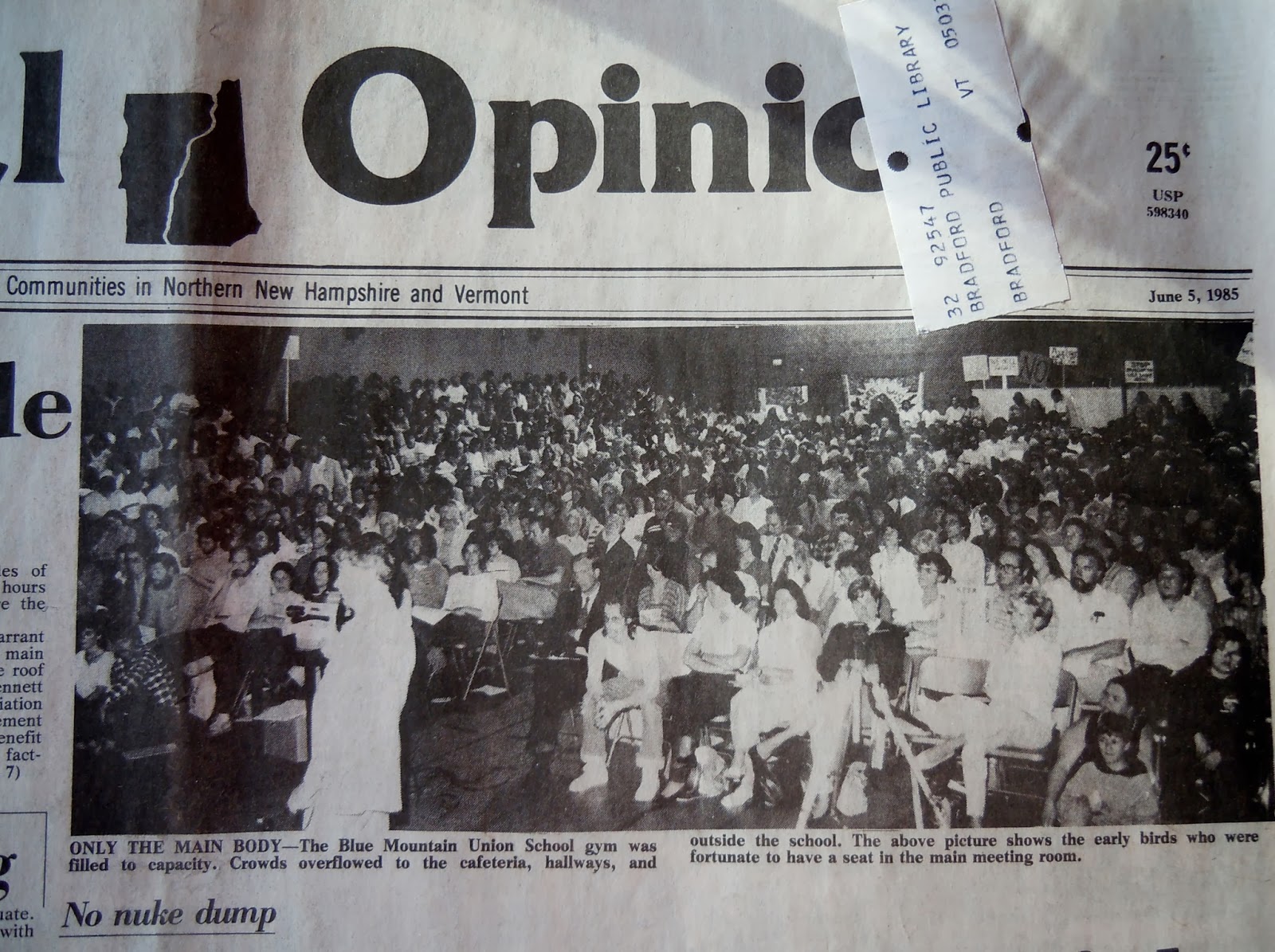
      Realizing that their environment made the area a “rural paradise,” residents were quick to protest the “radioactive horror” suggested by the federal authorities suggestion that Groton’s Knox Mountain might be designated as a nuclear dump site. “We will resist” was the response. The proposal went away.

    Protests against the building of a 121-mile high voltage line from Quebec to Massachusetts that would run through area towns were less successful.  The line was built.

      Jenny Nelson of Ryegate initiated a successful nation-wide boycott against the candy maker Hershey for its efforts to keep milk prices low.  Hershey’s actions were not the only threat to area farmers. Lower milk prices brought on by over production caused local farmers to dump milk in a staged protest in 1986. That same year the Federal government implemented a whole herd buy-out program that some farmers accepted.

       Farmers were driven to even consider collective bargaining, a course that ran contrary to traditional independence. Exceptionally dry weather in 1989 only added to farmers’ plight and farm auctions were common.

     State and Federal regulations also had an impact on town governments. Vermont’s passage of Act 200 with its regional planning heightened the fear that local control was being lost. Many opposition meetings were held. Some suggested that northern Vermont should secede and join New Hampshire where “local integrity” was honored. Opposition to town zoning was still strong and efforts to implement or alter existing plans received mixed responses.

      Other Vermont state actions that prompted local debate were a mandatory seatbelt law, smoking regulations, a state Equal Right Amendment and new state regulations on the appraisal of private property. That caused a small-scale revolt as town reappraisals were undertaken. At one point landowners around Lake Groton threatened to secede from Groton.

     Another issue was the raising of the legal drinking age from 18 to 21, done at the insistence of the federal government. In Vermont it was adopted in 1986, but with a grandfather clause that staggered its implementation. The use of alcohol continued to be a problem, especially when coupled with driving, and changing the age made little difference. Local high schools had active SADD groups and Project Graduations and worked to reduce students’ use of alcohol.

   The region was “a garden spot for marijuana cultivation.”  Local and state police in both states made major seizures of large-scale pot operations in almost every local town and burned the seized harvest.    Other drugs filtered into the area and led to several deaths and a rash of burglaries in homes and businesses.

      At one point there were a series of break-ins that occurred when residents in my neighborhood were asleep. Fearful, several of them bought barking dogs. Those thieves were soon caught but the neighborhood was filled with barking dogs for the next decade. In 1989, Haverhill police reported that the crime statistics for Haverhill were “scary.” Neighborhood watch programs were explored and implemented in several communities.

     Residents banding together to deal with a problem was not limited to dealing with crime. Towns had a heritage of community and individual generosity. Carole and Walter Young of Haverhill donated a new firehouse in Haverhill Corner and a scholarship program for local students.

      Residents supported replacing budget cuts to student activities in Woodsville, the creation of Lebanon’s David’s House, the building of Memorial Park in Bradford and the purchase of Nautilus equipment for Oxbow. At least three seriously ill youngsters were the center of efforts to raise funds and donate blood.

     When Bradford’s young Elizabeth Claflin died, a children’s park was suggested as a fitting memorial. In a two-year effort, involving hundreds of volunteers and capped by a five-day intense building project, Elizabeth’s Park was created. At first Bradford voters refused to make it a municipal facility to facilitate grant applications. A $50,000 private donation made the playground a reality. 

      The area drew the attention of the national media. Groton State Forest was so “natural and wholesome” a Grape-Nuts commercial was filmed there. Corinth was the location for a Quaker Oats commercial and the filming of Beetlejuice, a box office smash. Locals filled in as extras in this film as well as the horror film Return To Salem’s Lot that used Newbury’s common for its filming.

       CBS’s 60 Minutes filmed Bernie Sanders on a tour of the area. In 1987 Orford was hit by “Magnum mania” as rumors spread that Tom Selleck was purchasing property locally. He did not, but television personality Jameson Parker did.

     So did numerous “newcomers.” Frank Bryan spoke the fear of many that the area was becoming “too gentrified.” These “strangers” brought new ideas and needs and challenged traditional leaders and ways of doing things. The conflict of philosophies rubbed some “natives” raw and led to an unusual amount of friction.   

    In Corinth this sparring often took place at Selectboard meetings where even the contents of meeting minutes led to personal clashes. In Thetford the strong differences of opinion over the creation of a veterans memorial was just one example of community rankling.  As a result of changing voting patterns, candidates from the Democratic Party were more commonly elected.

     The Journal Opinion reported on all of the events mentioned above. It also featured lengthy “Town Topics” describing neighborhood activities and community social events. Bruce Bishop’s “Racing Currents”, Gary Moore’s “Thoughts on the Out of Doors” and Vid Roe’s “Between the Stripes” sports column were weekly regulars. The newspaper also ran a high school equivalency series, hosted homemaking expositions and, in response to higher food prices, created a budget recipe contest.    

    The more than 4500 pages of the newspaper printed in this five-year period described numerous other events and happenings not mentioned above. These included two plane crashes, several murders, numerous automobile mishaps, fires and floods.  Local issues included stray dogs, sewage pollution, the increased number of mobile homes, plantings on Newbury’s common, early discussion of the merger of Bradford town and village and the expansion of Woodsville Fire District.

     It chronicled the closing of the East Topsham Post Office, the razing of Bradford’s stately Low Mansion, the expansion of several area churches and the introduction of satellite and cable television, automobile leasing and round hay bales. It reported on the building of a new wing at Cottage Hospital and the Newbury Elderly Housing project, the refurbishing of several neighborhoods using federal grants, the establishment of Upper Valley Services serving handicapped adults and the need for a new regional ambulance service. Orange Arts programs, regional fairs and festivals and the productions of the new Old Church Theatre were described in detail. 

     Stories and advertisements informed readers about the awards won by super Electrolux salesman Joe DePalo, fair contestants and lottery winners. One ad was a memorial to Jiggs, a beloved Lab from Woodsville. There were articles about a rare document found at the Bradford Public Library and a strange tunnel found on the lawn of a Newbury village home. Initial mentions of AIDS brought letters of concern for individual safety.  A two-part article about Solomon “Lucky” Kubheka, a visiting student from South Africa, made area residents more aware of apartheid. “Wacky” weather was frequently described. The paper devoted space to those who wrote letters about the issues the writers felt were important.


     If today is the tomorrow the newspaper referred to in its 1980s promotion, than it is also true that “Today is the tomorrow you worried about yesterday.” Younger or newer residents who read the history of this period should realize that many of the problems facing the area today are not new.

     Writer John T. Tindsley’s complete thought is “Today is the tomorrow you worried about yesterday, and all is well.” While it would be dreaming to say that “all is well” in our neighborhoods today, it is safe to conclude that many of the problems that did materialize in the past have been solved by thoughtful actions by local residents. Because of these efforts, much is better.
 

School overcrowding faced every town in the region. Bradford, West Fairlee and Union 36 remodeled their elementary schools and Orford built a new one.
 
 
The federal proposal to consider Groton's Knox Mountain as a possible site
 for a nuclear dump brought a strong reaction from residents.


 In 1985 the gutted ruins of the once beautiful Low Mansion overlooking the
village of Bradford were removed. 
 
Arguments were not limited to just fishing.
 
 
 In the summer of 1986, a young cousin from California (l) join Melissa Munson,
 Nichole Marsh and Jennifer Munson to sell the blueberries they picked. The fruit of
their labors was a quick sell.  
 
Beetlejuice, filmed in East Corinth in June, 1987 was just one of several movies,
 television segments and commercials created using local residents and sites. 
 
 
 Executive Councilor Raymond Burton at just one of the hundreds of visits
to events he made during his long career. Here he presents a New Hampshire flag to the new Haverhill Corner Fire Station, donated by Walter and Carole Young of the community. Receiving the
flag is Fire Chief Michael Lavoie.


After two years of planning and a five-day building project, Elizabeth's Park in Bradford
 opened in the fall of 1988 as a memorial to Elizabeth Claflin. 


 In October, 1986 police officers burned pot plants seized in Corinth Corner.  This was just one of a number of large seizures in the area aka "a garden spot for marijuana cultivation."
 
 
On May 19, 1989 two planes collided over Bradford village.  Dozen of spectators
rushed to aid those trapped in a submerged plane in the Waits River.   

Monday, December 23, 2013

Smell of the Sawdust

NOW A SUPERMARKET.  This planing mill, part of the Newman Lumber Company operation was
destroyed by fire in 1978.  The site has been used for lumber processing since 1872.  It is now the site of Shaws Supermarket.  (Courtesy Walter Young) 


CREWS AT STEAM-POWERED MILL.  Woods and mill crews join together for a break from their work in front of a Vermont steam-powered sawmill around 1900.  Steam engines freed sawmills from their dependency on water-side
locations.  (Courtesy Bill Gove) 
CIRCULAR SAW AT WORK.  By the late 19th century, circular saws were being used on both small and large logs, significantly increasing the production of sawmills.  Gang and band saws along with other innovations increased production even further. (Courtesy UVM Landscape Change Program) 


AIR-DRIED HURRICANE HARVEST.  Prior to the production of kiln-dried lumber, sawmills air-dried lumber
stacked in their yards. This 1941 photo of a Vermont mill may also show lumber that was sawed from the
blow-down from the Great New England Hurricane of 1938.  (Jack Delano, Farm Security Administration) 

BRADFORD CENTER STORE & MILL.  Built on the banks of the Waits River, this sawmill was in place
as early as 1857 and changed ownership a number of times. (Courtesy Bradford Historical Society) 


500,00 BOARD FEET WEEKLY.  In the 1980s Newman Lumber Company of Woodsville was one of the largest producers of pine lumber in the nation. It carried on a tradition of sawmills in the Woodsville area stretching back to the settlement of Haverhill (Courtesy Walter Young) 


Journal Opinion, December 24, 2013

“I’ll stand by the gate and keep watching for those
Who come with the smell of the pine on their clo’es.
For even in heaven I’ll want it, I will,
The smell of the sawdust that comes from the mill.

Tall Trees, Tough Men
Robert E. Pike

Recently my Woodsville bowling buddies Roland Moore and Wayne Dickey suggested I devote an article to the history of sawmills. When they were younger, both worked in local sawmills. Pike’s book along with local histories and interviews provided more than sufficient material to meet their request.

When settlers arrived from southern New England they found dense and diversified forests. They built their first structures from logs they harvested. But to them frame houses were symbols of civilized permanency. As soon as towns were chartered sawmills were established “to supply the inhabitants with boards, thus making them as comfortable as possible.” The cost of framed structures, including the high price of nails, left others with log cabins and barns for decades.

In 1764 the proprietors of Newbury, meeting down country, “voted to give eighty acres to the man or men who should build a sawmill on Hall’s brook.” In Piermont money, land and water privileges were promised as rewards. Orford’s Israel Morey, who built that town’s first sawmill on Jacob’s Brook in 1766, was offered 100 pounds if he would build a saw and grist mill on the outlet of Fairlee Pond, something he completed in 1781. Nathaniel Niles met the challenge to build a mill on Middle Brook, but he may not have been paid the bounty raised for that purpose.

Local histories honor those individuals who were among the first to establish sawmills, thus helping to make their communities self-sufficient. In 1762 John Hazen built the first sawmill in the area along a brook in what is now North Haverhill. By 1765 he used sawed lumber to build a house on Little Oxbow Meadow. Benjamin Baldwin built the first sawmill in Bradford in 1774. It was located at the falls on the Waits River and was “greatly to the benefit of the early settlers.”

Sawmill pioneers in other towns included Corinth’s John Taplin, Thetford’s Eldad Post and Lyme Center’s James Cook. The first sawmill in Ryegate was built, with some controversy, out of town at the falls in Boltonville. In Corinth Corner Joseph Fellows built a sawmill in 1791 and the first boards produced were used for a frame house for his bride.

Where there was no water to power the saws, the earliest mills used up-and-down pit saws. Two men, one in a pit and the other above, used a long thick saw to cut up to 200 board feet daily. The easier method, however, used a water-driven saw activated by a crank handle. All parts for these early sawmills could be produced locally except for the saw and the crank. In his early history of the Coos, Rev.Grant Powers writes of six men from Newbury who nearly lost their lives making a winter trip to Concord to secure a crank.

These early mills served the immediate needs of the communities that grew up around the waterpower sources. Giant trees, including those reserved for the British navy, fell to the ax, supplying lumber for homes, barns, and bridges. When there was a surplus, timber and logs were shipped south on the Connecticut River.

There was money to be made in operating a sawmill, especially when it was coupled with other milling processes, such as grain, cloverseed and bark. Other mills manufactured shingles, fencing and clapboards and later bobbins, furniture parts, caskets and eaves troughs. One Orford sawmill also sawed soapstone. Some early owners sold or leased their mills while others passed the ownership on to family members for generations.

In the early 19th century the circular saw was introduced. Initially it was only used on smaller logs. This increased the production of sawmills significantly. New style waterwheels and gang saws with numerous blades that allowed multiple simultaneous cuts also increased production.

Over the years additional improvements included the edging and band saws. The Orford history indicates that young Royal Beal of Orfordville applied the use of the band saw in 1838 when he took four old saws and banded them together for use in his father’s mill. Some time before 1851 Randsom Aldrich introduced the board-planing machine into Orange County at his South Newbury mill resulting in a more finished product.The introduction of the log turner in 1899 was another significant improvement.

At first mills operated only when water supply was sufficient. Farmers often stockpiled logs in the mill yard to be sawed when spring rains came. Some mills could operate following downpours during other times of the year. The use of steam engines after the 1820s freed mill operation from dependency on natural water flow. Despite this advance, there were still 762 water-powered sawmills in New Hampshire in 1874.

In the 20th century some sawmills began using diesel engines to power their operation. One unique power source was used by Leo Jenks when he set up his first Lyme mill in 1931 driven by Cadillac V-8 engine. These new power sources sometimes allowed mills to be more easily dismantled and moved to new locations.

The coming of the railroads in the 1840s increased the market reach for local timber. The construction of the Montpelier & Wells River Railroad in the 1870s with its demand for ties and lumber for bridges and ease of transport to market gave a boost to local sawmills. As highways improved logs and lumber were increasingly transported by trucks.

It is impossible to list the numerous sawmills that operated in the area over the past 250 years. Wood working was second only to agriculture in the local economy. By the 1820s Haverhill had five sawmills, Bradford had four and Piermont and Warren had three each. By 1840 it was estimated there were over 31,000 sawmills in America with 1,081 in Vermont. Many of these mills were very simple buildings, often open on three sides and operating only seasonally. By 1855 there were up to 12 mills in Newbury and their operation “nearly stripped the town of its timber.”

With improved methods sawmills increased their production. Trussell’s Mill in Orford, built in 1866, produced 1 million board feet of lumber and 100,000 shingles annually. In the 1880s there were about 50 sawmills in Orange County, with six in Newbury, three in Corinth and two each in Groton, Bradford and Topsham. More than 800 portable sawmills were estimated to be in New Hampshire at that time.

Working in sawmills was also hard and hazardous. From harvesting to the sawing, logging was among the most dangerous of occupations. Maneuvering logs in icy conditions was unpredictable. At Corinth’s Bear Ridge, “logs were drawn to the top of the steep ledges by oxen and chains unhitched so the timber could be shoved over the edge for faster delivery to the sawmill. This method of skidding ended when a pair of oxen was dragged to its death along with a log of giant size.”

Sharp moving equipment, flying pieces of wood and metal and the occasional boiler explosion resulted in injuries and even death for millworkers. Local histories include descriptions of men who suffered broken bones, lost limbs and eyes and worse.

Floods sometimes washed away a streamside mill and its dam. Fire was also a constant danger. One sawdust fire at Baldwin & Hazen mill in Groton smoldered for years. Harry McLam of Bradford says that fire ended his grandfather’s mill operation in East Corinth around 1948 and small fires in the sawdust and shavings piles were common at his father’s mill in Bradford. Sometimes these disasters permanently ended the operation of a mill.

Several mills in Woodsville survived multiple fires. The first sawmill near the location of the present Shaw’s Supermarket was built in 1872. It burned in 1879, was rebuilt and burned again in 1902. Dwight Stone rebuilt the mill in 1910 and rebuilt it again after a fire in 1915. In 1921, it was incorporated as Acer Lumber Company. A second fire occurred that year.

The depletion of nearby timber and the Great Depression caused the mill to close until 1942 when it was leased to Johnson Lumber Company. That company built a second mill near the junction of routes 10 and 302. In 1946 a fire destroyed the complex. Rebuilt, it was purchased by Newman Lumber Company in 1953.

Newman suffered fires in 1973, 1977, and 1978, the last of which destroyed the planing mill at the original mill site. The company’s entire operation was then transferred to the Rte.10/302 location. The plant suffered another fire in 1988, but continued to be one of the largest producers of pine boards in the country, producing up to 500,000 board feet per week.It was sold in 1997 to Davidson Industries. Tembec, a Canadian company, was the last operator of the mill having purchased it in November 2001.  It closed permanently in 2003, the victim of an unstable lumber market and increased  foreign competition. Wal-Mart and Fogg’s Hardware now occupies the site.

The depletion of harvestable timber and the Great Depression caused the closure of many sawmills. The need to salvage the blow-down from the Great New England Hurricane of 1938 revived the industry temporarily. Logs waiting processing were stored in local ponds. George Nichols’ mill in Lyme alone processed over 4 million board feet between 1938 and 1942. The amount of lumber produced caused “a glut on the market.”

The number of saw mills dropped in the 20th century. Production reach a peak in Vermont in 1907 with 373 million board feet of lumber produced. D. C. McLam’s sawmill in Bradford ceased operation in 1955 when, according to Harry McLam, “good construction logs petered out” and they were replaced by Canadian lumber. The last stationary sawmill in Lyme burned in 1959 and Bradford’s last one closed several years ago.

Markus Bradley of Redstart Forestry in Corinth says smaller mills have disappeared while larger, specialized, efficient and safer operations have survived with no drop in overall production. Newman Lumber in Wells River and Britton Lumber in Fairlee are examples of these surviving mills. He went on to say there is an “organic movement” with small low budget portable sawmills, allowing operators to “make a living.”

Currently there are 105 stationary mills in Vermont, seven in Orange County. New Hampshire has about 50 stationary mills. Both states have a number of portable operations. One New Hampshire forestry specialist indicates that the total output of these mills is as great as when there were twice as many.
NEW INFORMATION MARCH 29, 2015


Britton Lumber Co. sawmill destroyed last night.  It was a two-story 50 x 250 ft building employing 20 workers.  Robert Moses owner said “It’s too premature to make any decision or plans.”   Had produced 10 million bd fee of eastern white pine per year .  Considered medium size for New England with large mills producing as much as 30 million board feet annually, Moses said. Mill was built in 1972 and grew over the past four decades. 


What about the sawmill connection of my two Woodsville friends? Roland Moore worked for short periods in three local sawmills around 1951. He stacked lumber, worked slabs and washed logs at Hansen’s Mill in South Newbury, Wood Brothers in Newbury and Eastern Pine in North Haverhill. When asked why he didn’t continue, he says he “smartened up.”

Beginning in 1968, 23 year-old Wayne Dickey began his 14-year employment as a lumber grader at Newman Lumber in Woodsville. He says he enjoyed the work despite the heat in the summer and the often bitter cold in the winter. One winter it was 50 degrees below for a week and “we stayed all day trying to get things going.” “Not a job for everyone.” He went on to say “Walter Young was my boss, a great man to work for.” He also recalls fighting the New Year Eve fire that destroyed the mill in 1978.

My Dad and two older brothers logged our property in Archertown, Orford. I sometimes went along to burn brush or snake logs with our workhorse Dick. I never got to drive the bulldozer or use a chainsaw. We delivered logs to Jenks’ in Lyme, Johnson’s in Fairlee and Dyke’s in Orfordville. Using stickers we stacked lumber at our Bridge Street home and sold it air-dried.


When I asked Wayne and Roland what reminded them of their sawmill experiences they say the smell of the cut lumber. I would add to that, from my limited experience in sawmill yards, the high pitched screech of the saw and planer as they, like the hardworking men in those mills, did their work.


In Jan 2019, the Valley News reported that Vermont's small sawmills were under major pressure from Canadian imports as well as the retirement of older owners. Additionally, Asian log buyers are "paying significantly higher prices" than local owners can afford. In 1970, Vermont had about 130 permanent sawmills.  By 2017, that number had been reduced to less than 50. There are over 100 mills just across the borders in Quebec.


The article went on to say that small sawmills do not benefit from "the economies of  scale" that larger mills do.   


Wednesday, November 27, 2013

Decades of Change: 1980-84

BRADFORD-PIERMONT INSTITUTION: Remembrance "Mem" Martin was the local police chief in Piermont for 34 years which overlapped with 16 years in the same office for the Village of Bradford.  When he died inJune 1981 the Journal Opinion editorial described him as being in the Vermont tradition of "hard work, service to others, along with stubborn pride." 

Add caption
NEW LIFE FOR OLD MILL:In August 1883, "amidst much hoopla, lots of praise," the newly renovated 1847 Bradford Mill
opened as a business and cultural center. Over 1,500 attended to view the work masterminded by Ray and Tina Clark. 
Add caption
OLD BRICK STORE, FAIRLEE TO LYME: On October 10, 1982 Fairlee's Hearthside Candle and Gift Shop burned. The building was built in the federal sytle in 1846 and was the oldest commercial building on Main Street. Upstairs was the author's first home in 1942 as his parents Ray and Lillian Coffin operated a garage in the building. It was later rebuilt in Bayne Stevenson's 13 Dartmouth College Highway development in Lyme where it is now an apartment building.

Journal Opinion, November 27, 2013

“What I know from my studies and from my life is that there is no such thing as a true event. We know dates and times and locations and participants but accounts of what happened depend upon the perspective from which the event is viewed.”
Ordinary Grace
William Kent Krueger

As I reread the 1980-1984 editions of the Journal Opinion I was also reading the novel mentioned above. Krueger’s closing comment on the events depicted in his story was a reminder that the article you see before you is largely colored by the perspectives of both the newspaper and this writer. There were events and trends that one or both skipped that others would have highlighted.

The Journal Opinion during this period frequently reported on property lost to fire. Some were businesses including the Copeland Factory and Our Place Restaurant in Bradford, the Hearthside Candle and Gift Shop in Fairlee and several country stores. The Woodsville-Bath covered bridge and Union 36 Elementary School were targets of arson. Bradford’s Low mansion and Corliss Tavern, both historic structures, were destroyed.

There were numerous home and barn fires. Often livestock was lost. Remarkably there was no loss of life either among residents or firefighters. Those impacted knew the feelings of loss that are experienced by losing one’s possessions.

Local volunteer firefighters often fought fires in the face of water shortages, dangerous conditions, remote locations and extreme temperatures. They held regular training sessions and sought support from voters for new equipment. New firehouses were built in Ryegate Corner and West Topsham.

The area was impacted by the national recession of the early 1980s. In 1982 unemployment nationally was 10.8%, with Vermont and New Hampshire unemployment rates at 6.6% and 7.6% repectively. At the same time there were periods of record inflation with 18% increases. Higher food prices meant that it took $87 a week to feed a family of four. By 1984 the economy had recovered and the two states were reporting some of the lowest unemployment in the nation.

Higher energy costs added to residents’ concerns. The newspaper reported in 1980: “Virtually every gas station has priced their gas over one dollar a gallon.” Home heating oil prices and electrical rates went up and people were encouraged to turn their thermostats down. Car pooling was encouraged and the new Stagecoach service offered local public transportation.

Several hydroelectric projects were created to offer some replacement for electricity from fossil fuel plants. Central Vermont Public Service rebuilt the Bradford dam and new dams were built on the Passumpsic River in East Barnet and on Eastman Brook in Piermont. There were proposals to replace older dams at Boltonville and on Dodge Falls between Bath and Ryegate.

The impact of these changing economic conditions was mixed. In 1980 Real Homes discontinued its planned Lake Tarleton development. Subdivisions in Newbury, Woodsville and Fairlee were shelved for economic or environmental reasons. For a time Lyme placed on hold plans to expand Bayne Stevenson’s complex at 13 Dartmouth College Highway.

Huntington Construction had mixed success in developments in Bradford and Thetford. Mountain Lakes residents purchased their defunct ski area and Haverhill sold 30 lots in that development in a major tax sale. One development that came to a sudden halt was one planned for Bradford’s Hackett Hill when its developer was arrested for dealing drugs and using the money to purchase the property.

A number of new businesses opened but subsequently closed or moved. They included the Agway Plant, Bankware, Crossroad Pharmacy and Maska in Bradford and Haverhill’s Burndy Manufacturing. Valley Floors and Shur-Auto Parts also opened and remained. The renovated Opera Block in Woodsville offered new senior housing and the Grist Mill in Bradford became a business and cultural center.

There was concern over police protection as crime rates increased. Lyme hired its first full-time police chief, Orford’s police chief battled citizen concerns over performance and Bradford tried to figure out its police security. In April 1981 the Village’s long-time chief “Mem” Martin was fired. Makeshift attempts to fill the position resulted in security officers with little training and reliance on the Vermont State Police Eastside Cluster. There was a prolonged fear that a fully-manned Bradford police department would cause costs to escalate as they had in Haverhill.

Controversies kept some residents on edge for much of the period. Military maneuvers held locally in 1983 brought protests by antiwar activists. Warren had a “missile crisis” when it was suggested that its Redstone rocket be moved to Derry, NH. The use of animal traps caused concerns for animal rights activists. Legislative efforts to raise the drinking age, adopt the Equal Rights Amendment, raise taxes and reform the state’s blue laws all brought strong local reactions.

Two issues raised at local town meetings attracted national attention. In 1982 many towns in Vermont and New Hampshire voted for a nuclear weapon freeze. Piermont, Orford, Lyme, Fairlee, Ryegate and Bradford were among them. At the Bradford Town Meeting, the majority voted favorably when highly-respected resident Jim Perry advanced the motion with the comment “I’m not sure it will do any good, but it certainly couldn’t hurt.” The next year towns along I-91 discussed articles calling for a halt to “secret” shipments of nuclear waste from Canada through the local area. CBS News covered the discussion at the Thetford town meeting.

There were other environmental concerns. As in the previous decade, wastewater treatment and solid waste disposal continued to be issues for local communities. Local Vermont towns sought to find a permanent landfill option. A proposed landfill near West Bradford was denied, a landfill in Thetford was thought to be polluting local drinking water and in Newbury two landfills operated. Volunteers in Bradford opened a bottle redemption center and wind and solar power were being explored.

South Ryegate, Wells River and Woodsville all developed wastewater projects during this time. Fairlee, Piermont village and Haverhill Corner worried about water pollution. Open burning at dumps in Orford, Warren and Piermont continued to raise concerns. In 1983, the state ordered these dumps closed and then issued a reprieve.

Schools continued to be of high interest and controversy. Increased student population, higher school costs and teacher contracts issues were constant topics for discussion and debate. A proposal to enlarge Bradford Elementary School brought initial rejection. Thetford and Orford voters continued to debate about where to send their high school students. In the end, Thetford Academy retained its town’s designation and Orford High School remained open.

Posters depicting Soviet Communist leaders in one Oxbow classroom caused a short-lived tempest that was noted in an edition of Playboy magazine. Legal suits by Oxbow and Blue Mountain against the manufacturer of their faulty roofing material were finally settled with both schools getting large damage payments. Discipline policies and the use of drugs, alcohol and tobacco concerned school personnel, parents and students.

Countering these school controversies were articles about the great things happening in area schools. Many classrooms were alive with innovative programs and special projects. Computers, initially labeled as “a plaything,” began to find a place as teaching and administrative tools. Local schools produced challenging science fairs and theatrical productions. Athletic teams won division and state championships with regularity.

Adult organizations also took an active role in community affairs. Lions Clubs, Jaycees, PTOs, Grange, Masonic, church and veteran organizations joined merchant groups to improve life in their respective towns. Their fund-raising ideas were as normal as chicken pie suppers and as unique as bath-tub races.

Bradford’s Midnight Madness was mimicked in the Wells River-Woodsville 11th Hour Sale. Groton’s Foliage Festival, Fairlee’s Lobster Dinners and Bradford’s Wild Game Supper as well as the Connecticut Valley and Haverhill Fairs were held annually. Bear Ridge auto racing and slo-pitch softball games continued to attract the attention of loyal fans and participants.

In addition to the fires mentioned above, the local area suffered some of the most disastrous floods in a decade. In these and other situations, communities responded generously to the plight of their neighbors. In 1982 a local man needed a heart transplant and the area residents raised $49,000 so that he could have the successful operation. In 1984 a 10-year old Fairlee child needed blood platelets to combat her leukemia and dozens of local residents went to Boston to provide them. Her battle was ultimately unsuccessful. Annually Operation Santa Claus transformed the local generosity into Christmas gifts for needy children. Regular blood drives met ambitious goals as did other service efforts.

Each year death by accidents, crime and disease robbed local communities of residents. Auto accidents were common. AIDS made national headlines during the period and took the life of at least one local resident. Many residents died of old age.

At the risk of ignoring many who experienced a life well lived, I mention just three local elders who died during this period. They exemplify the idea that the spirit of a small town is often personified by its long-time residents. Their concerns often determine the town’s priorities and their efforts are the town’s achievement.

One was Lucy Bugbee of Bradford, known as the “fern and flower” lady. She was a dedicated environmentalist before most knew what that meant. The second was W. Putnam Blodgett also of Bradford, a dedicated public servant who, with his wife Charlotte, amassed a large collection of historic items. The Blodgetts’ collection forms a major part of the Billings Farm and Museum in Woodstock, VT.

The third was Charles Pike of Fairlee, that town’s last living WW I veteran. Charles and his wife Mamie lived on a farm opposite the Fairlee Diner. He was a hoarder, the caretaker of the neighboring tramp house, a storyteller and one who could claim that he had bested Carlton Gray in a cattle deal. As I child often went to the Pike home. I thought of them as being very old, but now realized they were younger then than I am now.

Town government and elections continued to make news. While most discussion reflected “good sense and civilized conduct” there was just enough rebellion, especially over budgets, to remind local officials of voters’ concerns. Town planning and zoning seemed to have lost some of the edge that had characterized their role during the 70s. History was made when Democrat Madeline Kunin was elected governor of Vermont in 1984.

Another topic that had less news coverage was farming. Those farms still in operation struggled with the creation of new marketing strategies and a surplus of milk. While Future Farmers of America and 4-H clubs continued to be popular, the number of young people going into farming declined. Some farms were doing very well and there were news reports of outstanding production and model farming. In 1983 Dustin White of Corinth was named Vermont Dairyman of the Year. He, along with his wife Jane, had turned a rundown hill farm into a model one.

There are a number of items that do not fit into any of the above categories. They include the introduction of Cable and satellite TV, Channel 31, ATMs, Cabbage Patch Kids, PAC-Man, Rubik Cubes and PCs. A Laotian refugee family came to Bradford and stayed for a while. So did the measles. Country Singer Doc Williams and Chubby Checker came to the area for an evening. Robin Williams and a cast of Hollywood personalities arrived during the winter of 1982 to produce a movie, but left when essential snow came “too little, too late.”

All of the topics mentioned above and many more were covered by this newspaper. In 1984 a letter to the editor reproached it for not covering school and community events. The Editor’s response: “Are you sure you are reading the Journal Opinion?” This article is a mere hint at the local news so adequately covered.

In 1980, as the decade was at its opening, the editor of the newspaper suggested with foresight that “the decade of the eighties reminds us that things are no longer the same as they used to be.” Now we can look back at the 80’s with even sharper hindsight to know that he was so right. As we look back at the hopes, dreams, accomplishments and disappointments of this period, we might ask the question posed by the Old Testament prophet: “How does it look to you now?”

Friday, November 1, 2013

Carved in Stone

Journal Opinion October 30, 2013 “Beneath those rugged elms, that yew-tree’s shade, Where heaves the turf in many a moldering heap. Each in his narrow cell for ever laid, The rude forefathers of the hamlet sleep.” Thomas Gray, 1751 Elegy Written in a Country Churchyard

Death was a constant companion among the first settlers of our region. Soon after settlement they created a community cemetery in which to bury family members. With Halloween this week, stories of vampires, zombies witches and ghosts are rampant and superstitions about graveyards plague many. It would be easy to link all of these in this month’s column. But I resist the temptation. Rather, this column examines the development of cemeteries in local communities and the monuments that mark the graves.

The information comes from local town histories, Burial Grounds of Vermont edited by Bradford’s Arthur and Frances Hyde and a recent presentation in Warren by cemetery historian Glenn Knoblock. I also used Stone & Bones: Using Tombstones as Textbooks, an 86-page curriculum that I help three other Vermont teachers create and distribute to classrooms around the state and beyond.

Soon after settlement, towns had to deal with the burial of the dead. The oldest marked burial in Bradford’s Upper Plain Cemetery was of young Andrew McFarland who drowned in the Waits River in 1770. A portion of the East Common granted to Orford in 1773 by Israel Morey was for a burying ground. The Old Burying Ground, now the Ladd Street Cemetery in Haverhill was set aside in 1774. Zelpha Abbot was Groton’s first death and in 1784 she was buried at her home place, the beginnings of the Groton-Peacham burial grounds. Every community in our area has at least five known cemeteries. Thetford and Topsham have 13 each, Newbury 12, Groton 10, Piermont 8 and Bradford has five. Each neighborhood selected a location nearby, often in an elevated and well-drained location. William Little in his 1870 history of Warren, reflected on the desirability of local burial: “In the country, every man, woman and child, goes down to the dust amid those who have known them from their youth, and all miss them from their place.”

Some graveyards, like the Union Village Cemetery, Corinth’s Meadow Meeting House Cemetery and the East Orange Cemetery are located adjacent to a churchyard. Orford’s Dame Hill cemetery was so located, except that the church was relocated downhill in Orfordville. Lyme’s oldest cemetery has always been near the town’s meetinghouse, even as the original building was rebuilt at an adjacent location on the Common. Topsham’s Currier Hill cemetery, the town’s oldest, was located in the area of the town that was first settled. Ryegate’s Old Scotch Cemetery was located east of the original Commons. As these neighborhoods did not grow as expected, the number of graves located there are few or have been moved to more established cemeteries.

The opposite was true in Wells River where, as the village grew, the Grove Street Cemetery, first used in 1801, was replaced in 1867 by a new cemetery on nearby Bible Hill. In 1890 the bodily remains in the old village cemetery were moved to that new location. As the years passed and the number of graves increased, many primary cemeteries were enlarged. As town population levels changed it was not uncommon for there to be more dead than alive in a community. It was said of some towns that “the only thing growing was the cemetery.” As early as 1875, Bradford historian Silas McKeen noted that there were 1666 graves in the Upper Plain Cemetery, one of four in the town with a population of 1500. In neighborhoods that became deserted during the period after the Civil War, abandoned burial grounds may be the only sign that the area was once an active settlement.

Most of the earliest cemeteries were town owned. Some cemeteries are maintained by private associations. In Newbury, the cemeteries at Jefferson Hill, Boltonville, Wells River and the Oxbow are cared for by local associations. Bradford'sSawyer Cemetery is operated by the Bradford Cemetery Association and the town. There was also a 19th century tradition of farm or family burial spots, many now abandoned. Through the mid-19th century, these small cemeteries kept deceased family members close to the home place. Examples include the Whiting family plot in Fairlee with its three fieldstone markers, Thetford’s Mills Family Cemetery with five graves surrounded by a wall of granite blocks and the Manchester family’s three graves enclosed by a stone wall in Ryegate. In recent years there have been several Vermont court cases arising from these small burial plots as land ownership changes.

Many of the earliest gravestones in the area were carved by local artisans. Two of the earliest sources have been identified by the symbols the carvers consistently used. In 1771, established Connecticut carver Gershom Bartlett moved to Norwich and over the next 28 years produced hundreds of gravestones still found in area cemeteries. From 1786 to 1835, three generations of the Risley family of Hanover produced local stones, some of which still mark local graves. The materials used by these early craftsmen include field stone, slate and soapstone. Orford had two quarries of soapstone, the largest of which was at Cottonstone Mountain, also known locally as Gravestone Mountain.

In the 19th century, power tools replaced hammer and chisels with stones being manufactured in larger stone sheds often manned by immigrant workers. Ryegate, and to a lesser extent Groton, quarried and manufactured granite monuments during the 19th and early 20th centuries. Vermont is one of the largest domestic sources of slate, granite and marble, the three most common stones used for grave markers. The first marble quarry in the United States opened in Dorset, VT in 1785, the beginning of a major Vermont industry. Barre’s granite industry began in the 1820s and grew into one of the nation’s largest providers of monuments. From 1874 to 1914 a company in Connecticut manufactured zinc metal monuments that could be ordered through catalogues. One such monument can be found in the Upper Plain Cemetery in Bradford.

While the earliest grave markers were on boulders of common fieldstone, these quickly gave way to the doorway-shaped headstone, thinly cut and simple in design, suggesting the passage from this life to the next. In the 19th century pedestals, obelisks and even pyramid-shaped monuments began to appear. In cemeteries throughout the area the graves of prominent individuals and families are marked with obelisks, their size overshadowing adjacent stones. The gravesite of Nathaniel Niles in the West Fairlee Center cemetery has a pyramid adjacent to his 1828 marker. After 1900 markers were sometimes fashioned in designs ranging from angels to trees. The Hope Cemetery in Barre and the Pinehurst Cemetery in South Ryegate have very ornate memorials, often fashioned by the families of the stone crafters who worked in the local industry. Some gravesites have footstones as well as headstones and a family marker. In addition to the more common family plot cornerstones, some earlier plots were set off with stone curbing or metal fences. What was carved on grave stones changed over time.

In early New England symbols reflected almost exclusively religious attitudes toward life and death. The death’s head symbol was common. A familiar epitaph was “Death is a debt to Nature due. Which I have paid and so must you.” With the Great Awakening in the mid-18th century attitudes changed from mortality to immortality and salvation. This was reflected in the use of birds, angels and soul images as symbols of the belief in the resurrection. By the early 19th century imagery became more ornate reflecting the attitudes of the Enlightenment. Weeping willows and urns were more commonly used and epitaphs reflected beliefs in eternal peace and reunions in heaven, written to soothe the bereaved. Some appeared to defy death altogether. Inscriptions reflected the individual’s biographical information, personal characteristics, accomplishments, relationship to others buried nearby and circumstances of their death. In the late 19th century the use of epitaphs declined but carved images continued. Modern techniques now allow a headstone to be inscribed with complex etchings and even color.

In the earliest graveyards, gravesites were often in haphazard rows. After 1800 cemeteries became more organized with orderly grave location, roads, plantings and the addition of vaults for the placement of bodies awaiting spring burial. The Sawyer Chapel in the Upper Plain Cemetery was built in 1912 as both a vault and a building in which funeral services could be held. In some cases cemeteries took on the look of parks.

Even before it was required by state law, most cemeteries were surrounded by fences, some with stonewalls and others with a board fence, often with granite posts. The small Munn-Rowell cemetery in South Corinth has a unique slatted steel fence with granite posts. The fence around Orford’s West Burying Ground was first constructed in 1811 and after some years fell into disrepair. Despite the comment of one earlier caretaker that there was no reason to repair it, as “the people in there can’t get out,” that fence is now fine. Some graves are unmarked. This may be because they were never marked or because the markers have disappeared. Weathering and acid rain have made many markings illegible.

Some gravesites are cenotaphs or “empty tombs.” During the Civil War, with embalming in its infancy, many of the battle dead were not returned home but markers were sometimes erected in memory of the departed. The grave of Mary Sumner Hoyt in the Upper Plain Cemetery is marked, but with a question. The only information on the stone other than her name is “She lived, what more can be said? She died and that’s all we know, she’s dead.” Those who died on town poor farms were buried at town expense often with the smallest of markers. One exception to this can be found in a Corinth cemetery where, according to an 1880 newspaper report, “a handsome marble slab has been placed by the Selectmen at the head of an aged woman who died this spring in the town poor house.” This apparently was in recognition of her “industrious and prudent” nature.

Since 1868 many indigents who died at the Grafton County Home in North Haverhill have been buried in a paupers’ cemetery adjacent to the Horse Meadow Cemetery. Each grave is marked by a simple stone with the name, age, date of death and the Grafton County town from which the deceased came. At one point, even this information was omitted in favor of a simple number corresponding to records kept by the County Clerk.

The graves of veterans receive special attention. Their graves are marked annually with flags often placed in holders representing membership in veterans’ organizations. When leading groups on tours of the Upper Plain Cemetery I draw their attention to the marker for Bradford’s Charles Smith who died of his battle wounds in 1864. The stone that marks his cenotaph bears an epitaph that reflects his attitude toward life and the cause for which he died. “God is with the right and sooner or later the right must prevail. God help me to be ever in the right.”

In closing, I salute the work of groups such as the Vermont Old Cemetery Association, including members such as Frances and the late Arthur Hyde, that work to prevent old cemeteries from being “weed grown, forlorn, forgotten, headstones bent, some fallen away.” This includes local towns that regularly appropriate funds to maintain their cemeteries. This is especially important as many deceased no longer have descendants locally. It has been said that a town’s character can be judged by how well they maintain their cemeteries. I consider graveyard vandalism to be a serious crime against a community. The role of one of my students in the vandalism of a cemetery in the early 1990s led to the development of the Stone & Bones curriculum.

I appreciate those in local schools who take their classes to local cemeteries as part of a study of history, art or other subjects. As a genealogist and historian I am drawn to cemeteries. I have visited the gravesites of family members in England and New England as far back as nine generations. As I do not subscribe to the horror stories connected to cemeteries, I find them interesting and peaceful. I appreciate that the memory of those, known and unknown, are carved in stone. I can tell much about the history of a town or neighborhood by visiting the local cemetery. In May 1966, The United Opinion reporter Marilyn Spooner wrote of her visit to the older section of Haverhill’s Ladd Street Cemetery. Her comment reflects a lasting attitude toward cemeteries. She wrote “There is stillness in the air throughout the cemetery. Not the uneasy sort that frightens, but rather, one of tranquility. It speaks of death, yet softly.”