OXBOW GROUNDBREAKING: Raymond Green, chairman of the Oxbow School Board, uses a ceremonial shovel to break ground for the new union high school in March 1970. Joining him are other members of the board. (front left to right) Charles Smith, Jeanette Cobb and Dorothy Cole. (rear) Frank Coombs and Charles Bailey.
OWN A PIECE OF VERMONT: In May, 1972 a family could still purchase a nice local home for under $20,000. A growing demand kept local real estate agents busy and prices on the increase.
I CAN TELL YOU THIS!! Eighty-six year old Orford resident Andy Bedell shares his opinion with New Hampshire Governor Meldrim Thomson at the Orford School District Meeting in March, 1973. The main issue was the future of Orford High School.
DUMP WITH A VIEW!! PHEW!! Bradford was just one of several local towns under pressure to close its dump in 1971. The six-acre dump was located off South Road and users who looked up were treated to a view of the White Mountains to the east. It closed in May 1972.
LOCAL NEIGHBORS DISCUSS NATIONAL ISSUES IN 1974 . Vermont’s lone congressman Richard Mallary of Fairlee discusses the need for prudent economic restraints in the face of inflation with Arthur Burns, Chairman of the Federal Reserve System. Burns had a summer home in West Fairlee. About that time Chairman Burns spoke to my Voter Prep classes at Oxbow on the condition we would not notify the media or share his comments.
Journal Opinion
, May 1, 2013
“In the past two years, area towns have suddenly been faced with the growth of real estate development, new businesses and an influx of people on a scale undreamed of during the past two decades.” The United Opinion July 27, 1972
The first five years of the 70s were the years of anti-war protests, environmentalism, Richard Nixon and Watergate, stagflation, Roe v. Wade, the 1972 Munich Summer Olympics, Kent State. the 18-year-old vote and the 1973 oil crisis. New were The Godfather and Star Wars, The Carpenters and the Jackson Five, Mary Tyler Moore and Monday Night Football, bell-bottoms, streaking, lava lamps, lasers, floppy disks and much much more.
This column deals with those tumultuous years as they played out locally. The material was retrieved from over 3,500 pages of local newspaper copy. Most closely read were the articles with the boldest headlines. Ignored were the submissions of local correspondents such as Robert Evans, Shirley Bolles, Margie Gray and Katherine King. The weakness of this approach is that hidden in less prominent articles are undoubtedly significant news items and profound thoughts.
This research started in the closing issues of The United Opinion, Bradford’s newspaper since 1881. In 1970, Powell Communication purchased it from John Drysdale who had owned it since 1947. It was combined with the Woodsville Journal and renamed The North Country Journal Opinion. In the five years covered by this article the newspaper expanded its coverage of events and format, reflecting fairly common staff changes.
Some of the profound challenges facing the area came as the interstate highway snaked up the valley. It opened at Fairlee in November 1971, Bradford in 1972 and Ryegate two years later. Thoughts about a new east-west highway raised the remote possibility of using Wells River as a junction with I-91 and a connector to the west. The interstate opened the area to an extent never before experienced. Some felt that the locally produced theatre production “The Blob That Ate Vermont” aptly described the impact.
One of the results of this improved connection was land development. The Lake Tarleton project anticipated building 3,700 second homes and a “village of boutique shops.” Mountain Lakes and Allagash Corporation planned building hundreds of homes in Haverhill. Piermont had Riverdale and Fox Run and Corinth had Meadow Brook Farm. Several apartment complexes were planned for Bradford’s Upper Plain.
Newbury and Haverhill joined Bradford in seeking new industry to provide employment, a stronger tax base and a replacement for older departing businesses. Population growth brought greater demands for housing and public services. Real estate dealers were kept busy as newcomers responded to the idea that “happiness is owning a place in Vermont.”A nice home could be purchased for under $20,000.
Many felt that planning was needed, that the Vermont theme “choosing our tomorrows” made sense. The devil was in the details however, as town commissions offered zoning proposals and subdivision regulations for voter approval. That raised the opposition among those who valued property-owners’ rights. Vermont’s passage of the Land Use Act 250 and the Water Quality Act 254 in 1970 riled these opponents even further. These acts were examples of an expanded role for state government.
The Village of Bradford had adopted zoning in the 1930s, but an attempt to expand this town wide brought opposition in the form of The Committee of Concerned Citizens. But in the end, most towns adopted some form of zoning during this period. After a six-year struggle, Thetford adopted zoning in 1972. Similar compromise and perseverance led to zoning in Newbury, Corinth and Fairlee that year. Bradford, Haverhill and Piermont used interim zoning extensions while plans were being developed.
There were other aspects of the environmental movement that impacted the area. In April 1970 hundreds turned out locally for Vermont’s first Green Up Day. New Hampshire held a similar effort in 1971. Sewage and dump issues plagued some local towns. Pollution of the Connecticut by sewage from Woodsville was called “a crime.” Both states passed laws against open dumps and towns sought alternate sites. It took Bradford three years to close its dump and find a suitable landfill in Newbury. Haverhill’s dump continued to burn until 1974.
Local groups sponsored recycling efforts to accompany Vermont’s new bottle law. Drives to eliminate junk cars garnered wide results. For Land’s Sake was a local group organized to draw attention to erosion along the banks of the Connecticut River.
Woodsville studied the possibility of an improved water source, including one that would be regional in scope. Fairlee met its water needs with a new system. Bradford expanded its water lines north and south of the Village.
Probably the most column inches were devoted to area schools. Blue Mountain opened in 1970, “the result of 20 years of effort.” It held its first graduation the following June at the same time that Bradford Academy and Newbury High held their last. Ground had been broken for Oxbow High in March 1970 and the new school with its vocational center opened in September 1971.
During that same period Corinth and Topsham voters created Union 36. All schools struggled with increased enrollment and attempts to find more effective teaching strategies. After much discussion, kindergarten classes were added in Newbury and Fairlee and planned in Topsham and Corinth.
Student activities played a significant part in school news coverage. Groton’s Gremlins became BMU’s Bucks, Newbury’s Thunderbolts and Rhubarbs and Bradford’s Admirals became Oxbow’s Olympians, whereas Orford’s Wildcats, Thetford’s Panthers and Woodsville’s Engineers retained their identities. Year after year these athletic teams decorated their gym walls with banners signifying state championships.
Individual athletes and coaches won statewide recognition. Attention was also given to calendar-filling activities such as dances, class trips, special projects and graduations. Annual school meetings brought varied responses to school budgets as costs increased.
As in the 60’s, the generation gap between youth and adults widened for many and was reflected in attitudes, dress and music. Drugs became a major issue in the communities.
In 1970 Woodsville held a three-day drug institute to deal with the “growing menace.” The Cohase Lions Club offered up to $2,500 in rewards in a Bust-A-Pusher program. The following year, Bradford and Fairlee held drug education programs attended by hundreds of residents of all ages. Several area youth centers were created including Bradford’s The Belly of the Whale and one at Wells River’s old railroad station.
In August 1972 officers discovered 600 marijuana plants growing in a remote section of Topsham. News items reported the apprehension of users and dealers.
On a number of occasions during this five-year period, communities suffered a rash of burglaries. Homes, camps and businesses were the targets. In some cases businesses such as the Super Duper in Bradford and Chapman’s in Fairlee were targeted repeatedly.
In 1970, McAllister’s in Woodsville was hit with a major jewelry heist. There were also more violent crimes including assaults and murders. Several incidents reflected changing attitudes. In 1971 a Wells River youth was fined for wearing an American flag on the seat of his pants. That same year police seized an X-rated film being shown at a drive-in theater in Woodsville.
The most common drug was alcohol and traffic fatalities reflected the problem of DWI. Almost weekly the front page of the newspaper featured photos of “the slaughter on the area’s highways,” some the result of drunken drivers. Cars were not as safe as today and without airbags and the wide use of seat belts, many were injured or killed.
During the period ambulance service was improved. Bradford and Fairlee joined the Hanover dispatch program, while Haverhill and Newbury created a service operating out of the Cottage Hospital.
New buildings raised the question of what to do with the old. West Newbury District School became the home of the Newbury Historical Society. The Cookeville School was converted to town offices. Bradford Academy became the Community Learning Center for several years, with a wide variety of programs. This was one example of a program that was established with federal funds only to be discontinued when the funds ran out. In 1974 Bradford Town Offices were relocated to the building, bumping the Senior Center from its first floor location.
Similar questions were raised concerning three other structures. The building of a new Grafton County Courthouse left the old one without a permanent occupant for several years. The Old Goshen Church underwent restoration and opened for summer worship.
Probably the most aggressive rehabilitation was for the Bedell Bridge. Faced with its demolition, a group formed to save the historic structure in an effort described by CBS News as “an extraordinary restoration adventure.”
The traditional shopping centers of the area continued to provide most of the needs of area consumers. Families could do holiday and back-to-school shopping in Bradford, Woodsville and at Forest Hills in North Haverhill. New businesses, including the Super Duper, the Shamrock Clothing Store, Patton’s Sporting Goods, Prescott Lumber Yard, and the Colatina Exit, were established.
The opening of the Interstate in Bradford brought Coutee’s Drive-In, the Bradford Minimart and a traffic light to the intersection of Routes 5 and 25. New industries included Channel Mills in Bradford and Cormier Hosiery in Haverhill.
“Having Sold Our Farm” was the headline in many auction notices as dairy farms continued their decline in what was described as a “disaster industry.” Vermont lost 505 dairy farms between 1970 and 1973. The July 1970 auction at Fairlee’s Mallary Farm drew a crowd of 2000 from all over the world. In 1974 the Bradford Creamery closed.
Accomplishments still drew honors for herds owned by such farm families as the Robies, Devins, Stoddards and Tylers. Future Farmers of America chapters and 4-H clubs for youngsters kept agricultural interests alive for some. Dairy production groups for farmers flourished for those still in business.
These were not the only economic problems facing area residents. In 1970 a decline in the stock market and a tight money market hurt the economy. In 1973 an oil embargo led to the worst recession in forty years. As unemployment rose so did prices in a condition called stagflation. Food prices had the largest increase in two decades.
The newspaper reported that ground beef that had sold for 60 cents a pound a year before was now $1.89.The bottom fell out of the second home market and several of the developments mentioned above were described as “defunct.”
There were things considered new that are now taken for granted including Midnight Madness, snowmobile clubs, Warren’s Redstone missile, the WIC program, cable television, computers, rock music, Vermont Yankee and summer theatre. Political leaders who achieved wide recognition include Meldrim Thomson, Richard Mallary, Patrick Leahy, Walter Peterson and Dean Davis.
In every time period there are projects that are considered but never come to be. These included the creation of a swimming pool at Oxbow, renewed copper mining in Corinth, Newbury’s purchase of Camp Farwell and the building of two nuclear power plants adjacent to the Comerford Dam in Monroe.
At that time there was a weekly column in the Journal Opinion written under the penname of the Old Fogie. Doing this series at 70 years of age makes me feel very much an old fogie. It brings back memories of events that affected my teaching at Bradford Academy and Oxbow High and my family living in Bradford village. It makes me wonder where the years went.
The Norwegian songwriter Dag Vognstolen wrote “Time is a robber that takes all your tomorrows and turns them into things of the past.” Doing a retrospective project such as this series reminds me that just as time turns our tomorrows into yesterdays, it dilutes our memories, makes the significant insignificant, and the seemly insignificant magnify into major change. It dulls enthusiasm and enhances appreciation. In the end, it is “the subtle thief” of our youth.
Friday, May 3, 2013
Sunday, April 21, 2013
The Kelley Portraits: Story of a South Road Bradford Family
BENJAMIN AND MARY KELLEY
The Bradford Historical Society, with the assistance of a number of Bradford residents, was able to purchase two 1852 paintings of Benjamin and Mary Horman Kelley by HK Goodwin. On Saturday, April 20 they were unveiled before an audience of about 50. Fourteen of those present were direct descendants of the couple. BHS President Larry Coffin gave the history of both the project and the Kelley-Kidder family in Bradford. Hood Museum curator Barbara MacAdams spoke about the style of painting represented by the portraits. Tunbridge historian Euclid Farnham added information on the painter Harvey King Goodwin. Money is being collected by the Bradford Historical Society to pay for repairs to the 160-year old paintings. Donations may be sent to Diane Smarro, BHS Treasurer, 854 Goshen Rd., East, Bradford, VT 05033. Some funds have already been donated in memory of Dorothy Cole.
DANIEL KELLEY (b.1747 Newton, NH-d. 1833 Bradford) and MARY WEBSTER (b. 1749-d. 1837 Bradford) This couple came to Bradford about 1797 and occupied land on what is now Kidder Road. He was a carpenter and farmer. Both are buried in the Upper Plain Cemetery. Their children are Mary, William, Mary (named for her deceased older sister), Benjamin (below), Lydia, Daniel, Sally, Joanna. He was a descendant of one of the original settlers of Newbury, MA.
PORTRAIT COUPLE: BENJAMIN KELLEY (b. Sandown, NH 1774- d. Bradford, June 10, 1857) and MARY HORMAN (b. Sandown NH-1774-d. Bradford Feb. 4, 1857). They were married in 1797 and came to Bradford about 1804 and family tradition has it, built the house on Kidder Road. He was a carpenter and farmer. Portraits by Harvey King Goodwin in 1852. They both died in Bradford. She is buried in the Upper Plain Cemetery, he probably is, but no stone can be found. She was a descendant of Hannah Dustin whose historical escape from her Indian captors is well known in New England folklore.
CHILDREN OF PORTRAIT COUPLE: JOSEPH married Chastina Osborne of Piermont. CYNTHIA married Joel Osborne. BENJAMIN JR. (1806-1896) married Anna Bailey of Newbury/Topsham (1805-1898) This couple is the subject of a United Opinion article on 2/14/1896 when they celebrated their 69th anniversary. He was a carpenter, farmer, shoemaker and cooper and made “much sought after” hay rakes. He lived his entire life in the house on Kidder road. Both are buried in the Upper Plain Cemetery. They had 8 children, 30 grandchildren and 16 great grandchildren by the time of their death. His ob said “Few men are permitted to enjoy so long a lease of life and leave so great a record behind them. He was not sick but simply worn out, the machinery of life could hold out no longer. Their children include Mary Ann, James, Philinda (married James Shumway), Anna (married William Moore), Hannah (married James McLane and then Asa Gray, Kimball (married Lydia Barber and is the ancestor of Madeline Messenger), Levina (married David Derby and Sarah (married Hartwell Pillsbury).
SARAH and HARTWELL PILLSBURY had one child MARY PILLSBURY (1877-1971). Upon her mother’s death in 1879, 2-year old Mary went to live with her Aunt Levina Derby. Her grandparents were also living in the home. MARY married FRED ALBION KIDDER (1867-1923). Their children, including two sets of twin boys, were: KENT (1906-1999), KEITH (1906-2000) LLOYD (1910-2003), DESOLINE (1909-1909) AND LYLE (1910-1920). Keith and his wife Nora were the last to occupy the Kidder house and have possession of the portraits which were sold at auction c. 2001.
THE ARTIST: HARVEY KING GOODWIN
Born Tunbridge on Sept. 7, 1823 in the area known as Goodwin Hill the son of James and Dolly Goodwin. In addition to being a farmer he also operated schools of penmanship in Bradford and Danville (in the winter), was a poet and portrait painter and was a preacher without a church…considered eccentric in his manner.
His first wife was Martha C. Stowell (married in 1845 died six years later). They had at least one child, Henry. His second wife Sarah Jane Pellett he met when she was a student at his Bradford school.
In 1861 he joined Company E, 2nd Vermont Infantry as a musician. After the Battle of Savage Station VA, his friend Henry Hayward recalled that he came upon Goodwin sitting beside a tree facing the direction the enemy would come. Hayward said “Harvey, you will be taken prison in five minutes if you don’t move. Goodwin replied that “he did not care whether he was taken prisoner or not.” He was taken prisoner by the Confederates. and died on July 7, 1862 in Libby Prison, Richmond, VA
Much is known about the troubled nature of the man from the transcript of a trial that took place in Salem MA in 1885-86. His son Henry was charged with the murder of Lawrence businessman Albert Swan. Henry’s lawyer former Ma governor Benjamin Franklin Butler raised a plea of insanity, a condition Henry had inherited from his father the portrait painter. Witnesses including six from Tunbridge and his second wife testified about the painter’s troubled nature. His former wife described Harvey as a wife abuser, including threatening her with a knife. Henry was found guilty of murder in the second degree and served 19 years in prison before being pardoned by the Governor.
The paintings will be on display in the Bradford Historical Society museum in the Bradford Academy Building in Bradford.
Friday, March 15, 2013
Settled Here: At Anchor
March 13, 2013
Journal-Opinion
This observation was printed in an 1847 edition of the Vermont Agriculturalist. It refers to retired sea captains who found it profitable to “devote a part of their hard earnings to the cultivation of the soil.”
While many chose to remain close to the sea, where their numbers “were as common as cranberries,” a few chose to move inland. This column describes that move by sea captains to Orford and Bradford in the early 19th century. Efforts to find examples from other area towns were unsuccessful.
This topic came to my attention with the recent publication of Eighteen-Century Global Trade, The Logs of Captain William Trotter by Maryanne Tefft Force. Trotter lived in Bradford from 1804 until his death in 1822. His logs and other artifacts are still in the possession of the Bradford Public Library. They are kept secure at the Merchants Bank in Bradford, located on the site of Trotter’s Bradford home.
Force and her husband Roland became interested in Trotter in the early 1980s and, as part of their interest in the South Pacific, began researching his adventures. After her husband’s death, Maryanne Force again pursued the project actively until her death in 2010. During that time she traveled extensively researching Trotter’s life, including trips to Bradford from her home in Hawaii.
Funds in Force’s estate made it possible for her voluminous notes to be edited into a finished book by Nan Sumner-Mack, also of Hawaii. Sumner-Mack, who spends time every summer in Waits River, also studied Trotter’s logs and artifacts. Copies of the new book are available at the Bradford Public Library.
Trotter was born in England in 1769. At age 9 he started his maritime career as a cabin boy on a vessel carrying coal to Ireland. As an island nation, Britain had one of the world’s largest merchant fleets protected by one of the world’s strongest navies.
At age 19 Trotter began keeping his logs aboard the British merchant ship Betsy. His careful entries recorded both the details of his voyages and his rise in rank from able-bodied seaman to boatswain and then second mate. As such he was an officer.
Soon after, he signed onto an American sailing ship, never again to sail under the British flag. Over the years he would become master and supercargo on voyages from South America to Europe and the South Pacific to the Pacific Northwest.
A master on a merchant ship was the same as captain. According to Black’s Law Dictionary, a supercargo is defined as “An agent of the owner of goods shipped as cargo on a vessel, who has charge of the cargo on board, sells the same to the best advantage in a foreign market, buys a cargo to be brought back on the return voyage of the ship, and comes home with it.”
Cargos under Trotter’s control included products of industry and agriculture to be exchanged for rare teas, spices and porcelain of the Far East as well as furs from Northwestern North America. Long voyages away from his home port of Providence, RI often lasted up to three years. The need to trade and to replenish supplies led to visits to Hawaii, Tonga, Australia, Rio de Janeiro, Liverpool and Canton.
There were constant dangers from storms, sickness and pirates. Another danger came from protracted war involving Britain, France and Spain. America tried to remain neutral while profiting from trade disruptions among these warring nations and their colonies.
American vessels were in danger of being taken as a prize or being shut out of certain ports. On at least one occasion, Trotter’s valuable cargo was confiscated. It was only the possibility of huge profits that led ship owners to take the risks involved. There was also a personal danger to Trotter of being impressed by the British navy, as he was still a British subject.
Trotter profited from the voyages. One of the most profitable came from the rise of trade with South America. However, Spain restricted the exporting of gold and silver from Spanish colonies to nations other than Spain. Trotter, planning to circumvent these policies, was placed in charge of an initial smuggling voyage to Buenos Aries.
Bradford historian Silas McKeen tells an amusing story about that venture involving Trotter’s wife Deborah who was accompanying her husband on the voyage. They had hidden bullion among her clothing in order to smuggle it aboard. However her straps broke. As she pretended to swoon, Trotter scooped her up and carried her and the treasure safely aboard.
By age 32 Trotter had profited handsomely, risen in society and become a naturalized American citizen and was ready to retire. In 1804 he and Deborah settled in Bradford, building a “commodious house” on Main Street. According to McKeen he became a highly respected member of the community and was known for his “natural kindness.” In addition to his farm, he built a mill on the Waits, established a whiskey distillery, set up a store and a cotton mill and speculated in land.
In 1813 Deborah died. Less than two years later Trotter married Hannah Davis Brooks. Apparently Trotter’s business activities were not as profitable as his sailing ventures for by 1821 his fortune had “gradually diminished.” This decline in his fortunes may have been accelerated by poor economic times in Vermont caused by the War of 1812, the year-long cold of 1816, periods of inflation and economic panic.
Trotter passed away in 1822 and is buried beside Deborah in the Upper Plain Cemetery. Because he died without a will, the town received $4,356, a major portion of his estate. That is the equivalent of over$80,000 in today’s money. Over the years the Trotter Fund has been used by the Bradford school district to provide scholarship aid to local graduates. In 2012, almost 190 years after being established, the fund still had a balance that is close to $10,000.
The Trotter home on Main Street was enlarged to become the Trotter House and welcomed guests until it burned in April 1887. The Merchants Bank is now located on that site.
While I was able to find the most details about William Trotter, he is not the only sea captain to retire to the area. A number of seafaring men settled in Orford before 1810. In his 1865 Centennial Celebration remarks, Orford’s Joel Mann said that these wealthy men were attracted by “the natural beauty and fertility” of the riverside community. He said they “helped greatly the religious and educational interests of the town.” Details of their lives in Orford come from Thanks to the Past, The Story of Orford, N.H. by Alice Doan Hodgson and internet sources.
William Simpson, originally from Portsmouth, commanded a vessel in the West Indies trade. He came to Orford in 1777. He became “an extensive land owner” in the village and ran a tavern at his home, the only house on Orford’s Ridge at that time.
Mann describes him as “of commanding and dignified bearing [and] a very prominent man in town, acting for many successive years as moderator of town meetings and filled various town offices.” He served as both a legislator and a member of the Governor’s Council and held the rank of Colonel in the militia. He died in 1823 at age 81.
Captain Alexander Story came to Orford around 1789. He was born in Ireland in 1752 and came to America during the Revolution. He was a privateer and commanded the Race Horse, a ship with 8 guns and a crew of 25. He was also the master of the sloop Three Friends.
Privateers operated under letters-of-marque from the government. These were licenses that allowed them to attack and capture enemy ships, committing what would otherwise be piracy. These privateers inflicted major damages on British commerce during the Revolution, resulting in significant income for the crew and owners.
Using his share of the profits from these ventures, Story purchased 228 acres on Orford’s Lower Street and built a new house. Hodgson quotes one local description of his wealth: “He put butter on his doughnuts and drives a stud hoss.” He actually rode in Orford’s first hooded top chaise, a “luxurious vehicle.” He also owned a grist mill on Jacob’s Brook.
After 1821, his fortunes declined as legal judgments were rendered against him by his creditors. He lost his home place, but continued to live there as a tenant. By 1830, his property was limited to two cows and no horse. He died in 1834 at age 81. His farm eventually became the S. S. Houghton Pavilion Stock Farm, a show place with a mammoth barn.
Joseph Pratt was also a retired sea captain from Salem, MA and came to Orford in 1791. He had gone to sea at age 14 and at about age 47 retired to Orford with “many rousing tales to tell.” Hodgson writes that his “most thrilling adventures occurred during the Revolutionary War.” Pratt was also a privateer during that war. Pratt commanded the Grand Turk, a privateer outfitted with 24 guns and a crew of 100. This ship took a number of British merchant ships as prizes.
Pratt had two engagements with British warships. His first encounter was with a heavily armed British frigate. Pratt, whose ship was outgunned and outmanned, succeeded in outsmarting his opponent and took the prize without a shot fired. In a second encounter, he took as prize another British man-of-war without receiving return fire. These "rousing tales" were retold by his son Nathaniel and may have been exaggerated for effect.
He came to Orford wealthy with the proceeds of these adventures and purchased a home opposite the north end of the Common. He had a “thriving farm,” as well as a sawmill and potash works on Jacob’s Brook and a village store “where liquor was a profitable commodity.” Captain Pratt died in 1832 at age 87.
Two brothers, George and Hardy Ropes, from Salem, MA, purchased farms in Lower Orford around 1800. Hardy was described as a shipmaster and owner who “suffered losses” due to plundering by French privateers. In failing health, he moved to Orford and remained there for the rest of his life. Captain George Ropes did not remain in Orford as he “became weary of a farmer’s life [and] returned to Salem and resumed a seafaring life.” He died at sea.
In 1859, Boston’s The Magazine of Agriculture observed that “retired merchants and sea captains make very poor agriculturalists.” If the story of these six sea captains is any guide, it might be said that some were successful at farming and others not. Some retirees made good merchants and others didn’t. Some managed their wealth and others lived beyond their means. Some contributed to the betterment of their adopted towns in ways that outlived the contributors.
Other than George Ropes, they seemed content to exchange the excitement and dangers of the high seas for the more placid life of the rural gentry. We might assume that on long winter evenings, now anchored in their safe local harbor, they regaled family and neighbors with tales of high adventure.
| Captain William Trotter, merchant ships' master and supercargo retired to Bradford in 1804 after a maritime career that took him to harbors in every part of the Atlantic and Pacific. (Courtesy of Estate of Maranne Force) |
An illustration depicts the Grand Turk, an American privateer commanded by Capt. Joseph Pratt. During the war it took a number of British ships as prizes.
Captain Joseph Pratt, one of five retired sea captains that found safe harbor in Orford, NH. Pratt made his fortune as a privateer in the American Revolution. He came to Orford in 1791 with "many rousing tales to tell."
The tombs of Deborah and William Trotter are located in the Upper Plain Cemetery, Bradford. The Trotters retired to Bradford after William's profitable adventures on the sea took him around the world. The epitaph on Deborah's indicates she accompanied him on some of those voyages. (Larry Coffin)
This enlarged hotel in Bradford was established in the "commodious house" built by Capt. and Mrs. William Trotter in 1804. Located on the Main Street of Bradford village, it burned in 1887 and was replaced by a larger hotel. The Merchants Bank is now located on the site. (Bradford Historical Society)
Journal-Opinion
“We have found that sailors sometimes
make very excellent, exact, methodical farmers,
when they leave plowing the deep,
and go plowing the land.”
While many chose to remain close to the sea, where their numbers “were as common as cranberries,” a few chose to move inland. This column describes that move by sea captains to Orford and Bradford in the early 19th century. Efforts to find examples from other area towns were unsuccessful.
This topic came to my attention with the recent publication of Eighteen-Century Global Trade, The Logs of Captain William Trotter by Maryanne Tefft Force. Trotter lived in Bradford from 1804 until his death in 1822. His logs and other artifacts are still in the possession of the Bradford Public Library. They are kept secure at the Merchants Bank in Bradford, located on the site of Trotter’s Bradford home.
Force and her husband Roland became interested in Trotter in the early 1980s and, as part of their interest in the South Pacific, began researching his adventures. After her husband’s death, Maryanne Force again pursued the project actively until her death in 2010. During that time she traveled extensively researching Trotter’s life, including trips to Bradford from her home in Hawaii.
Funds in Force’s estate made it possible for her voluminous notes to be edited into a finished book by Nan Sumner-Mack, also of Hawaii. Sumner-Mack, who spends time every summer in Waits River, also studied Trotter’s logs and artifacts. Copies of the new book are available at the Bradford Public Library.
Trotter was born in England in 1769. At age 9 he started his maritime career as a cabin boy on a vessel carrying coal to Ireland. As an island nation, Britain had one of the world’s largest merchant fleets protected by one of the world’s strongest navies.
At age 19 Trotter began keeping his logs aboard the British merchant ship Betsy. His careful entries recorded both the details of his voyages and his rise in rank from able-bodied seaman to boatswain and then second mate. As such he was an officer.
Soon after, he signed onto an American sailing ship, never again to sail under the British flag. Over the years he would become master and supercargo on voyages from South America to Europe and the South Pacific to the Pacific Northwest.
A master on a merchant ship was the same as captain. According to Black’s Law Dictionary, a supercargo is defined as “An agent of the owner of goods shipped as cargo on a vessel, who has charge of the cargo on board, sells the same to the best advantage in a foreign market, buys a cargo to be brought back on the return voyage of the ship, and comes home with it.”
Cargos under Trotter’s control included products of industry and agriculture to be exchanged for rare teas, spices and porcelain of the Far East as well as furs from Northwestern North America. Long voyages away from his home port of Providence, RI often lasted up to three years. The need to trade and to replenish supplies led to visits to Hawaii, Tonga, Australia, Rio de Janeiro, Liverpool and Canton.
There were constant dangers from storms, sickness and pirates. Another danger came from protracted war involving Britain, France and Spain. America tried to remain neutral while profiting from trade disruptions among these warring nations and their colonies.
American vessels were in danger of being taken as a prize or being shut out of certain ports. On at least one occasion, Trotter’s valuable cargo was confiscated. It was only the possibility of huge profits that led ship owners to take the risks involved. There was also a personal danger to Trotter of being impressed by the British navy, as he was still a British subject.
Trotter profited from the voyages. One of the most profitable came from the rise of trade with South America. However, Spain restricted the exporting of gold and silver from Spanish colonies to nations other than Spain. Trotter, planning to circumvent these policies, was placed in charge of an initial smuggling voyage to Buenos Aries.
Bradford historian Silas McKeen tells an amusing story about that venture involving Trotter’s wife Deborah who was accompanying her husband on the voyage. They had hidden bullion among her clothing in order to smuggle it aboard. However her straps broke. As she pretended to swoon, Trotter scooped her up and carried her and the treasure safely aboard.
By age 32 Trotter had profited handsomely, risen in society and become a naturalized American citizen and was ready to retire. In 1804 he and Deborah settled in Bradford, building a “commodious house” on Main Street. According to McKeen he became a highly respected member of the community and was known for his “natural kindness.” In addition to his farm, he built a mill on the Waits, established a whiskey distillery, set up a store and a cotton mill and speculated in land.
In 1813 Deborah died. Less than two years later Trotter married Hannah Davis Brooks. Apparently Trotter’s business activities were not as profitable as his sailing ventures for by 1821 his fortune had “gradually diminished.” This decline in his fortunes may have been accelerated by poor economic times in Vermont caused by the War of 1812, the year-long cold of 1816, periods of inflation and economic panic.
Trotter passed away in 1822 and is buried beside Deborah in the Upper Plain Cemetery. Because he died without a will, the town received $4,356, a major portion of his estate. That is the equivalent of over$80,000 in today’s money. Over the years the Trotter Fund has been used by the Bradford school district to provide scholarship aid to local graduates. In 2012, almost 190 years after being established, the fund still had a balance that is close to $10,000.
The Trotter home on Main Street was enlarged to become the Trotter House and welcomed guests until it burned in April 1887. The Merchants Bank is now located on that site.
While I was able to find the most details about William Trotter, he is not the only sea captain to retire to the area. A number of seafaring men settled in Orford before 1810. In his 1865 Centennial Celebration remarks, Orford’s Joel Mann said that these wealthy men were attracted by “the natural beauty and fertility” of the riverside community. He said they “helped greatly the religious and educational interests of the town.” Details of their lives in Orford come from Thanks to the Past, The Story of Orford, N.H. by Alice Doan Hodgson and internet sources.
William Simpson, originally from Portsmouth, commanded a vessel in the West Indies trade. He came to Orford in 1777. He became “an extensive land owner” in the village and ran a tavern at his home, the only house on Orford’s Ridge at that time.
Mann describes him as “of commanding and dignified bearing [and] a very prominent man in town, acting for many successive years as moderator of town meetings and filled various town offices.” He served as both a legislator and a member of the Governor’s Council and held the rank of Colonel in the militia. He died in 1823 at age 81.
Captain Alexander Story came to Orford around 1789. He was born in Ireland in 1752 and came to America during the Revolution. He was a privateer and commanded the Race Horse, a ship with 8 guns and a crew of 25. He was also the master of the sloop Three Friends.
Privateers operated under letters-of-marque from the government. These were licenses that allowed them to attack and capture enemy ships, committing what would otherwise be piracy. These privateers inflicted major damages on British commerce during the Revolution, resulting in significant income for the crew and owners.
Using his share of the profits from these ventures, Story purchased 228 acres on Orford’s Lower Street and built a new house. Hodgson quotes one local description of his wealth: “He put butter on his doughnuts and drives a stud hoss.” He actually rode in Orford’s first hooded top chaise, a “luxurious vehicle.” He also owned a grist mill on Jacob’s Brook.
After 1821, his fortunes declined as legal judgments were rendered against him by his creditors. He lost his home place, but continued to live there as a tenant. By 1830, his property was limited to two cows and no horse. He died in 1834 at age 81. His farm eventually became the S. S. Houghton Pavilion Stock Farm, a show place with a mammoth barn.
Joseph Pratt was also a retired sea captain from Salem, MA and came to Orford in 1791. He had gone to sea at age 14 and at about age 47 retired to Orford with “many rousing tales to tell.” Hodgson writes that his “most thrilling adventures occurred during the Revolutionary War.” Pratt was also a privateer during that war. Pratt commanded the Grand Turk, a privateer outfitted with 24 guns and a crew of 100. This ship took a number of British merchant ships as prizes.
Pratt had two engagements with British warships. His first encounter was with a heavily armed British frigate. Pratt, whose ship was outgunned and outmanned, succeeded in outsmarting his opponent and took the prize without a shot fired. In a second encounter, he took as prize another British man-of-war without receiving return fire. These "rousing tales" were retold by his son Nathaniel and may have been exaggerated for effect.
He came to Orford wealthy with the proceeds of these adventures and purchased a home opposite the north end of the Common. He had a “thriving farm,” as well as a sawmill and potash works on Jacob’s Brook and a village store “where liquor was a profitable commodity.” Captain Pratt died in 1832 at age 87.
Two brothers, George and Hardy Ropes, from Salem, MA, purchased farms in Lower Orford around 1800. Hardy was described as a shipmaster and owner who “suffered losses” due to plundering by French privateers. In failing health, he moved to Orford and remained there for the rest of his life. Captain George Ropes did not remain in Orford as he “became weary of a farmer’s life [and] returned to Salem and resumed a seafaring life.” He died at sea.
In 1859, Boston’s The Magazine of Agriculture observed that “retired merchants and sea captains make very poor agriculturalists.” If the story of these six sea captains is any guide, it might be said that some were successful at farming and others not. Some retirees made good merchants and others didn’t. Some managed their wealth and others lived beyond their means. Some contributed to the betterment of their adopted towns in ways that outlived the contributors.
Other than George Ropes, they seemed content to exchange the excitement and dangers of the high seas for the more placid life of the rural gentry. We might assume that on long winter evenings, now anchored in their safe local harbor, they regaled family and neighbors with tales of high adventure.
Thursday, February 14, 2013
Decades of Change 1965-69
Ground Breaking at Pierson Industrial Park, June 1968
Pictured Mike Ricker on dozer, Bradford businessman Graham Blake
and contractor Bill Martin of Corinth.
Pictured Mike Ricker on dozer, Bradford businessman Graham Blake
and contractor Bill Martin of Corinth.
Newbury 4-H plants flowering trees on Main Street
Journal Opinion, February 13, 2013
The last editions of Bradford’s The United Opinion for 1968 clearly listed some of the harbingers of change that faced area residents. They voted for bonds for two union schools while still celebrating student activities in existing schools.
Doe Brothers, which had sold dry goods on Bradford’s Main Street for 83 years closed while Rich’s Department Store became one of the first to open in the new shopping area on West Lebanon’s 12A. The interstate highway snaked its way up the valley.
Statewide personal income was up, but rural poverty was common. Many residents feared losing local control to larger entities. Change was constant and brought with it new opportunities and new uncertainties.
This column is the second in a series examining events and changes that occurred locally since 1960. A major source of information is The United Opinion. That newspaper covered the news of most towns in the area with gossip-laden local columns as well as the activities of schools, organizations and local governments.
It had a bias toward Bradford, not only because that is where its office was located, but also because Bradford was a major source of its advertising income. The winter carnival for Bradford Academy got front-page coverage with photos while a similar activity for Haverhill Academy was often found inside as a single column.
Of all the elements of change during the second half of the 1960s, local education ranked highest in column inches. Pressure from state initiatives, increased school populations and expenses and aging facilities made unification of local districts an imperative.
The proposals were like educational shape shifters, with districts studied, formed and broken apart only to reform in a different pattern. As quickly as proposals gained voter approval there were petitions for re-votes by disgruntled minorities, sometimes fueled by “petty jealousies, local prides and fears.”
Wells River, Groton and Ryegate formed Union 21 in 1962 and proceeded to break ground for a K-12 school on Route 302. Bradford, Corinth, Fairlee and Newbury Town School District formed Union 30, but before a bond vote could be held, Corinth and Fairlee withdrew. Hoping to draw tuition students, the two remaining towns voted a $1.9 million bond and, in 1969, broke ground on Route 5 north of Bradford Village. The State Department of Education designated the school as the location for a regional vocational center.
Across the river, residents of Haverhill voted to consolidate Haverhill Academy and Woodsville High School as they had their elementary schools. Orford voters were in a quandary as they considered options including closing their small high school or merging across state lines. It would be many years before any change was made. No change was made in Thetford, as the venerable and private academy continued, with enlarged facilities, into its 150th year of operation.
Elementary schools in the area experienced record enrollments. Thetford and Bradford added to that number by offering public kindergarten for the first time and Newbury planned one for 1970. Several towns used neighboring buildings to house the overload and approached voters for bonds to expand facilities. Fairlee’s attempts to fund additional space were brought before the voters several times before a final decision was made. Thetford considered a union elementary school with West Fairlee and Vershire as did Topsham and Corinth.
During the 60’s, Vermont’s population grew by 14%. That growth was reflected in area towns closest to the economic engines of the college and hospital in Hanover. Fearful of the transformations that change would bring, the state moved to protect its natural resources and manage the modifications. The state prohibited open dump burning and mandated sewage treatment to protect the state’s waterways. Both of these impacted local communities. Bradford Village finally, after much discussion, began to plan a sewage treatment plant.
In response to the fear that Vermont would “become an asphalt jungle,” local zoning was encouraged and town selectboards were allowed to implement interim plans for up to two years in the face of growth. During this time interim zoning was adopted in Fairlee, Newbury and Thetford. In Bradford the 1932 village zoning was upgraded and the town adopted interim zoning in 1969.
Vermont was very much “the beckoning country” during this period. Tourists streamed to and through the area, often stopping at Bradford’s Information Booth staffed by Mabel Humphrey. While deer hunters, summer campers and foliage seekers were regulars, those attending the 1967 World Fair in Montreal added to the throngs. Many considered more permanent relocation to the area and bought existing homes or built new ones.
Events from afar had an impact locally. America’s role in Vietnam drew many locals into the service. Service assignments, promotions, honors, letters and casualties were regularly reported by the Opinion. Efforts of the home front to support the troops were also reported. There was growing opposition to the nation’s increased involvement and the draft. Residents lined up on both sides of those issues, with debates taking place in schools and other settings. Some of that was reflected in October, 1969 when the national Moratorium Day was observed locally.
This was not the only issue debated in local high schools. Old standards of dress and behavior chafed young people. While many students wore clothing and hairstyles acceptable to their parents and school officials, others rebelled. Some of those dissenters spoke eloquently about freedom of expression. Parent-Teacher groups struggled with issues of behavior and drugs in area schools.
Many who went to school in that period remember vividly the split between those they called straights and hippies. They also remember the changes in music as various forms of rock became more popular. Two local students who attended the Woodstock Festival came back to declare it “crazy but wonderful.”
Urban refugees, described as hippies, appeared in small settlements around the area. They were often young people who were disenchanted with their possession-centered upbringing. Accused of nudity, lack of cleanliness and being advocates of free love and drugs, they shocked many locals. Like many prejudices, these accusations were sometimes exaggerations.
There were others who came to the area seeking a back-to-the-land lifestyle. While some failed and left, others stayed and added significantly to the area’s culture.
Prejudice against alternative lifestyles was not the only intolerance that rose to the surface. Vermonters’ faces were white. Despite ongoing Fresh Air programs, there was opposition to Governor’ Hoff’s proposal to bring black children to Vermont for the summer.
Gunshots fired at the home of an African-American minister in Irasburg was one end of a spectrum of racial prejudice that included local minstrel shows and “Kake Walks.” Many discussions of racial integration ended with the strong bias against interracial marriage. One African-American professional stated he left the area to return to the South because there he knew clearly how people felt about his race.
On the other hand, locals rallied to support minorities. The Civil Rights movement had its participants and supporters. One young man with local ties was wounded in Georgia and another killed in Alabama. Following the assassination of Martin Luther King, Jr., locals struggled to understand the plight of many African Americans.
Funds were raised locally to purchase school materials so that students might become aware of “negro history.” For the first time, history textbooks included brief references to the specific contributions of minorities and women.
Economically the nation was in the midst of one of the longest periods of prosperity in its history. For many in Vermont this meant steady employment, rising wages and inflation. In hopes of taking advantage of industrial growth, the Bradford Development Corporation was formed and began to create Pierson Industrial Park. Northlands, a manufacturer of modular homes, located there in 1969.
Area wide some businesses closed and others opened. In Bradford village that included The Shamrock opened replacing Erskine’s clothing store, Gove and Bancroft Pharmacy got a new owner while Gove and Morrill Hardware enlarged into the old Doe Brothers store. A Sears store opened and the Western Auto enlarged. The First National store closed and the Super Duper began building a new grocery store on the Lower Plain.
McLam’s hardware store and Wing’s grocery store in Fairlee both enlarged their facilities. T. Borden Walker, “Furniture King of the Valley”, had two stores in Woodsville. On the other hand, the bobbin mill in East Corinth burned in 1967 and was never rebuilt. Wells River declined as Clark’s Grocery and the 5 & 10 closed.
Farmers continued to decline in number as milk prices often fell below subsistence level. Fluid milk was still a major export from the area with local creameries becoming part of regional ones. During this time, Some local milk was made into cheese in creameries in both Wells River and Bradford. Farms such as the Mallary Farm in Fairlee and the Tyler Farm in West Newbury led in production and awards.
Change meant the introduction of new things. In 1965 one area bank introduced a computer, calling it a “wonder machine.” Area banks introduced the Americard, the first credit card most residents ever had.
White kitchen appliances were replaced by coppertone, avocado and harvest gold in quick succession. In 1965 local stores announced that production could not keep up with the demand for new color televisions and the new The Sound of Music was released.
Not all new things were greeted with universal enthusiasm. While many enjoyed the new Bear Ridge Speedway, others objected. The new 3% sales tax put local Vermont businesses at a disadvantage. The proposal to introduce nuclear power in Vermont brought both the promise of cheaper electric energy and opposition to potential dangers.
Several of the new projects that were proposed during this five-year period came to be eventually. Despite the prediction that “second homes would become as common as second cars,” local projects did not always materialize. Those included proposals at Orford’s Sunday Mountain for vacation homes and year-round skiing on mineral snow and a proposal to build a pond and 100 vacation homes in Newbury.
In 1969, Lake Tarleton Club was sold to Boise-Cascade who had plans to build 3,000 vacation homes there. The proposed National Connecticut River Park never got beyond the planning stage.
Civic involvement reached a high level at this time. Older organizations and clubs such as the Lions, 4-H, women’s clubs, community improvement groups and church societies flourished, adding significantly to the annual schedule of local events. The Jaycees were established in Bradford in 1965. This group of young men immediately became a major force for community improvement, contributing to everything from a Memorial Day field day to raising funds for a new local Orange County Mental Health office to a Jr. Miss pageant. Volunteer firefighters fought fires, held variety shows and, in the case of Bradford, refurbished their new station on South Main Street.
Many readers will not remember the five years covered by this column. Only by talking with elders will they understand the following: Miller Formula, each town having a member of the Vermont House, Republican majorities, digging for bottles, the bicentennial in Bradford and Orford, Overseers of the Poor, the Hard Line Loggers, Lake Morey Stables and Top Value stamps.
They will never know librarian Laura Dickey, Judge Frank Brock, pharmacists Lee Chapman and James Thomas, civic leaders Maurice Roberts, Bert Holland and Morris Perry, teacher Paul Kimball, Dr. William Putnam, environmentalist Lucy Bugbee or the scores of others who were the backbone of local communities in this period.
Beyond their experiences are July urban riots, the Great Society, barn dances, the Kettledrum Restaurant, paper drives, the 1965 blackout, 4 cent postage stamps, a 31 cent gallon of gas and ice cream for 69 cents per half gallon, Forest Hills store in Haverhill, introduction of zip codes and direct long-distance dialing, proposals for a Bradford swimming pool or the Fairlee train wreck.
Gone are the times when the local hearse doubled as an ambulance, Newbury had no dial telephone, Hales gave out small Lane hope chests to female graduates, there were poll taxes and 18 to 20 year old men could be sent to Vietnam but not vote for the President who sent them.
Those who were young then may sometimes think back to that time with fond memories. But they may also recall the personal and societal traumas that filled those 10 years with anguish. With those in mind, one might also recall that on New Years Eve, 1969 many wished a hearty farewell to the decade of the 60s and were happy to see it end.
Blue Mountain School Takes Shape
Super Duper--Big store of the 60's
Thursday, January 3, 2013
What's In A Name Part Two
January 2, 2013
Journal Opinion
This is an 1871 poem entitled “The American Traveller” by humorist R. H. Newell. In bold print, I have substituted four local names so that all the place names are local. It seems to be an appropriate opening for this the second part of a two-part column dealing with the place names we use for the political divisions, neighborhoods, roads, buildings and physical features of our region.
Last week’s column explained the origin of place names for the states of Vermont and New Hampshire and our local counties and towns. In addition to the influence of Native Americans on local names, that column explained the role of New Hampshire royal governor Benning Wentworth. In providing the names for many of the local counties and towns, he used the opportunity to honor and influence members of the British aristocracy. Other towns and counties were named by the Vermont General Assembly in the years after independence.
Sources for this column include Vermont Place-Names, Footprints of History by the late Esther M. Swift and local town histories. Swift was the Vermont Director of the Place-Name Survey for the American Name Society. There are hundreds of place names in our local area. This column only deals with the most unusual and prominent as well as those that are good examples of categories in naming. I have attempted to select examples from every corner of the region.
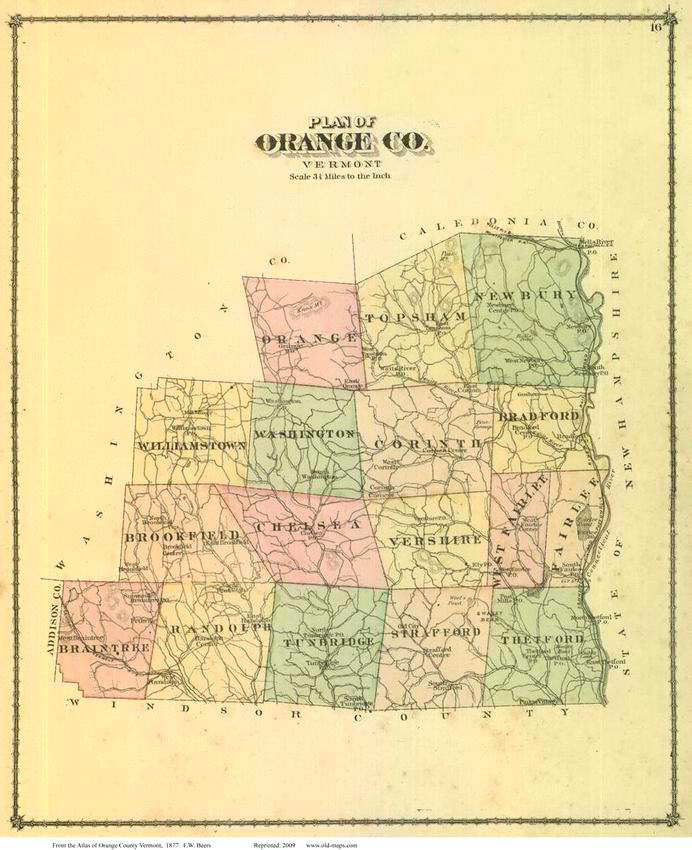
A village often took its name from the town in which it is located and its location within that town, for example East Corinth, Haverhill Corner and Thetford Center. Some other villages struck out on their own with distinct titles. In Newbury, Wells River took its name from the river. The river, according to village historian Horace Symes, may have been named by Wentworth for Captain Jonathan Wells who explored the area in 1707. Waits River in Topsham also took its name from the nearby river, named for Joseph Wait, a member of the Rogers’ Rangers.
Other villages took their names from an early entrepreneur or settler. In Thetford, Post Mills got its name from Eldad Post who built the first grist mill and saw mill there after 1779. Beanville is named for Alvah Bean who came to West Fairlee in 1839 and opened four businesses.
About the same time John Woods, a mill and store owner, gave Woodsville a reason for its name. Pike in Haverhill took its name from its role as a company town for Pike Manufacturing.
Some small villages underwent name changes. Union Village was originally called Lockes Mills after an early mill owner, but the name was changed “to signify the unity” between the towns of Norwich and Thetford. At various times East Corinth has been called Slab City, Hemlock City and Taplin Mills. Ely in Fairlee has been known in the past as South Fairlee and Wares Crossing. George’s Hill in Topsham became Galusha in 1811 because so many voted for a candidate for governor by that name.
Some locations, populated in the past, are mere shadows of their former selves. Quinttown in Orford, Charleston on the Warren-Piermont line, Pike Hill in Corinth and Tinkhamtown in Lyme are examples of this decline. No longer are geese exported from Goose Green in Corinth. Some names, such as Cilley Flat between Bradford and Corinth, have just disappeared. Arthur Pease of Orford suggested that Gilman’s Corner in East Fairlee seems to fit that last category.
Roads and highways are given titles based on their location and direction. While Main Streets are common, Woodsville’s principal street is Central Street. River Road was the main north-south road through the area until 1922 when it became known as Route 2 and finally renamed U.S. Route 5 in 1927.
I-91 was named, under a system developed in 1957, because it is a north-south interstate highway in the eastern portion of the nation. The advent of the 911 system required many individual names to be given to local byways that had previously gone unnamed.
Some local landforms still retain names given by natives or have titles that signify the names and beliefs of early European residents. Mt. Moosilauke gets its name from the Abenaki words for bald and place, a description of its bare summit. At some times in the past the name was corrupted in publications and local usage as Moose Hillock.
The Ammonoosuc was so called because it was the “narrow fishing-place” and the Ompompanoosuc comes from “mushy, quaky land.” Known as “water of the mountain place,” the Asquamchumauke River in Warren was renamed for Captain Thomas Baker who led his men in skirmishes against local natives. He is also remembered in the naming of Upper and Lower Baker Ponds in Orford.
Along came British settlers with biblical names for places such as Zion Hill, New Jerusalem and Brimstone Corner in Corinth, Mt. Moriah in Fairlee (later renamed Sawyer Mountain), Goshen in Bradford and Bible Hill in Newbury. In Orford, Sunday Mountain got its name from the tragic tale of a man who was skipping Sabbath service and was torn apart by bears on its slopes.
Early settlers and later families, knowingly or unknowingly, lent their names to local sites. Those titles that still exist include Dame Hill in Orford, Wallace Hill and Leighton Hill in Newbury and Wright’s Mountain, Chase Hallow and Sawyer’s Ledge in Bradford. Lakes and ponds bear family names such as Baker, Ricker, Tarleton and Morey. Rather than being named for a local, Mt. Pulaski in Newbury has the name of the Polish general who assisted the American cause in the Revolution.
Bridges also have names attributed to important families and individuals. Baldwin Bridge in Bradford was named for surveyor Benjamin Baldwin and Bedell’s Bridge between Newbury and Haverhill for Moody Bedell. In 1937 the newly constructed bridge between Orford and Fairlee was named in honor of inventor Samuel Morey who had lived in both towns.
Other names can be attributed to characteristics of the landform. Those characteristics are easily recognized in Roaring Brook, Middle Brook, South Fork, Mud Turtle Pond, Burnt Mountain, Eagle Ledge, Bear Notch and Pine Mountain. But Mt. Cube in Orford does not speak to its winter weather. It was originally known as Mt. Cuba, a name it took, according to local historian Alice Hodgson, in memory of a hunting dog that lost its life on that mountain in a battle with a bear.
Ticklenaked Pond does not get its name from skinny dipping, but rather its name comes from the native word tickeneket or “little beaver.” Perhaps Cape Moonshine refers to its nighttime reflections rather than any illicit activities. There is no longer a fairground on Fairground Road. Pout Pond in Lyme gets its name from the hornpout found there not from any attitudes of unsuccessful anglers.
While the reason for names such as Mosquitoville, North Road, Cow Meadow and Potato Hill may be obvious, other names are more elusive, their meaning lost in the vocabulary of earlier residents. Wormwood Hill in West Fairlee may, according to Swift, get its name either from the thistle-like weeds that may have grown there or from the expression “bitter as wormwood,” describing how someone might react to a bad land deal.
Copperas Hill in Strafford gets its name from the iron compound found there in the 19th century. South America in Corinth, located on the road to West Fairlee, got its erroneous designation from a teacher who tried to tell her students they lived on another continent. Skunk’s Misery in West Fairlee may have referred to a “low-lying swampy” area. Sawney Bean in Thetford and West Fairlee may get its name from the earlier term for foolish or silly.
Likewise boundaries between locations in a town may be elusive. I have wondered how an outsider would know where on Snake Road the boundary between South Newbury and West Newbury is located. Even without a road sign, folks who live along that road seem to know which side of the invisible line they live on. That may be true in other towns with multiple named locations.
Local names are sometimes corrupted with time. Garden Hill in Corinth was originally named for the Gardner family who lived there many years ago. One name that seems to be most complex is Sawney Road and district. In Thetford’s recently republished history Fifty for 250, Jessie Baldwin’s 1979 article on the subject comments on other spellings, pronunciations and origins. It is often spelled Sawmee and misprounced Swan-ey. Baldwin was unsure if it referred to a Bean family that lived in nearby West Fairlee or Strafford, but does mention that the old English word referred to a silly or stupid fellow.She doesn’t mention that early settlers would have been familiar with the Scottish tale of Sawney Bean, notorious murderer.
Naming buildings for individuals has usually followed the rule of avoiding those who are still alive. The Woods School Building and Woods Library in Bradford are named for John L.Woods who left significant bequests to finance their construction. The Peabody Library, Patten Library, Tenney Memorial and Blake Memorial, among other area libraries, derive their names from individuals or families who provided significant funds for their support.
In the 19th and early 20th centuries, one-room schools were usually named for the district they served and secondary schools for the town in which they were located. Naming union schools offered a challenge as several towns were involved. When Oxbow High was being created dozens of names were suggested, and many, including the obviously incorrect “Western Vermont High,” were quickly dismissed. When faced with names such as Cohase Country or Abenaki Regional, students asked that the name chosen omit words like regional or union.
Waits River and Blue Mountain were titles chosen for those schools from nearby natural features. Westshire Elementary School, serving West Fairlee and Vershire, and Samuel Morey Elementary School, serving Orford and Fairlee, reflect the names and histories of the communities they serve.
Despite the general reluctance to name a facility for a living person, those who have performed exemplary duties have been chosen to receive that honor. The Mona Garone Gym, the Shirley Beresford Library, Martha Jane Rich Theatre and the Raymond S. Burton Bridge are all named in honor of such individuals.
What if there is a need for a name change? In 1890 the U.S. Board of Geographic Names was established in an attempt to deal with the “complex issue of domestic geographic feature names during the westward expansion following the Civil War.” It now oversees name changes as they apply to modern usage. That Board was recently in the news when it approved the request of voters in Mont Vernon, NH to change the pejorative name Jew Pond to Carleton Pond after the person who donated the pond to the town.
In both Vermont and New Hampshire a town or city that, by vote of its citizens, expresses the wish to have a name change must get the approval of the state legislature. In 1999 the Vermont General Assembly voted to rename Sherburne as Killington, a name it had previously held.
In 2013 New Hampshire legislators will be asked to consider the sale of naming rights for bridges, roads and similar structures. The idea, which has received consideration by other states, is being suggested as a new revenue source for the New Hampshire Department of Transportation.
This column has shown that names of locations are often given after deep thought and just as often, casually. Either way, they give direction to our lives in more than one way. They help to identify who we are as residents, voters and landowners. They allow us to honor native culture and outstanding citizens and recall hardy forebears. They are a guide to a stranger seeking directions and to first responders providing assistance. That’s what’s in a name.
Journal Opinion
“He sought the mountain of Vermont,
Upon a railroad train.
Cow Meadow, in the Green Mountain state
Was his first stopping place
And the Skunk’s Misery displayed
Its sweetness and its grace
By easy stages then he went,
To visit Devil’s Den,
And Brimstone and
Zion Hill by the way,
Did come within his ken.
Then via Goose Green and Sawney Bean,
He travelled through the state.”
Last week’s column explained the origin of place names for the states of Vermont and New Hampshire and our local counties and towns. In addition to the influence of Native Americans on local names, that column explained the role of New Hampshire royal governor Benning Wentworth. In providing the names for many of the local counties and towns, he used the opportunity to honor and influence members of the British aristocracy. Other towns and counties were named by the Vermont General Assembly in the years after independence.
Sources for this column include Vermont Place-Names, Footprints of History by the late Esther M. Swift and local town histories. Swift was the Vermont Director of the Place-Name Survey for the American Name Society. There are hundreds of place names in our local area. This column only deals with the most unusual and prominent as well as those that are good examples of categories in naming. I have attempted to select examples from every corner of the region.
A village often took its name from the town in which it is located and its location within that town, for example East Corinth, Haverhill Corner and Thetford Center. Some other villages struck out on their own with distinct titles. In Newbury, Wells River took its name from the river. The river, according to village historian Horace Symes, may have been named by Wentworth for Captain Jonathan Wells who explored the area in 1707. Waits River in Topsham also took its name from the nearby river, named for Joseph Wait, a member of the Rogers’ Rangers.
Other villages took their names from an early entrepreneur or settler. In Thetford, Post Mills got its name from Eldad Post who built the first grist mill and saw mill there after 1779. Beanville is named for Alvah Bean who came to West Fairlee in 1839 and opened four businesses.
About the same time John Woods, a mill and store owner, gave Woodsville a reason for its name. Pike in Haverhill took its name from its role as a company town for Pike Manufacturing.
Some small villages underwent name changes. Union Village was originally called Lockes Mills after an early mill owner, but the name was changed “to signify the unity” between the towns of Norwich and Thetford. At various times East Corinth has been called Slab City, Hemlock City and Taplin Mills. Ely in Fairlee has been known in the past as South Fairlee and Wares Crossing. George’s Hill in Topsham became Galusha in 1811 because so many voted for a candidate for governor by that name.
Some locations, populated in the past, are mere shadows of their former selves. Quinttown in Orford, Charleston on the Warren-Piermont line, Pike Hill in Corinth and Tinkhamtown in Lyme are examples of this decline. No longer are geese exported from Goose Green in Corinth. Some names, such as Cilley Flat between Bradford and Corinth, have just disappeared. Arthur Pease of Orford suggested that Gilman’s Corner in East Fairlee seems to fit that last category.
Roads and highways are given titles based on their location and direction. While Main Streets are common, Woodsville’s principal street is Central Street. River Road was the main north-south road through the area until 1922 when it became known as Route 2 and finally renamed U.S. Route 5 in 1927.
I-91 was named, under a system developed in 1957, because it is a north-south interstate highway in the eastern portion of the nation. The advent of the 911 system required many individual names to be given to local byways that had previously gone unnamed.
Some local landforms still retain names given by natives or have titles that signify the names and beliefs of early European residents. Mt. Moosilauke gets its name from the Abenaki words for bald and place, a description of its bare summit. At some times in the past the name was corrupted in publications and local usage as Moose Hillock.
The Ammonoosuc was so called because it was the “narrow fishing-place” and the Ompompanoosuc comes from “mushy, quaky land.” Known as “water of the mountain place,” the Asquamchumauke River in Warren was renamed for Captain Thomas Baker who led his men in skirmishes against local natives. He is also remembered in the naming of Upper and Lower Baker Ponds in Orford.
Along came British settlers with biblical names for places such as Zion Hill, New Jerusalem and Brimstone Corner in Corinth, Mt. Moriah in Fairlee (later renamed Sawyer Mountain), Goshen in Bradford and Bible Hill in Newbury. In Orford, Sunday Mountain got its name from the tragic tale of a man who was skipping Sabbath service and was torn apart by bears on its slopes.
Early settlers and later families, knowingly or unknowingly, lent their names to local sites. Those titles that still exist include Dame Hill in Orford, Wallace Hill and Leighton Hill in Newbury and Wright’s Mountain, Chase Hallow and Sawyer’s Ledge in Bradford. Lakes and ponds bear family names such as Baker, Ricker, Tarleton and Morey. Rather than being named for a local, Mt. Pulaski in Newbury has the name of the Polish general who assisted the American cause in the Revolution.
Bridges also have names attributed to important families and individuals. Baldwin Bridge in Bradford was named for surveyor Benjamin Baldwin and Bedell’s Bridge between Newbury and Haverhill for Moody Bedell. In 1937 the newly constructed bridge between Orford and Fairlee was named in honor of inventor Samuel Morey who had lived in both towns.
Other names can be attributed to characteristics of the landform. Those characteristics are easily recognized in Roaring Brook, Middle Brook, South Fork, Mud Turtle Pond, Burnt Mountain, Eagle Ledge, Bear Notch and Pine Mountain. But Mt. Cube in Orford does not speak to its winter weather. It was originally known as Mt. Cuba, a name it took, according to local historian Alice Hodgson, in memory of a hunting dog that lost its life on that mountain in a battle with a bear.
Ticklenaked Pond does not get its name from skinny dipping, but rather its name comes from the native word tickeneket or “little beaver.” Perhaps Cape Moonshine refers to its nighttime reflections rather than any illicit activities. There is no longer a fairground on Fairground Road. Pout Pond in Lyme gets its name from the hornpout found there not from any attitudes of unsuccessful anglers.
While the reason for names such as Mosquitoville, North Road, Cow Meadow and Potato Hill may be obvious, other names are more elusive, their meaning lost in the vocabulary of earlier residents. Wormwood Hill in West Fairlee may, according to Swift, get its name either from the thistle-like weeds that may have grown there or from the expression “bitter as wormwood,” describing how someone might react to a bad land deal.
Copperas Hill in Strafford gets its name from the iron compound found there in the 19th century. South America in Corinth, located on the road to West Fairlee, got its erroneous designation from a teacher who tried to tell her students they lived on another continent. Skunk’s Misery in West Fairlee may have referred to a “low-lying swampy” area. Sawney Bean in Thetford and West Fairlee may get its name from the earlier term for foolish or silly.
Likewise boundaries between locations in a town may be elusive. I have wondered how an outsider would know where on Snake Road the boundary between South Newbury and West Newbury is located. Even without a road sign, folks who live along that road seem to know which side of the invisible line they live on. That may be true in other towns with multiple named locations.
Local names are sometimes corrupted with time. Garden Hill in Corinth was originally named for the Gardner family who lived there many years ago. One name that seems to be most complex is Sawney Road and district. In Thetford’s recently republished history Fifty for 250, Jessie Baldwin’s 1979 article on the subject comments on other spellings, pronunciations and origins. It is often spelled Sawmee and misprounced Swan-ey. Baldwin was unsure if it referred to a Bean family that lived in nearby West Fairlee or Strafford, but does mention that the old English word referred to a silly or stupid fellow.She doesn’t mention that early settlers would have been familiar with the Scottish tale of Sawney Bean, notorious murderer.
Naming buildings for individuals has usually followed the rule of avoiding those who are still alive. The Woods School Building and Woods Library in Bradford are named for John L.Woods who left significant bequests to finance their construction. The Peabody Library, Patten Library, Tenney Memorial and Blake Memorial, among other area libraries, derive their names from individuals or families who provided significant funds for their support.
In the 19th and early 20th centuries, one-room schools were usually named for the district they served and secondary schools for the town in which they were located. Naming union schools offered a challenge as several towns were involved. When Oxbow High was being created dozens of names were suggested, and many, including the obviously incorrect “Western Vermont High,” were quickly dismissed. When faced with names such as Cohase Country or Abenaki Regional, students asked that the name chosen omit words like regional or union.
Waits River and Blue Mountain were titles chosen for those schools from nearby natural features. Westshire Elementary School, serving West Fairlee and Vershire, and Samuel Morey Elementary School, serving Orford and Fairlee, reflect the names and histories of the communities they serve.
Despite the general reluctance to name a facility for a living person, those who have performed exemplary duties have been chosen to receive that honor. The Mona Garone Gym, the Shirley Beresford Library, Martha Jane Rich Theatre and the Raymond S. Burton Bridge are all named in honor of such individuals.
What if there is a need for a name change? In 1890 the U.S. Board of Geographic Names was established in an attempt to deal with the “complex issue of domestic geographic feature names during the westward expansion following the Civil War.” It now oversees name changes as they apply to modern usage. That Board was recently in the news when it approved the request of voters in Mont Vernon, NH to change the pejorative name Jew Pond to Carleton Pond after the person who donated the pond to the town.
In both Vermont and New Hampshire a town or city that, by vote of its citizens, expresses the wish to have a name change must get the approval of the state legislature. In 1999 the Vermont General Assembly voted to rename Sherburne as Killington, a name it had previously held.
In 2013 New Hampshire legislators will be asked to consider the sale of naming rights for bridges, roads and similar structures. The idea, which has received consideration by other states, is being suggested as a new revenue source for the New Hampshire Department of Transportation.
This column has shown that names of locations are often given after deep thought and just as often, casually. Either way, they give direction to our lives in more than one way. They help to identify who we are as residents, voters and landowners. They allow us to honor native culture and outstanding citizens and recall hardy forebears. They are a guide to a stranger seeking directions and to first responders providing assistance. That’s what’s in a name.
Thursday, December 27, 2012
What's In A Name?
“What’s in a name?
That which we call a rose
By any other name would smell as sweet.”
Romeo and Juliet, William Shakespeare
If Orford had been called Mannburg or Newbury was Riverton and Bradford was chartered as Salemville, would it have made any difference in their history? How about Cumberland County instead of Orange?
What if New Connecticut had remained the name for what is now Vermont? Would the appeal have been the same? That is a difficult question to answer. But this column will deal with how our political divisions were named. It is the first of two parts. The second one will deal with the naming of neighborhoods, roads and physical features of the area.
WHAT'S IN A NAME? Fairlee may have had its name taken from an estate on the Isle of Wight familiar to Governor Benning Wentworth who granted its charter in 1761. The name means "a beautiful open or cleared land or meadow," a description that apparently applied to both the estate and the new town. (Larry Coffin)
Orange County was created after the American Revolution and, just as a number of locations in New England. gets its name from the title Prince of Orange, borne by William III, who became King of England in 1689. Some of the towns were named by New Hampshire Royal Governor Benning Wentworth. Some towns have undergone name changes in the time since their charters were granted.
When Grafton County was created in 1769 it was named for the Third Duke of Grafton, Prime Minister of Great Britain. Many of the towns were named by Wentworth, pictured below.
LAND GRANTER. Benning Wentworth was the Royal Governor of the Province of New Hampshire from 1741 to 1766. During this time he granted about 200 towns charters in what is now Vermont and New Hampshire. Many were named by Wentworth to honor members of the British aristocracy. Portrait by Joseph Blackburn, 1760.
NAMING TALE. Dr. Samuel Peters claimed that he christened the green mountains Verd-Mont, from atop Mount Pisgah or Killington Peak in 1763. He is pictured here in a 1938 National Life Insurance Company advertisement by Roy F. Heinrich. Most historians discount this story and give credit to Dr. Thomas Young, who first used the title Vermont in April 1777. (Courtesy Bradford Historical Society/National Life Insurance Company)
This column draws on information from Vermont Place-Names, Footprints of History by the late Esther M. Swift, Indian Place Names in Vermont by John C. Huden, local history books and internet sources. Swift was the Vermont Director of the Place Name Survey project for the American Name Society. Huden, who wrote widely on Native Americans, was the principal of Bradford Academy from 1930 to 41.
The original place names for the region were applied by the natives who were here prior to the arrival of Europeans. The names those natives used were derived from the key characteristics of a physical feature, how it applied to their needs or its relationship to other physical features. Their name for the area now occupied by the Bradford golf course was mas-ba-ak, “where much water overflows,” tolbabauk on Lake Fairlee meant “snapping turtle pond.” The Ammonoosuc translates as “narrow fishing-place” and is an example of how Europeans sometimes applied the native name for a local spot to a larger entity.
When Europeans began to settle the region, they dismissed most of these traditional names. The lack of a common language, speech sounds and subsequent numerous spellings made using native titles difficult. When they were used, they were often garbled or erroneously interpreted. Kwenitegw, “the long river,” became the Connecticut and tickeneket, “little beaver” became Ticklenaked Pond. Koaske, “the place of the white pines,” has many spellings, including coos, coosuc, cohos and cohase. It was also thought that the name meant “a crooked river, a wide valley or a great fishing place.”
Most political entities in the two states were named by the English settlers prior to the end of the 18th century. The exception to this is the names applied by the French in areas closest to New France north of the border. There are no political entities named by the French in our area.
New Hampshire was given that name by Captain John Mason who received major grants of land from the Council of New England in 1629. He selected the name for his new territory from the English county of Hampshire, his childhood home.
Massachusetts got its name from the natives who lived there at the time of European settlement and the native name for the river became the anglicized name for Connecticut. Rhode Island and Providence Plantations were given that name by settler Roger Williams. The Dutch colony of New Amsterdam was captured by the English in 1664 and renamed New York in honor of the Duke of York, brother of King Charles II.
Vermont was created out of the New Hampshire grants in 1776 and 1777. When delegates met in Windsor in January 1777, they voted to call the new republic New Connecticut. Later, when they found that that name was being used in Pennsylvania, they changed the name to Vermont.
There are two different stories about the origin of that name. One is that Dr. Samuel Peters claimed that he christened the green mountains Verd-Mont, from atop Mt. Pisgah or Killington Peak in 1763. Peters was related to the Peters family who were among the first settlers of Bradford and an important family there for over 200 years.
Most historians discount the Peters story and give credit to Dr. Thomas Young, who published a broadside in April 1777 entitled, “To the Inhabitants of Vermont, A Free and Independent State.” It is the French words for “green mountain,” in a grammatical format used by the French for place names. That term had been applied to the Green Mountain Boys as early as 1772.
The names of towns and counties in our area come from the areas of New England that were settled earlier and from connections with England. Most were given their names by Benning Wentworth who became royal governor of New Hampshire in 1741. He assumed that his colony stretched westward to the Hudson River, an assertion disputed by New York. Between 1749 and 1766 he wrote grants for nearly 200 towns in the unpopulated areas in what is now Vermont and New Hampshire. At least two of them, Bennington and Wentworth, bear his name.
Wentworth’s land grants transferred ownership from the Crown to groups of private individuals or proprietors. These were often friends or associates of Wentworth, many of whom had no plans to settle in the new towns. Following the example of Massachusetts and Connecticut, these grants were for townships of about 30,000 acres. Establishing townships as a primary political division was based on the New England traditions of town meetings and the Congregational form of local church control.
While fees were paid to the office of the Governor, the major benefit to Wentworth was that he received a large tract of land in each town, which he could then sell. The proprietors were also in a position to make money from the sale of land to settlers. In many cases the first town meetings were not held in the new towns, but rather in remote locations such as Portsmouth.
When granting a town to its proprietors, Wentworth often selected a name chosen “to honor or influence members of the peerage of England.” These were powerful individuals the governor hoped would support him politically or economically.
Thetford was one of these grants, and its name may have come from the English Viscount Thetford, a distant relative of Wentworth. There are others who believe that it derives its name from the England town of Thetford. Although Orford was referred to earlier as Number 7 or Sugar River, it was named for Robert Walpole, Earl of Orford and Britain’s first prime minister. Strafford got its name from the Earl of Strafford, a title held by Wentworth’s cousin.
Fairlee may have had its name taken from an estate on the Isle of Wight familiar to Wentworth. The name means “a beautiful open or cleared land or meadow,” a description that apparently applied to both the estate and the new town. When the town was split in 1797, West Fairlee became the official name of that section, while the rest, bordering on the Connecticut River, was often referred to as East Fairlee.
Warren was named by Wentworth in honor of British naval hero Sir Peter Warren. There is an alternate version that suggests that name describes a township that was “beautiful and full of rabbits.”
Many thought that the name of Ryegate came from either the city of Rye in Scotland or the one in New Hampshire. Ryegate historian Dwight White explains in his book, The Down of the Thistle, that Ryegate was named by Wentworth in honor of Charles Mordaunt, Earl of Peterborough and Baron of Reigate.” Swift also suggests that one of the most prominent early families in Ryegate had connection with Reigate in England.
When Grafton County was created in 1769 it was named for the 3rd Duke of Grafton, prime minister of Great Britain. Orange County was created after the Revolution, just one of a number of locations in New England whose name derives from the title Prince of Orange, borne by William III, who became King in 1689.
Caledonia County was created by the Vermont legislature in 1792, a body unlikely to name it for the aristocracy. In fact, the name is taken from the ancient name for Scotland and recognizes the importance of Scots to the county’s settlement. Politics apparently also played a role when, in 1810, the name of Jefferson County was changed to Washington County.
Bradford was not one of the towns granted by New Hampshire and was actually settled five years before it was chartered. These inhabitants called their community Waits River Town or Waitstown. In 1770, a delegation from the squatters approached the royal governor of New York asking for a charter that would recognize their land ownership. That request was granted and the town was named Mooretown in honor of Governor Sir Henry Moore, who had died the previous year. After that the town was sometimes referred to as Salem, “perhaps as an increased dislike to be named after a royal governor.” At the request of the inhabitants in 1788, the Vermont General Assembly voted to rename the town Bradford, probably after Bradford, Massachusetts.
Corinth was one of two towns that Wentworth named after ancient cities, Jericho being the other. The Corinth Bicentennial Committee, among others, preferred to think that the town was named after Corinth in England. Swift believes that no connection between the two towns has been found. There has also been considerable debate over the pronunciation of the town's name.
Lyme’s history says that the origin of its name “has been the subject of some controversy.” While there were those who believed it came from Lyme, Connecticut, there was no immediate connection between those two towns. Lyme’s history states: “It appears more reasonable that this town was named by the Massachusetts proprietors.” They, more than the royal governor, would have appreciated the connection with the English town of Lyme Regis, a puritan stronghold. The name was spelled Lime until about 1823.
Some of the first settlers of Topsham were from Topsham, Maine and took that name for their new community. Both are named for Topsham in England. Newbury and Haverhill got their names from the older adjoining towns in Massachusetts, which in turn are taken from towns in England. Piermont was given its name by its proprietors in 1764. According to the 1947 town history: “It is quite likely that Peaked Mountain, standing out like a great pier, suggested the name.”
The Vermont General Assembly “coined” the name of Vershire as a combination of the names of the states of Vermont and New Hampshire. Swift quotes Child’s 1888 Gazetteer, “the town was first called Number 7, afterwards Caley Town and it was also at one time called Arlington.” In 1878, the residents voted to change the name of the town to Ely in honor of the owners of the copper mines, a vote that was rescinded four years later.
Groton’s charter was voted on by the Vermont legislature in 1780, but not officially issued until 1789. Like all the other Grotons in America, this name is taken from the town of that name in England. Groton historian Waldo Glover indicates that, while no documentation exists, he supports the theory that the grantees named the town in honor of an ancestor of fellow grantee Thomas Butterfield. That ancestor, having gone to the defense of Groton, Connecticut in 1704, was captured by the natives and “cruelly treated.”
We use these names of states, counties and towns to help identify who we are. While not as likely as in the past, some individuals reside their entire lives within one town or county. In the past these small communities have been compared to the walled cities of the Middle Ages, defensive against outsiders and competitive with neighboring towns. While these identities have dulled with changing population and modern communication, many still swell with pride over their town’s accomplishments and bristle when the town is belittled.
Wednesday, November 28, 2012
Decades of Change: 1960-64
This column is the first of a series examining interesting events and changes that occurred locally since 1960. Other articles, covering about five year periods of time, will appear over the next 20 months, interspersed with other topics.
It would not be original to say that the only constant during the period from 1960 to the present was change. In many ways the 1960-64 period were the calm before the changes that would alter the area in remarkable ways. The majority of area residents cannot remember the period. While many are just too young, others moved here later. Those who do remember are encouraged to share those memories with those who don’t.
In several months I will write an article on the period 1965-1969. I am seeking volunteers to contribute to that and other future articles with stories and photographs. Contact me if you have things to share. In researching this article, I took over 20 pages of single-spaced notes. In writing it, I may have left out or misinterpreted things that others consider significant. Corrections and additions may be sent to lccoffin@charter.net.
Sources for this series include The United Opinion, and its successor the Journal Opinion, local history books and residents’ recollections. History does not fall conveniently into neat five-year blocks. The events and trends that are covered sometimes occur quickly and sometimes develop over decades. While the articles will draw from events in all area towns, this effort may result in an updated history of Bradford.
Established in 1881, The United Opinion was the local weekly. It featured Bradford news along with columns and news items from other area towns. In 1947 Randolph’s John Drysdale began publishing it in conjunction with his White River Valley Herald. Local staff and community columnists reported the news, supplemented by guest editorials from around Vermont.
That news reflected the normal activities of this area. Seasonal news, with variations, repeated year after year. Regular articles included school openings and deer hunting in the autumn, skiing and basketball in the winter, sugaring and graduation in the spring followed by golf, baseball and vacation news in the summer. Local columns were gossipy, informing folks of local events as well as neighbors’ trips, visitors, illnesses and home improvements.
Shopping small and shopping local were more practice than slogan in the early 1960s. Bradford was a main shopping center, and one could find almost everything needed in its stores. Route 5 was the main route and brought shoppers and tourists to town. Every Friday night was as active as Midnight Madness later became.
During this period Bradford boasted three major grocery stores and several smaller ones. There were two appliance stores, a furniture store, several clothing stores, four new car dealers, a bank, three hardware stores, two dentists and two doctors along with insurance agencies, filling stations, lawyers, oil and gas dealers, a slaughter house, two grain stores, a pharmacy, several gift stores, two railroad stations, salons and a barber, restaurants and lodging establishments. The Woodsville and Wells River commercial districts combined to offer similar services.
While the area was not as wealthy as some other areas of the state, it was recovering from the recession of 1958 and new businesses were common. Established businesses often relocated within the same community with enlarged facilities.
In 1960, the Bradford National Bank moved to its new building on the site of the demolished Bradford Hotel. In 1962, the Red and White Store moved from Main Street to Barton Street adjacent to the A & P grocery store. It opened as the 5,000 square feet Super-Duper, with such modern features as “music to shop by.” By comparison, the new Hannaford store will be 36,000 square feet.
In 1963, Perry’s Oil moved to its present location replacing Hale’s furniture store which relocated across the street. Perry’s shared the building with the Central Vermont Public Service appliance store. That company, which also used the brick mill as a local operations center, forecast the increase use of electricity with “flameless” appliances and “all electric” heating for homes.
Forward thinking business leaders urged local towns to encourage planned growth. In 1963-64 the Bradford Area Development Committee brought leaders of local towns together to encourage industrial growth. In 1963, a major industry targeted Bradford for a possible relocation. Local supporters raised $26,700 in pledges to help with the project. As with the 1962 proposal to build the Sunday Mountain Ski Area in Orford, this one never came to be.
In other towns, the Gould family retook ownership of its Piermont store and Wing’ Market took over the First National Store in Fairlee’s Colby Block. Across the street, the Bradford National Bank opened a branch in the former Fairlee post office. Fairlee acquired a new post office building as did Orford while the post offices in Newbury and East Corinth had new locations.
The new Carriage Stop Restaurant in Fairlee joined established ones in the area including the Kettledrum, the Chimes, Bill’s, the Happy Hour and the Fairlee Diner. Lake Morey Inn added a new convention center and served tourists along with Bonnie Oakes and the Rutledge Inn.
Agriculture was a major economic pursuit in the area. Fluid milk flowed to markets in southern New England. But a “creeping disaster was stalking the small Vermont dairy farm.” The combination of new regulations, irregular prices, uncertain weather and increased competition from other states, caused many farmers to auction off their family farms.
“1962 was a year of sharp adjustments for many farm families who were faced with the choice of going out of farming or investing heavily in equipment to meet new marketing requirements.”
New barns and milk houses with bulk tanks were increasingly required. The Bradford Creamery, which served farmers who shipped in cans, closed in January 1962. Through local efforts it was reopened and continued to serve farmers who used either cans or bulk tanks. Bradford’s Whiting Creamery also went through a period of bankruptcy and reopening. Farm organizations, such as the Farm Bureau, the Grange, 4-H and the Corinth Dairy Herd Improvement Association, assisted farm families in their efforts to keep farm traditions alive and growing.
School news was prominent in the weekly papers with in-depth reports of teams, clubs and events. Graduations were celebrated. All area towns struggled to provide education for an expanding student population. Communities spent local resources to improve programs including new courses and facilities. New courses, such as physical education and new math, were introduced. Proposed changes in state aid caused joy in only some towns. The 1962 U. S. Supreme Court decision prohibiting prayer in public schools raised concerns if not always immediate compliance.
Just prior to this time, Lyme and Haverhill consolidated their elementary schools. In April 1962 the new Thetford Elementary School opened, consolidating five village schools. After at least three failing votes, Bradford added three rooms to its elementary school. Area special needs students were served by The Valley School in North Thetford.
There was considerable discussion regarding the creation of regional high schools. At this time Orford, Woodsville and Haverhill voters decided to keep their high schools. There was pressure from the Vermont State Board of Education to reduce the number of school districts and area towns responded with study after study. In November 1964, Wells River, Groton and Ryegate voted to form a union school district.
Town and village voters regularly considered special projects. Bradford voters bought a new grader, fire truck and thought about a new fire house. East Corinth bought a new truck and built a new fire station. Piermont proposed to outfit its new fire department with a truck and fire station. In 1964 Lyme undertook a study that led to improved fire protection. Despite these improvements, some area buildings still disappeared in flames.
Some towns took seriously the advice: “You must consider the type of development you want before other kinds of development swoop down on you.” When in 1963 Thetford conducted a planning survey, it drew the attention of national media.
The United Opinion supported the idea that, “A small community needs to plan more carefully than a big city. A small town cannot afford to make mistakes.” Many feared government intrusion on private property rights while others saw zoning as a way of protecting property values and encouraging growth. Bradford voted down zoning at least three times and other communities never broached the subject.
Dumps and pollution were regular topics of discussion. Newbury bought land for a new dump and Fairlee studied how to prevent further pollution of the Connecticut River by moving its dump to a new site. The Village of Bradford solved the sewage disposal issue by dumping raw sewage into the Waits River. Two attempts in 1962-63 failed to gain voters’ support for a disposal plant.
Transportation issues often dominated local discussions. As railroad traffic declined, concerns over the future of local stations were voiced. Automobile dealers’ offerings were of high interest to the public and a major source of revenue for the paper. In 1962 Blake’s Chevrolet unveiled its new models at the Bradford Armory before a crowd of 1000 residents.
“The birth pains of a new superhighway through scenic Vermont towns and countryside.” were a constant source of news. As plans for the I-91 route were announced, some towns reacted with concerns. Fairlee fought to save both its village and Lake Morey by unsuccessfully suggesting several more westerly routes than the one proposed.
In Bradford, one route would have built the interstate on the meadows east of Memorial Field. That was discarded in favor of one over the Waits River intervale. The proposal to have the highway reduced to two lanes north of the Bradford interchange was eventually discarded as well.
Church activities were also reported in detail. Church attendance for all ages was common. Churches held regular and special services, served suppers and had holiday sales and bazaars year round. There was a new St. Martin’s Chapel in Fairlee and a Roman Catholic chapel in Orford. In 1962 Woodsville’s Calvary Baptists relocated to the former Universalist church. Other churches in the area consolidated or closed when membership declined.
The interfaith services held following President Kennedy’s assassination in 1963, seemed to break the ice in favor of ecumenical activities. In June 1964 the graduating class held Bradford Academy’s first interfaith Baccalaureate service in the school’s auditorium.
Not all activities were so serious. Golfing news was reported in depth as were results of ball games. During the school year, school sports were followed closely. Adult basketball teams included the Black Guards and the Hard Line Loggers. “There was nothing like baseball” reported the newspaper as it covered Little and Babe Ruth Leagues and the adult Bradford Bombers. There were also rifle clubs and skiing at the Northeast Ski Slopes as well as swimming at Bradford’s Baldwin Bridge, Fairlee’s Community Beach and Newbury’s Halls Pond.
Drive-in theaters in the area offered summer time viewing of blockbusters such as The Alamo and Ben-Hur along with films by Walt Disney. There were bowling leagues in Woodsville, record hops, Sadie Hawkins Day dances, Junior Proms, and card parties. Clubs included scouts, 4-H, church groups, the fraternal Odd Fellows and Masons, veterans organizations, Grange, Lions Clubs, women’s clubs and active PTAs. Libraries listed new acquisitions, activities and physical improvements. Art shows, strawberry festivals and concerts along with Fairlee’s Itty Bitty Bazaar and Newbury’s Cracker Barrel Bazaar, were annual events.
No activity dominated fall editions more than hunting. The area boasted “some of the best deer hunting in the country.” The names of successful hunters were printed along with those who were successful trappers. Anglers who were extra lucky were pictured with proof of their fish stories.
The Bradford Wild Game Supper was prepared by the Bradford Congregational church. Some men also attended Richard Shearer’s annual men’s beaver supper.
This was bicentennial time for area towns. Considerable planning went into elaborate programs and parades. Historical societies were active. Celebrations were held as follows: Fairlee, Lyme and Thetford in 1961, Haverhill, Newbury and Topsham “had fun” in 1963 and Piermont and Corinth partied in 1964. By the end of this period Bradford was well into planning its 1965 celebration.
I close this first article of the series with things common to this period: The Rare Bird and Animal Farm in Fairlee, Granddad’s Toys in Thetford, polio clinics, the bookmobile, Princess phones, Top Value stamps, overseers of the poor, turning on your headlights during holiday weekend, caddying, five-cent ice cream cones, Bradford’s Hilltop Dairy, Rockdale’s in Lebanon and the Saturday noon whistle. These, along with some very fine local folks, exist now still in the pages of The United Opinion and in the memories of some.
(Editor’s note: Consider giving the author’s book In Times Past: Essays From the Upper Valley Book Two as a gift this holiday. It is available at local outlets and benefits the Bradford Public Library.)
Vermont Babe Ruth League Champions
The Bradford area All Star team became Vermont Babe Ruth champions in August 1962. First row, left to right: Bill Cronin, Kingswood; Mike Whalen, Woodsville; Mike Martin, Bradford; Allen Reed, Fairlee( actually from Orford) ; Bob Turner, Bradford; Billy Hill, Woodsville; Gary Eggleston, W. Topsham; Bob Munson, Bradford, Second row: George Huntington, Jr., coach; Mike Maxwell, Bradford; Dave Chase, Woodsville; Steve Munson, Bradford; David Paronto, Woodsville; Phil Fillian, Fairlee; Paul Choate, Woodsville; Steve Johnson, W. Topsham; and Harry McLam, coach, Bradford.
A Super Duper Sale. Soon after its 1963 grand opening on Bradford’s Barton Street, the Super Duper offered a trainload sale of items. Formerly the Red and White Store, it had been located on Main Street.
United Opinion Correspondents. In June, 1961 local correspondents met at the home of Mr. and Mrs. Morris Perry. On couch: left to right: Mrs. Charles King, Newbury; Mrs. H. M. Goodwin, Fairlee;, Mrs. Harry Deal, Piermont; Mrs. Warren Martin, Piermont and Bradford; standing: Mrs. Lester Gray, Orford; Mrs. Morris Knapp, East Corinth; Mrs. Harold Carleton, West Newbury; Mrs. Clinton Sawyer, Waits River; Mrs. George Hastings, Corinth. In chairs: Mrs. Lee Gilman, Norwich; Mrs. Ernest Cilley, West Topsham; on floor: Mrs. Russell Fuller, Newbury Center; Mrs. Roscoe Whitney ,South Newbury.
These local women weekly reported the news of their town and neighborhood. It kept local readers informed of the comings and goings of the local residents. It might be noted that in the early 60s married women were generally listed by their husband’s name.)
Bradford Doctor and His Babies. Dr. Franklin Dwinell practice family medicine in the local area for 44 years, retiring in 1964. This 1962 photo show the doctor seated before his office wall covered with pictures of some of the over l100 babies he delivered.
Proposed Interstate Route. In July196,3 this map of the proposed interstate at Bradford showed the use of the Waits River intervale route rather than one to the east of the village. Also shown was the plan to build only two lanes north of the Bradford exit, with the other two lanes to be built at a later date. .
The Old Swimming Hole. Every summer, swimmers from the Bradford area took advantage of the cool waters of the Waits River at Baldwin Bridge for lessons and free swimming.
It would not be original to say that the only constant during the period from 1960 to the present was change. In many ways the 1960-64 period were the calm before the changes that would alter the area in remarkable ways. The majority of area residents cannot remember the period. While many are just too young, others moved here later. Those who do remember are encouraged to share those memories with those who don’t.
In several months I will write an article on the period 1965-1969. I am seeking volunteers to contribute to that and other future articles with stories and photographs. Contact me if you have things to share. In researching this article, I took over 20 pages of single-spaced notes. In writing it, I may have left out or misinterpreted things that others consider significant. Corrections and additions may be sent to lccoffin@charter.net.
Sources for this series include The United Opinion, and its successor the Journal Opinion, local history books and residents’ recollections. History does not fall conveniently into neat five-year blocks. The events and trends that are covered sometimes occur quickly and sometimes develop over decades. While the articles will draw from events in all area towns, this effort may result in an updated history of Bradford.
Established in 1881, The United Opinion was the local weekly. It featured Bradford news along with columns and news items from other area towns. In 1947 Randolph’s John Drysdale began publishing it in conjunction with his White River Valley Herald. Local staff and community columnists reported the news, supplemented by guest editorials from around Vermont.
That news reflected the normal activities of this area. Seasonal news, with variations, repeated year after year. Regular articles included school openings and deer hunting in the autumn, skiing and basketball in the winter, sugaring and graduation in the spring followed by golf, baseball and vacation news in the summer. Local columns were gossipy, informing folks of local events as well as neighbors’ trips, visitors, illnesses and home improvements.
Shopping small and shopping local were more practice than slogan in the early 1960s. Bradford was a main shopping center, and one could find almost everything needed in its stores. Route 5 was the main route and brought shoppers and tourists to town. Every Friday night was as active as Midnight Madness later became.
During this period Bradford boasted three major grocery stores and several smaller ones. There were two appliance stores, a furniture store, several clothing stores, four new car dealers, a bank, three hardware stores, two dentists and two doctors along with insurance agencies, filling stations, lawyers, oil and gas dealers, a slaughter house, two grain stores, a pharmacy, several gift stores, two railroad stations, salons and a barber, restaurants and lodging establishments. The Woodsville and Wells River commercial districts combined to offer similar services.
While the area was not as wealthy as some other areas of the state, it was recovering from the recession of 1958 and new businesses were common. Established businesses often relocated within the same community with enlarged facilities.
In 1960, the Bradford National Bank moved to its new building on the site of the demolished Bradford Hotel. In 1962, the Red and White Store moved from Main Street to Barton Street adjacent to the A & P grocery store. It opened as the 5,000 square feet Super-Duper, with such modern features as “music to shop by.” By comparison, the new Hannaford store will be 36,000 square feet.
In 1963, Perry’s Oil moved to its present location replacing Hale’s furniture store which relocated across the street. Perry’s shared the building with the Central Vermont Public Service appliance store. That company, which also used the brick mill as a local operations center, forecast the increase use of electricity with “flameless” appliances and “all electric” heating for homes.
Forward thinking business leaders urged local towns to encourage planned growth. In 1963-64 the Bradford Area Development Committee brought leaders of local towns together to encourage industrial growth. In 1963, a major industry targeted Bradford for a possible relocation. Local supporters raised $26,700 in pledges to help with the project. As with the 1962 proposal to build the Sunday Mountain Ski Area in Orford, this one never came to be.
In other towns, the Gould family retook ownership of its Piermont store and Wing’ Market took over the First National Store in Fairlee’s Colby Block. Across the street, the Bradford National Bank opened a branch in the former Fairlee post office. Fairlee acquired a new post office building as did Orford while the post offices in Newbury and East Corinth had new locations.
The new Carriage Stop Restaurant in Fairlee joined established ones in the area including the Kettledrum, the Chimes, Bill’s, the Happy Hour and the Fairlee Diner. Lake Morey Inn added a new convention center and served tourists along with Bonnie Oakes and the Rutledge Inn.
Agriculture was a major economic pursuit in the area. Fluid milk flowed to markets in southern New England. But a “creeping disaster was stalking the small Vermont dairy farm.” The combination of new regulations, irregular prices, uncertain weather and increased competition from other states, caused many farmers to auction off their family farms.
“1962 was a year of sharp adjustments for many farm families who were faced with the choice of going out of farming or investing heavily in equipment to meet new marketing requirements.”
New barns and milk houses with bulk tanks were increasingly required. The Bradford Creamery, which served farmers who shipped in cans, closed in January 1962. Through local efforts it was reopened and continued to serve farmers who used either cans or bulk tanks. Bradford’s Whiting Creamery also went through a period of bankruptcy and reopening. Farm organizations, such as the Farm Bureau, the Grange, 4-H and the Corinth Dairy Herd Improvement Association, assisted farm families in their efforts to keep farm traditions alive and growing.
School news was prominent in the weekly papers with in-depth reports of teams, clubs and events. Graduations were celebrated. All area towns struggled to provide education for an expanding student population. Communities spent local resources to improve programs including new courses and facilities. New courses, such as physical education and new math, were introduced. Proposed changes in state aid caused joy in only some towns. The 1962 U. S. Supreme Court decision prohibiting prayer in public schools raised concerns if not always immediate compliance.
Just prior to this time, Lyme and Haverhill consolidated their elementary schools. In April 1962 the new Thetford Elementary School opened, consolidating five village schools. After at least three failing votes, Bradford added three rooms to its elementary school. Area special needs students were served by The Valley School in North Thetford.
There was considerable discussion regarding the creation of regional high schools. At this time Orford, Woodsville and Haverhill voters decided to keep their high schools. There was pressure from the Vermont State Board of Education to reduce the number of school districts and area towns responded with study after study. In November 1964, Wells River, Groton and Ryegate voted to form a union school district.
Town and village voters regularly considered special projects. Bradford voters bought a new grader, fire truck and thought about a new fire house. East Corinth bought a new truck and built a new fire station. Piermont proposed to outfit its new fire department with a truck and fire station. In 1964 Lyme undertook a study that led to improved fire protection. Despite these improvements, some area buildings still disappeared in flames.
Some towns took seriously the advice: “You must consider the type of development you want before other kinds of development swoop down on you.” When in 1963 Thetford conducted a planning survey, it drew the attention of national media.
The United Opinion supported the idea that, “A small community needs to plan more carefully than a big city. A small town cannot afford to make mistakes.” Many feared government intrusion on private property rights while others saw zoning as a way of protecting property values and encouraging growth. Bradford voted down zoning at least three times and other communities never broached the subject.
Dumps and pollution were regular topics of discussion. Newbury bought land for a new dump and Fairlee studied how to prevent further pollution of the Connecticut River by moving its dump to a new site. The Village of Bradford solved the sewage disposal issue by dumping raw sewage into the Waits River. Two attempts in 1962-63 failed to gain voters’ support for a disposal plant.
Transportation issues often dominated local discussions. As railroad traffic declined, concerns over the future of local stations were voiced. Automobile dealers’ offerings were of high interest to the public and a major source of revenue for the paper. In 1962 Blake’s Chevrolet unveiled its new models at the Bradford Armory before a crowd of 1000 residents.
“The birth pains of a new superhighway through scenic Vermont towns and countryside.” were a constant source of news. As plans for the I-91 route were announced, some towns reacted with concerns. Fairlee fought to save both its village and Lake Morey by unsuccessfully suggesting several more westerly routes than the one proposed.
In Bradford, one route would have built the interstate on the meadows east of Memorial Field. That was discarded in favor of one over the Waits River intervale. The proposal to have the highway reduced to two lanes north of the Bradford interchange was eventually discarded as well.
Church activities were also reported in detail. Church attendance for all ages was common. Churches held regular and special services, served suppers and had holiday sales and bazaars year round. There was a new St. Martin’s Chapel in Fairlee and a Roman Catholic chapel in Orford. In 1962 Woodsville’s Calvary Baptists relocated to the former Universalist church. Other churches in the area consolidated or closed when membership declined.
The interfaith services held following President Kennedy’s assassination in 1963, seemed to break the ice in favor of ecumenical activities. In June 1964 the graduating class held Bradford Academy’s first interfaith Baccalaureate service in the school’s auditorium.
Not all activities were so serious. Golfing news was reported in depth as were results of ball games. During the school year, school sports were followed closely. Adult basketball teams included the Black Guards and the Hard Line Loggers. “There was nothing like baseball” reported the newspaper as it covered Little and Babe Ruth Leagues and the adult Bradford Bombers. There were also rifle clubs and skiing at the Northeast Ski Slopes as well as swimming at Bradford’s Baldwin Bridge, Fairlee’s Community Beach and Newbury’s Halls Pond.
Drive-in theaters in the area offered summer time viewing of blockbusters such as The Alamo and Ben-Hur along with films by Walt Disney. There were bowling leagues in Woodsville, record hops, Sadie Hawkins Day dances, Junior Proms, and card parties. Clubs included scouts, 4-H, church groups, the fraternal Odd Fellows and Masons, veterans organizations, Grange, Lions Clubs, women’s clubs and active PTAs. Libraries listed new acquisitions, activities and physical improvements. Art shows, strawberry festivals and concerts along with Fairlee’s Itty Bitty Bazaar and Newbury’s Cracker Barrel Bazaar, were annual events.
No activity dominated fall editions more than hunting. The area boasted “some of the best deer hunting in the country.” The names of successful hunters were printed along with those who were successful trappers. Anglers who were extra lucky were pictured with proof of their fish stories.
The Bradford Wild Game Supper was prepared by the Bradford Congregational church. Some men also attended Richard Shearer’s annual men’s beaver supper.
This was bicentennial time for area towns. Considerable planning went into elaborate programs and parades. Historical societies were active. Celebrations were held as follows: Fairlee, Lyme and Thetford in 1961, Haverhill, Newbury and Topsham “had fun” in 1963 and Piermont and Corinth partied in 1964. By the end of this period Bradford was well into planning its 1965 celebration.
I close this first article of the series with things common to this period: The Rare Bird and Animal Farm in Fairlee, Granddad’s Toys in Thetford, polio clinics, the bookmobile, Princess phones, Top Value stamps, overseers of the poor, turning on your headlights during holiday weekend, caddying, five-cent ice cream cones, Bradford’s Hilltop Dairy, Rockdale’s in Lebanon and the Saturday noon whistle. These, along with some very fine local folks, exist now still in the pages of The United Opinion and in the memories of some.
(Editor’s note: Consider giving the author’s book In Times Past: Essays From the Upper Valley Book Two as a gift this holiday. It is available at local outlets and benefits the Bradford Public Library.)
Vermont Babe Ruth League Champions
The Bradford area All Star team became Vermont Babe Ruth champions in August 1962. First row, left to right: Bill Cronin, Kingswood; Mike Whalen, Woodsville; Mike Martin, Bradford; Allen Reed, Fairlee( actually from Orford) ; Bob Turner, Bradford; Billy Hill, Woodsville; Gary Eggleston, W. Topsham; Bob Munson, Bradford, Second row: George Huntington, Jr., coach; Mike Maxwell, Bradford; Dave Chase, Woodsville; Steve Munson, Bradford; David Paronto, Woodsville; Phil Fillian, Fairlee; Paul Choate, Woodsville; Steve Johnson, W. Topsham; and Harry McLam, coach, Bradford.
A Super Duper Sale. Soon after its 1963 grand opening on Bradford’s Barton Street, the Super Duper offered a trainload sale of items. Formerly the Red and White Store, it had been located on Main Street.
United Opinion Correspondents. In June, 1961 local correspondents met at the home of Mr. and Mrs. Morris Perry. On couch: left to right: Mrs. Charles King, Newbury; Mrs. H. M. Goodwin, Fairlee;, Mrs. Harry Deal, Piermont; Mrs. Warren Martin, Piermont and Bradford; standing: Mrs. Lester Gray, Orford; Mrs. Morris Knapp, East Corinth; Mrs. Harold Carleton, West Newbury; Mrs. Clinton Sawyer, Waits River; Mrs. George Hastings, Corinth. In chairs: Mrs. Lee Gilman, Norwich; Mrs. Ernest Cilley, West Topsham; on floor: Mrs. Russell Fuller, Newbury Center; Mrs. Roscoe Whitney ,South Newbury.
These local women weekly reported the news of their town and neighborhood. It kept local readers informed of the comings and goings of the local residents. It might be noted that in the early 60s married women were generally listed by their husband’s name.)
Bradford Doctor and His Babies. Dr. Franklin Dwinell practice family medicine in the local area for 44 years, retiring in 1964. This 1962 photo show the doctor seated before his office wall covered with pictures of some of the over l100 babies he delivered.
Proposed Interstate Route. In July196,3 this map of the proposed interstate at Bradford showed the use of the Waits River intervale route rather than one to the east of the village. Also shown was the plan to build only two lanes north of the Bradford exit, with the other two lanes to be built at a later date. .
Subscribe to:
Posts (Atom)