Popular Posts

Statcounter

Friday, September 17, 2010

Damming the Falling Waters

Glacial Lake Hitchcock was formed behind a giant earthen dam at Rocky Hill, Connecticut about 15,000 years ago. Before it drained away about 3,000 years later it had reshaped the valley for almost two hundred miles upstream. (Map Umass Geoscience)

The mill pictured above and the two below are typical of the many mills located on the streams, rivers and lake outlets of the region. The one above is the Sanborn mill established in1876 on the Grant Brook in Lyme Center. (Lyme Historians)
The dam on this Lyme mill is a log dam. Logs of this type were hauled to tanneries
and the bark was used for hide processing. (Lyme Historians)
This tannery was established in 1846 by S. W. Balch and is located
on Grant Brook in Lyme. (Lyme Historians)
The falls at Boltonville on the Wells River was one of the significant sources of hydropower in the area. The river falls about 60 feet in a distance of about 130 feet. The first mill was build at this site in 1775 by the Scots-American Company of Ryegate.


There were three log or timber dams on the falls of the Waits River in Bradford. Pictured above is a repair crew working on the flume that leads to one of the factories near the second falls (c. 1880's) Bradford Historical Society
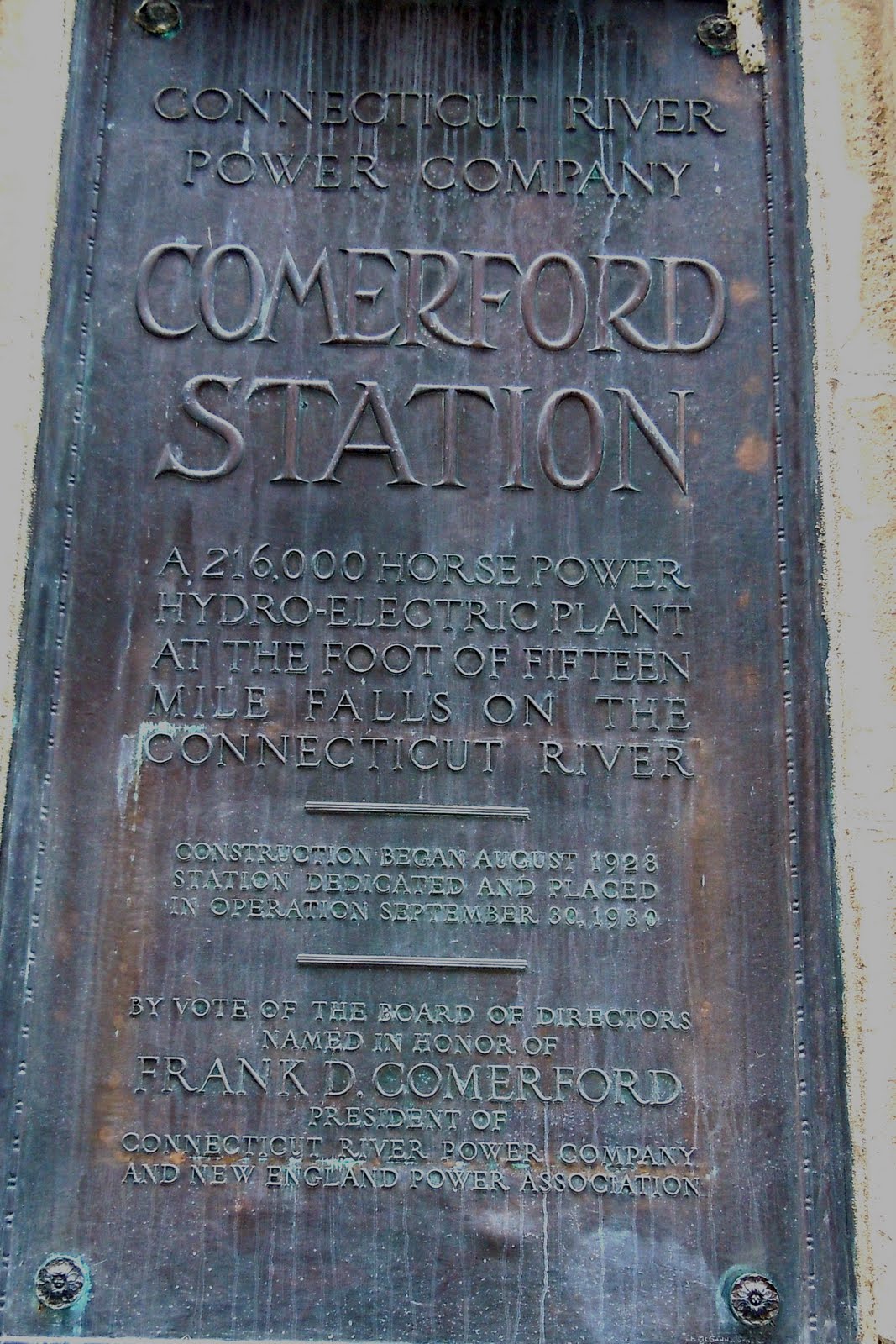
The Comerford Dam in North Monroe/East Barnet was constructed between 1928 and 1930. Up to 2700 men worked on the project, with crews working around the clock. A village was created to house and feed the men.
The completed Comerford dam was the first stage in the development of the
Fifteen Mile Falls area of the Connecticut River


This bronze plaque recalls that the dam was named in honor of Frank D. Comerford,


President of the New England Power Associaton at the time of its construction. These next photos were on Wednesday, Sept.15, 2010 during a tour of the dam. Staff member ScottFullam, Control Technician, was my very helpful tour guide.


"The Button"


In the lobby of the Cumerford Dam power station is mounted the button President Hoover pushed to activate the dam. The inscription reads: "By pressing this button, set up in the telegraph room of the White House in Washington, Herbert Hoover, President of the United


States , at 10:30 A.M. on September 30, 1930, placed Cumerford Station in operation. The impulse from the President's finger, traveling 700 miles over a special telephone circuit, opened the turbine gates and set no. 2 generator in operation."


This is the channel in the Connecticut River downstream from the Comerford dam.


The downstream face of the dam shows the "jersey barrier" type


supports that hold the dam in place.


As printed in Journal-Opinion
September 15, 2010.

Fifteen thousand years ago, the retreating glaciers deposited a giant dam near Rocky Hill, Connecticut. A huge lake, known as Lake Hitchcock, extended 200 miles up the river to present-day St. Johnsbury. By the time the dam gave way about 12,000 years ago, it had given a new shape and fertility to the Connecticut River Valley.

Within the heritage of the Abenaki, who peopled this valley before the coming of the Europeans, are legends of Odzihozo, the earth-shaper and Ktsi Amiskw, the Great Beaver.

This Great Beaver held back the waters of the Kwanitekw, or the Connecticut. But a cousin of Odzihozo broke the back of the beaver and released the captive waters.

On September 30, 1930, President Herbert Hoover pressed a button in the White House and one of the turbines in a newly-constructed dam on the Connecticut River between East Barnet and North Monroe began to produce electricity that was sent to southern New England.

On Saturday, September 18, the Third Annual Local Energy Alternatives Festival will be held in Bradford. Organized by the Energy Committee of the Bradford Conservation Commission along with others, it will be dedicated to, “renewable energy, sustainable living, local food production, transition to a world without oil and re-skilling.” A tour of the hydro-electric station at the dam on the Waits River is just one of the activities.

Taking its lead from these four events, this column deals with the history of dams in our area. In addition to standard local histories, it takes information from Where the Great River Rises, published by the Connecticut River Joint Commissions and From the Rivers by John T. Landry and Jeffrey L. Cruikshank.

Runoff from ample rainfall flows down the rocky foothills of the Green and White Mountains into the valley, creating rapidly flowing streams and numerous waterfalls. Ponds and lakes release their overflows down outlets to rivers into the Connecticut. Where hydropower was created by flowing and falling waters, the earliest settlers established their homes. The building of mills to grind grain and saw lumber was of primary importance.

For many of these mills, dams enhanced the available power. Some of these were rudimentary dams that sometimes didn’t survive the spring freshets. Others were stout wooden frameworks of logs or timbers filled with earth and stone. Where there were rock outcrops, these dams might be secured by iron spikes. Norman Smith’s History of Dams explains that the upstream wall might be sloped, “causing the pressure of the water to stabilize the dam and hold the facing materials in place…the air face was vertical so that the overflow fell straight.”

Some dams operated on a “store-and-release” principle, storing water until it was needed. Other mills operated with natural flow or “run-of-the river” design. In many cases, the mills were “high water mills” that operated only portions of the year. Dams on navigated rivers had to “include canals and locks for passage of lumber and farm products.” Water was transferred to a mill’s waterwheel by a sluice or canal to a gate that regulated the flow.

The power of the rushing or falling water was harnessed by means of waterwheels. “Protruding boards on these wheels, called ‘buckets,’ caught the downward pressure of waterfalls, turning the wheel and rotating the attached power shaft.” Wheels were of different designs with water being caught at the top, middle or bottom of the wheel.

Each town’s local history chronicles the many mills and dams located on the lakes, rivers
and streams of its community. There were as many as 50 water wheels on the Ompompanoosuc and its tributaries. At one time or another, there were a similar number on Jacob’s Brook in Orford. Wherever there was flowing water, small industrial sites developed.

Some of these include Post Mills and the other villages of Thetford, Waits River and the other villages of Topsham, East Corinth, East Ryegate, Wells River and the other valley villages of Newbury, Woodsville and the other villages of Haverhill and all along the brooks of Lyme, Piermont and Orford.

Dams were also located at the outlets on lakes such as Lake Fairlee, Morey, Tarleton and Ricke and Halls as well as Ticklenaked Pond. In addition to providing power for mills, these dams regulated the level of the lakes. Many lakes and ponds still rely on dams for that purpose.

In addition to grist and saw mills, the early water wheels ground clover and linseeds for oil; turned lathes that fashioned chairs and bobbins; powered machines that made fishing poles, paper, shingles, boxes and clothes pins. They pressed fruit for cider and jelly. Electricity was generated at Woodsville on the Ammonoosuc and at Thetford Center at the Great Falls of the Ompompanoosuc.

The falls in the Waits River at Bradford and the Boltonville Falls on the Wells River have been two of the most significant sites for power production on tributaries of the Connecticut. The first mills at Boltonville were built in 1775 by the Scots-American Company of Ryegate. Katharine Blaisdell’s Over the River and Through the Years describes the development of the river, which, at Boltonville, falls about 60 feet in a distance of about 130 feet. In 1909, the Ryegate Light and Power Company built a power plant at the foot of the second falls. Damaged by the 1927 flood, the dam was repaired and continued operation until the 1950’s, when the plant was severely damaged by lightning.

In 1772, John Peters built the first mill at the falls in Bradford. It was a grist mill
located just south of the Route 5 bridge. Two years later, Benjamin Baldwin built a sawmill at the third falls near the present Bradford Veneer and Panel Company. In 1847, Asa Low built the brick grist mill that stands at the entrance to Bradford village. Other mills, including Low’s large paper mill, stood on the west side of the river and used water from three dams to power their machines.

At the1847 grist mill, the water was carried from the fall by a wooden flume under the bridge into the basement of the mill. The water turned a large water wheel and then returned to the river. The interior location, common in many northern mills, prevented the wheel from freezing in cold weather. In 1897, the Bradford Electric Light Company began to use the old gristmill for the production of electricity and in 1902, built a stone arch dam at the middle falls. This dam was built from cut stones remaining from Low’s destroyed paper mill. The height of the dam was raised in 1921 with a 16-foot concrete section.

In 1972, the hydroelectric dam had become silted and damage to the main turbine caused the plant to be closed. In August, 1981, Central Vermont Power Company spent $3.5 million to rebuild the dam and powerhouse. Presently, it has the capacity to produce 1,500 kilowatt-hours of generated electricity. One of the activities of Saturday’s LEAF Festival will be a tour of the adjacent power station.

As has been stated before, on September 30, 1930, what is now known as the Comerford Dam in North Monroe was officially set into operation. Begun in 1928, the project employed up to 2,700 men, with crews working around the clock. It was built in cooperation with the New England Power Association which had begun to acquire land and water rights on both sides of the river several years earlier.

United Opinion articles at the time described the dam as “the largest hydro-electric plant ever built in New England.” It was the first phase of the mammoth Fifteen Mile Falls development, and it rose 175 feet above the river bed and stretched 2,253 feet from shore to shore. It had the largest concrete retaining wall ever built in the United States and each of its four turbines were capable of developing 54,000 horsepower of electricity. The electricity was sent by newly-constructed steel tower lines to Massachusetts, thus saving an estimated 200,000 tons of coal annually.

President Hoover’s role was particularly appropriate because, as Secretary of Commerce and chairman of a special government commission that was studying the “super-power” resources of the northeastern section of the country, he had visited New England. The commission’s report highlighted the need to develop the hydroelectric potential of the Connecticut generally and the Fifteen Mile Falls specifically. In that section of the Connecticut, the river drops 367 feet in elevation and, “for centuries the 400,000 horse power… was running wastefully to the sea.”


The other two dams in the Fifteen Mile Falls project are the McIndoes Station in Monroe, completed in 1931, and the Moore Station in 1957. The latter is located south of Littleton, N.H, and is the largest of the three with an output of 190,000 kilowatts. Together the three dams “comprise the largest hydroelectric generating complex in New England.”

The last significant project on the Connecticut in our region was the rebuilding of Wilder Dam(1950-1952) at the Wilder Falls. The first dam was built in 1882, slightly north at the Olcott Falls. That dam was of timber-crib construction with a concrete dam added in 1926. It had initially been built to supply water power to a paper mill, with hydroelectricity capacity added later. The mill closed in 1927.

A new dam was proposed in 1944, but local opponents such as Henry W. Keyes Jr. of North Haverhill, fought its construction in a protracted legal battle. They pointed out that the increased height of the proposed dam, and the resulting lake, would flood thousands of acres of prime farmland. Despite these concerns, some of which have proven accurate, the dam was completed. Prior to the construction of the dam, one could see the middle rock base for the Fairlee-Orford covered bridge as a small island south of the present bridge. As a result of the higher level of water, it no longer can be seen even in the most prolonged drought. The resulting lake with its flood control capability has made possible riverside homes and river recreation unknown in the 1950’s. In 2017, all four of these modern dams were purchased by Boston-based Great River Hydro from TransCanada Hydro Northeast. The State of Vermont had looked into buying 13 hydroelectric stations from TransCanada by ArcLight Capital Partners, owners of Great River was more aggressive in their bidding.


Following the devastating floods of 1927 and 1936, a different type of dam was built.
Specifically designed for flood-control, they remain generally empty during most of the time. Three such dams are the ones at East Barre, Union Village and North Hartland.

The mighty dams on the Connecticut are the modern descendants of the mammoth glacial dam of Lake Hitchcock and, perhaps, even the giant dam created by the legendary Great Beaver. With their huge artificial mounds of rock, flooded acres and altered riverbanks, they are like Odzihozo, the earth-shaper. Dams have created the industrial and recreational bases of towns and villages throughout our region and continue to give electrical lifeblood to our modern way of life. Water controlled behind dams throughout the valley means a constant supply of drinking water for people and animals and water with which to fight fires. The water that would otherwise flood homes is held in check.

The power from the hydroelectric dams free industry from being located only on the banks of rivers and streams. Whether small or large, whether the water released from them turn waterwheels or turbines, they represent the renewable energy being celebrated by the LEAF Festival this weekend. For nearly 250 years, dams have taken the power of rushing water, increased its natural power and used it over and over again as it flows to the sea.

Wednesday, August 25, 2010

Slavery: A Crime Against Humanity

The Presbyterian Church in East Topsham was one of the local churches of that denomination that included many abolition sympathizers. Their pastor, the Rev. R.N. Johnston, took an early and active stance for abolition. William Lloyd Garrison, pictured below, once spoke there "to a crowded hours." (Journal-Opinion photo)

William Lloyd Garrison (1805-1879), a major spokesman for the abolitionist
movement and publisher of the abolitionist magazine The Liberator
"The Negro Woman's Appeal to Her White Sisters" ca. 1850.
This type opf abolitonist material aimed to appeal to women as wives
and mothers for the plight of slaves separated from their families. (Library of Congress)


Alexander Twilight, born in Corinth, Vermont in 1795, became the first African-
American to graduate from an American college (Middlebury) and the first of his race to
serve in a state legislature. His lasting contribution was a teacher and headmaster of the
Orleans County Grammar School in Brownington, Vermont.


(Library of Congress)


Published in the Journal-Opinion, August 25, 2010


“Born of a resistance to arbitrary power—her first breath that of freedom—her first voice a declaration of the equal rights of man— how could her people be otherwise than haters of slavery—how can they do less than sympathize with every human being and every community which asserts the rights of all men to blessings like their own?”

This is how, in 1855, the Vermont Senate explained the strong stand taken by many Vermonters against slavery in America. As we approach the 150th anniversary of the beginning of the Civil War, this column examine the way Vermonters struggled with America’s “peculiar institution.”

Slaves from Africa were first brought to Virginia in 1619. By the time the union was formed there were slaves in all the states. Slavery was the basis of the economy in southern regions, and it was a contentious issue. Slavery’s importance was reflected in the compromises written into the Constitution. But, not in Vermont. When it adopted its constitution in July 1777, Vermont declared adult slavery unlawful.

As there was a negligible black population, this significant action was easy. Randolph Roth, who has written on both the subject of abolition and the Connecticut River Valley, estimates that approximately 250 blacks lived in the valley in the late 1700’s. Some were free and others held as slaves. The 1790 census recorded four slaves held in Haverhill, three in Orford and two in Piermont. It also listed a small number of “non-white free persons.” The 1791 Vermont census listed as free, Jeptha Sharp of Bradford, George Knox of Thetford, Jeremiah Virginia of Newbury and other African-American area residents.

Some of these were active leaders in their communities. Jeptha Sharp was among those Bradford residents, who in 1796, petitioned the state to create Vermont’s first incorporated library. Alexander Twilight, born in 1795 in Corinth, was the first African-American to graduate from an American college and the first to serve in a state legislature. His lasting contribution was as a teacher and headmaster at the Orleans County Grammar School in Brownington, Vermont. His lasting monument is the large granite hall he built with his own hands for the school’s expanding student population.

While both Vermont’s dedication to equality and individuality, (and its small black population), are important reasons for the growth of the abolition movement, the lack of shipping interests involved in the slave trade or commercial dealings with the South were contributing factors.

The first organized effort in Vermont to deal with the issue of slavery was the formation of the Vermont Colonization Society in 1818. Its members held that the cure to the “heavy curses” of slavery was to purchase slaves from their masters and send them back to Africa. Believing that whites and blacks could not mix in society, they feared a “dreadful collision” between the two races.

Rev. Silas McKeen of Bradford was active in the Society. In a sermon delivered at their meeting in Montpelier in October, 1828, he reviewed the success of the national effort in establishing Liberia on the west coast of Africa and the settling there of 1200 free blacks. He extolled the valuable influence of this Christian colony on the rest of Africa’s “moral desert.”

McKeen hoped that these efforts might awaken a “slumbering conscience” in slave holders. As a result, Southerners would recognize that the “intolerable burden and curse” of slavery could be “taken off their hands” as freed blacks were restored to freedom in Africa. He predicted that unless this effort was successful, the “impending doom” of God’s wrath would descend upon the nation.

For other Vermonters, the only solution to the curse of slavery was immediate emancipation. This more radical movement found its voice in the Vermont Anti-Slavery Society, organized in 1834. With great zeal, its members criticized both slavery and the racist “gradualism” of the colonizationists. William Lloyd Garrison of Boston was its primary spokesman.

Strident voices raised the level of reaction to the abolitionist movement. Abolitionist attacks on the Constitution led to fears among many for the union it created. Commercial interests feared for interruption of trade and the loss of rights to private property. Abolitionists’ connections with other reform movements, such as women’s rights and the prohibition of alcohol, caused additional opposition. There is no doubt that some Vermonters feared the impact of a free black population.

In 1835, Congressman William Slade of Vermont reflected this hesitancy with the following statement: ”I believe the immediate and unqualified abolition of slavery to be inconsistent with a just regard, both of the best interest of the community, and the highest welfare of the slaver.” In later years, he became an advocate of immediate emancipation.

In 1835 two incidents in the area reflected that opposition. They are described in the Vermont History article “Racism in Antebellum Vermont” by John M. Lovejoy. In September, an itinerant abolitionist lecturer was driven from a Bradford lectern by a mob with the use of a fire pump. He had chosen to speak despite appeals that it would “only agitate the subject.”

In November, Rev. George Storrs of the New Hampshire Anti-Slavery Society spoke at the Methodist Church in Newbury. “A number of men and boys gathered in and outside the chapel making speeches, talking loudly about maintaining the Constitution and the Union. They did their best to disrupt the event, hollering, ringing the bell, breaking a panel on the front door, and throwing brickbats. But Storrs prevailed, raising his voice loudly when the occasion called for it.”

While three of these rioters were arrested and fined for disruption of the free speech rights of Rev. Storrs, there seems little doubt that many Vermonters agreed with them. Wells’ History of Newbury mentions, that in 1842, many at the Newbury Seminary objected to the admission of a black student as, “it was held by a large portion of the public to be a sin and a crime to teach a colored person to read and write.”

In the late 1830’s and 40’s, national events increased support for the abolition movement. Since Vermont’s and Kentucky’s entrance into the Union, there was a pattern of balancing new states between free and slave. From the beginning of the nation’s expansion, there was more agreement in Vermont against the spread of slavery than there was over what should be done with it. Territorial gains from the acquisition of Texas, the Mexican War, and “schemes for the acquisition of Cuba” raised fears among otherwise conservative residents of the area.

When, in 1850, Congress passed the Fugitive Slave Act designed to punish those who harbored slaves with imprisonment and fines, Vermonters declared any slave brought into the state would be free. This was an extension of the 1804 statement by Judge Harrington of Middlebury who declared that “slave ownership would only be recognized by a bill of sale for the slave signed by Almighty God, Himself.” Numerous petitions and legislative resolutions from Vermont so outraged many in the South that one Georgia Senator suggested that a ditch be dug around Vermont so that it could be floated into the Atlantic.

Runaway slaves found refuge and work among area residents. The sewing circle of the Topsham church wrote the following: “We want to give the little money we raised, in such way that the fugitives who are really needy, will be befitted.” Tradition holds that there were a number of stations along the Underground Railroad in towns bordering the Connecticut. Modern research suggests that the notions of danger and secrecy are exaggerated and “that actual aid to fugitives was provided casually if not haphazardly and often delivered quite openly.”

The battle between the two major anti-slavery groups caused turmoil between and within the major Protestant churches of Vermont. Congregational ministers generally supported the colonization even as a growing number in their membership joined many Baptists, Methodists and Presbyterians in supporting the more radical abolitionists. With time, some Congregationalists abandoned their earlier stance. This change is reflected in an 1856 Thanksgiving sermon preached at Lyme by Erdix Tenny, entitled “American Slavery: Not Sanctioned by the Bible.”

The Rev. Orange Scott of Newbury was one Methodist minister who worked to persuade his denomination to “embrace immediate emancipation.” Both abolitionist groups used Christianity to justify their stance, an appeal that had less effect on the unchurched.

Two of the most active ministers in the cause were Rev. James Milligan, of Ryegate and Barnet and Rev. R. N. Johnston of Topsham. Both served Presbyterian churches, a denomination that took an early and active stance for abolition. Milligan toured the area lecturing for the “immediate, unconditional abolition of slavery and the full integration of Afro-Americans into American society.” He joined Storrs in facing down the Newbury mob in 1835.

Johnston served the Topsham church from 1851 to 1866. According to Roth, Johnston both gave anti-slavery lectures and arranged lecturing tours that “opened the way for old anti-slavery apostles.” On one of these occasions, William Lloyd Garrison lectured in Topsham, “to a crowded house, for almost all classes of people were curious if not anxious to hear the great Abolitionists.”

Topsham Sketches states that Johnston’s activities “roused not only the ire of some of the members of his church but of people in neighboring towns and several times he received threats against his life. A placard was hung on “the church by some pro-slavers which read ‘Death to traitors and nigger preachers.’” He wrote on one occasion that he was warned that a mob of 50 men from Corinth and Bradford was coming to do him harm. Johnston was also involved in two anti-slavery conventions held in Bradford in 1858 and 1860. At those meetings, conflicts continued to erupt between “every shade” of anti-slavery advocates.

By the time these conventions were held, the abolition movement was having a major impact on Vermont’s political parties. In 1854, Vermonters began to abandon the Democratic and Whig parties and embraced the newly formed Republican Party. The Republicans held Vermont’s loyalty until 1964, the longest single-party state control in American history.

By 1860, the issue of slavery had created an “insolvable dilemma” that tore the nation apart. The Republican candidate in the election of 1860 was Abraham Lincoln. Lincoln held more moderate views on slavery than the radical abolitionists and Vermonters gave him three-quarters of their votes. When in 1861, Vermonters responded to Father Abraham’s call for troops, the main motive was not to abolish slavery, but to restore the union.

In 1863, Lincoln signed the Emancipation Proclamation giving freedom to those slaves being held in the 10 rebellious states. In 1865, at the conclusion of the Civil War, the 13th Amendment was adopted, officially abolishing slavery in America.

Tragically, it was not the end of involuntary servitude, which still exists in America. In April, Governor Douglas signed into law a bill establishing a task force to recommend actions to the Legislature to deal with the issues of human trafficking. In doing so, Vermont joins most other states in addressing this issue. To rephrase the 1855 statement: How could Vermonters be otherwise than haters of slavery—how can they do less than sympathize with every human being and every community which asserts the rights of all people to blessings like their own?

Thursday, July 29, 2010

Going to Summer Camp

Early in the 20th century train-loads of campers arrived in the Upper Valley for summer residential youth camps established by pioneers in the industry. (Photo: Frank.J. Barrett, Jr.)
Some of the nation's earliest camps for girls were located in the Upper Valley. Anna Dodge of Post Mills was a force behind the establishment of Quinibeck on Lake Fairlee. Campers are shown here presenting a classical tableau, c. 1915. Performances of this type were prepared for camp and public audiences. (Photo: Fairlee Historical Society)


One of the earliest, if not the earliest, camp for girls was established on Halls Lake in Newbury by Julia Farwell. Riders from the camp are shown here in front of Hale's Tavern in Wells River about 1910. (Photo: Newbury Historical Society/David Kazan)


Virgil Prettyman established Camp Moosilauke in 1904 on Upper Baker Pond in Orford. In the early years boys swam without bathing suits. The photo below shows the rustic cabins original to the camp. Today the camp still uses some of these cabins and the original dining hall. It is described by the current staff as "a recess with no classes." (Photos: Camp Moosilauke)


Girls of Summer gather on the railroad platform at Ely c. 1916. (Photo:Thetford Historical Society)

Boys from Lake Morey's Camp Lanakila prepare for a camp expedition around 1926. Establihsed in 1922, it was part of the Aloha family of camps and served "the little brothers of Aloha and Hive campers." Below is a photo of Mother and Father Gulick (Luther and Harriet Farnsworth Gulick). The Gulicks and their extended family are responsible for establishing the Aloha camps, Camp Hanoum (now Farnsworth) and the Camp Fire Girls. (Photos: Aloha Foundation)

Going to Summer Camp”
In Times Past
Journal Opinion July 28, 2010
THIS ESSAY IS JUST ONE IN THE COLLECTION "IN TIMES PAST: ESSAYS FROM THE UPPER VALLEY, BOOK TWO" AVAILABLE FROM THE AUTHOR FOR $24 INCLUDING POSTAGE AND HANDLING.   
“There seems to be something almost magical in the common things of life that draw people together. Doing those things together that all the people of the world have done together; experiencing the world-old and world-common feel of the earth under one’s feet, the look of green trees, the touch of fresh water; cooking in the open; sleeping on the ground about a camp fire; carrying the pack; standing the strain of the long trail…under such conditions souls fuse.” Dr. Luther H. Gulick, 1917.

Residential youth camps have flourished in the Upper Valley from early in the 20th century. Those who established these camps were pioneers in the camping industry. This column will identify several of those pioneers and describe their lasting contributions. The impetus for this column comes from an unpublished manuscript from David R. Kazan, a summer resident of West Newbury. His manuscript describes the contributions of Julia Farwell of Newbury and the camp she established on Halls Lake.

Leslie Paris’ Children’s Nature: The Rise of the American Summer Camp describes the origins of the camping movement in the cultural changes of the late 19th century. As America became more urbanized there were fears that the increased leisure for youth would lead to boredom, listlessness and “unsavory influences.” Many camp pioneers worried that urban living was unhealthy and would also diminish, “a familiarity with the natural world, a slower pace, a rootedness in the land.” The first camps were established in the 1880s and served several hundred middle and upper-class Protestant boys. In the 50 years that followed, youth residential camping expanded to include other groups and by the interwar years, more than a million children went to camp each summer.

Most of the early camps were for boys and young men. A few visionaries felt that the benefits should be extended to girls. One of the earliest pioneers in camps for girls was Julia H. Farwell. Born in 1855, she grew up in Wells River and was a graduate of Mt. Holyoke Seminary, Barnard College and Columbia College. As early as 1898 she began teaching in the Castle School, a school for girls in Tarrytown, New York. During summer recess she returned to her home in Wells River.

The exact date she established “Miss Farwell’s Summer Camp for Girls” on Halls Lake is part of the mysteries that Kazan explores in his manuscript. Some sources list the date as 1905 or 1906. However, a May 26, 1909 New York Times advertisement states that the camp was in its 20th year. If the camp was established in 1889, that makes it the oldest girls camp in the nation. Even the later dates place it among the oldest. Farwell directed the camp until 1918. The camp bears her name to this day.

Of all the local pioneers, the extended family of Dr. Edward and Harriet Farnsworth Gulick receives the most credit. Known as Father and Mother Gulick, they established Camp Aloha on Lake Morey in 1905 and Aloha Club on Lake Katherine in 1915. In 1910, they founded the Camp Fire Girls and were among the founders of the American Camping Association. In 1908, Harriet’s brother, Charles Farnsworth and his wife Ellen opened Hanoum (now Farnsworth) in Thetford. Sister Ellen Farnsworth established Aloha Hive on Lake Fairlee in 1915 for girls too young to attend Aloha. In 1922, the Gulicks’ daughter Carol Gulick Hulbert and her husband Chauncey opened Lanakila on Lake Morey for “the little brothers of Aloha and Hive campers.”

At the time of its centennial in 2005, the Aloha Foundation recalled Aloha’s opening day: “On June 30, 1905, Father Gulick took the children, Leeds 13, Carol, 8, and Harriet, 6, to meet the train in Fairlee. There they greeted Aloha’s first twenty-three campers, sooty and tired after arduous travels by horse and carriage and a succession of trains. Once in Fairlee, some of the exhausted girls proceeded to Aloha Cottage aboard the Lake Morey Steamer, and some finished the journey by horse and carriage. Trunks and duffels followed by wagon up the dusty lake road.”

Another early camp was Lake Fairlee’s Quinibeck, described in the 1925 Directory of Private Summer Camps as, “one of the most successful camps for girls in the country.” Much of that success is attributed to Anna Dodge. A Post Mills native, Dodge played a leading role at the camp from its inception in 1911 until it closed in 1971. A graduate of Thetford Academy and Castleton Normal School, she was a teacher and superintendent in the Thetford schools. Dodge’s influence extended beyond Quinibeck as she served on the board of the National Association of Directors of Girls’ Camps and hosted sessions for New England camp personnel at Lake Fairlee.

In neighboring New Hampshire there are several early summer camps. In 1904, Virgil Prettyman established Moosilauke, a camp for boys, on Upper Baker Pond in Orford. He was the first headmaster of the Horace Mann School, an affiliate of Columbia College. Nearby is Pemigewasset, established in 1908 by three friends, Drs. Edgar Fauver, Edwin Fauver and Dudley Reed. They were all graduates of Oberlin and Columbia Medical School. “Pemi” is the oldest summer camp in the country under the same continuous family ownership and management.

In this period there were a number of other camps established, some of which were short-lived. On Lake Fairlee: Billings (1906), Big Pine (later Beenadeewin 1908), Shanty Shane (now Ohana, 1911), Neshobe ( later Norway 1912), Kenjocketee (1912), Lochearn (1915) and Wyoda (1916), On Lake Morey: Honomoka (1910) and Wynona (1914). On Lake Armington: Tahoma (1913); Lake Tarleton: Serrana (1916). South Strafford: Ken-Jocketee (c. 1920); Lyme Pond: Pinnacle (1916). On Lake Stinson in Rumney: Eagle Point (1905), Agawam (1919-20) and Stinson (1927); Thetford Center: Campanoosuc (1907) and Kokosing (1920). Others were established in later years.

While some of the camps offered separate age-group divisions within the same location, others created affiliated camps to separate younger campers from older ones. Boys were separated from girls and it was only later that a few co-educational camps were created. In 1915, Billings began devoting half the season to boys and the other half to girls. Shanty Shane was created as a family camp for those parents who had children encamped nearby.

Many of these camp names were taken from Indian legends or landmarks with native names. This was in keeping with the pseudo-Indian programs often carried out in the camp activities. Wyoda was a “beautiful Indian maiden of high ideals.” Passumpsic was a native word for “much still water.” Aloha, Lanakila and Hanoum came from the Gulick-Farnsworth families’ experiences as missionaries in Hawaii and Turkey. However, Billings took its name from the Billings family of Woodstock, generous patrons of the camp. Lochearn’s name reflected its Scottish theme.

The men and women who established and staffed these camps were individuals who had built careers working with young people. They were educators in public and private schools and colleges. Some were staff members in church or youth organizations. Counselors were chosen for their ability to work with children and be positive role models. Parents were assured that the personnel offered group and individual guidance within a carefully supervised and safe environment.

Camp programs were centered in the activities mentioned by Edward Gulick in his 1917 statement. Campers learned to swim, sail and canoe on area lakes and rivers. Wearing required camp uniforms, they hiked local mountains, tented in wilderness areas and went horseback riding on wooded trails. Creative fun in the form of handicrafts, nature crafts and group games made up a portion of each day. Stories, performances and group singing around a campfire rounded out the evening. Accommodations were rustic cabins or tents. For urban children, this was “fun with a purpose”, a fulfillment of the “back to the country” movement, nature up close and personal.

Some camps advertised specialized programs. Farwell “made much of archery” and horseback riding. Hanoum in 1910 tutored campers in foreign languages and mathematics augmented by toasting marshmallows and “girl talk.” Pinnacle advertisements mentioned manual training and rifle practice. Moosilauke’s early program included auto maintenance.

Interviews with local elders reflect a variety of opinions about camping experiences. Those who grew up in rural settings or were from poorer families rarely had the opportunity to go to camp. The farm or village or city streets were “camp” for many. Their summer activities, like my own, were more likely to be self-directed. Some camps operated by church or youth organizations made camping available to girls and boys of moderate means. Billings did that by keeping fees low and by establishing a scholarship fund in 1916.

Of those who went to camp, most recalled positive camp experiences, often establishing lasting friendships. One local resident commented, “It was the highlight of my youth.” But there were also bouts of homesickness and pranks. Those pranks could turn both ways. While most discount short-sheeting of a camp cot or a nightly snipe hunt as harmless, being designated the camp”goat” bordered on harassment and abuse. One elder recalls being thrown into a lake “to learn to swim” as the basis of a life-long aversion to swimming.

The summer camp industry had a major impact on the local economy. It offered summer employment to those who were available because of school and college breaks. Many were counselors and others worked in the local train stations and camp offices, kitchens, infirmaries and laundries. Maintenance personnel positions were both seasonal and year round.

During the first half of the century, campers usually arrived in special train cars from southern and eastern cities and would be dropped off at local stations. Local individuals provided transportation for campers to and from train stations as well as to churches and river docks and on mountain expeditions.

Camp advertisements often noted that fresh produce was purchased from local farmers, eventually supplemented by wholesale produce companies. Camp Quinibeck maintained its own farm and provided year round employment for its farmers. When parents’ weekend began, the impact on local hotels and restaurants was significant.

Campers and counselors purchased items at local stores. An entry in a 1910 camp diary reported that a troop of girls descended on a Fairlee soda fountain and left the young attendant quite beside himself. He was probably not the only local lad upended by these city girls of summer. Having purchased a lantern, the diary writer stated the campers, “lit up the town.”

Campers also participated in local events and often attended local churches. The Post Mills church was filled to overflowing with campers, many of whom arrived via the lake on “war canoes.” Farwell campers enjoyed attending local baked bean suppers. Camp choruses and theatre companies performed for local audiences. In 1911, campers from Hanoum played a major role in the Thetford Pageant. In 1922, Camp Moosilauke Merrymakers began a yearly appearance performing for a Fairlee church benefit.

Some of these camps have closed and others have opened. The Great Depression and World War II impacted the camping industry as did the post-war prosperity. Closed or open, many have alumni organizations. Alumni loyalty being significant, some families attended a camp over several generations. Former campers sometimes became camp staffers. Alumni visits to the local area added to the positive economic impacts.

An added benefit of the camping experience was to free parents of their children during the long summer vacation. One advertisement stated: “Thoughtful parents find in Camp Passumpsic a happy solution to the summer vacation problem.” All programs were designed to send youngsters back to their parents healthier and more self-reliant, “enriched and inspired” by a summer at camp. Therein lies the value of the summer youth camp movement; a movement that has its roots in our region.

Sunday, July 4, 2010

Bradford UCC Celebrates Bicentennial

Mary Sanborn describes the contributions of long-time organist Katrina Munn as the Bradford Congregational Church celebrates its bicentennial.

We gather together to celebrate 200 years of worship. Group photograph taken following the bicentennial service of worship, Sunday, June 27, 2010. (photo: David Perry)


The Bradford Congregational Church (UCC) was organized June 24, 1810. Two hundred years later it held a gala bicentennial celebration. The pictures below are by Janice Neubauer for The Bridge Weekly Sho-Case.

Moderator Daniel Perry II, longtime member of the church, acts as Master of Ceremonies for Saturday, June 26th special presentation honoring the present church building, its history and architecture and the special contributions of several significant members in its past.


Rev. Silas McKeen, represented here by Larry Coffin, was the pastor of this church for 43 years in the 19th century and was instrumental in its growth. A native of South Corinth, McKeen became the pastor in 1814. He was widely known for his sermons and efforts on behalf of the temperance and abolition movements.


Martina Stever, general chair of the Bicentennial Celebration, gives a history of the original church building, and describes the architecture of the current church building pointing out the stained glass windows which over the years replacing the originals.


Carolyn Coffin (right) conducted tours of the restored and renovated Church Parsonage.


She is shown here with church member Barbara Stahl.


Bruce Stevens of Ryegate, plays the church's newly restored pipe organ at the Concert, the grand climax to Saturday's events. Stevens was recently honored as Artist of the Year by the Vermont Chapter of the American Guild of Organists.


Church Historian Eris Eastman provided a history an memorabilia display for the Bicentennial Celebration. The display included programs from previous celebrations as well as photographs from as far back as 1875.


Some of the members of the church pose with Vermont Governor Jim Douglas, who with his wife Dorothy, honored the church with a visit to the Saturday celebration. Back row L-R: Eris Eastman, Virginia Moore, Gloria Fox, Daniel Perry, Robert Gallo. Front row: Mary Sanborn portraying long-time organist Katrina Munn, Governor Douglas , and Larry Coffin as Rev. McKeen.


Thursday, June 24, 2010

Church, Town and Disestablishmentarianism

The First Congregational Church of Thetford was organized in 1773. The meeting house was built in 1787 at the south end of Thetford Hill's common, serving both as a church and town meeting hall. It was moved to the present site in 1830 and is now the oldest church building in continuous use in Vermont.
In 1875-6, the Bradford Congregational Society voted to replace its old church with a new one. The new one, shown here being constructed, was designed an built by Bradford's George Farr. The older structure can be seen on the left, before being moved to the rear of the lot.

On June 24, 1810, the Bradford Congregational Church was established and in late June, 2010 held a weekend of activities to commemorate its bicentennial.


The First Congregational Church at Haverhill Corner traces its orgins to the Haverhill town
church and preaching of Rev. Peter Powers in 1765. The building was built in 1827 by the Methodist Episcopal Society and sold to the Congregationalists in 1829.


CHURCH, TOWN AND DISESTABLISHMENTARIANISM
Journal-Opinion, June 23, 2010

During this coming weekend the Bradford Congregational Church will celebrate its bicentennial. Celebration activities begin with an old fashioned hymn sing on Friday night. On Saturday, following a tour of historic sites connected with the church, a ham and salad dinner and a Bruce Stevens organ recital will be held. Activities conclude with a church service and birthday luncheon on Sunday. All of these events are open to the public.

If the Congregational denomination was the dominate one in the early years of this area’s settlement, why did it take over 40 years for the Bradford Congregational Church to be established? To answer this question, this column explores the relationship between town government and churches in the area during the first half-century following settlement.

The early settlers transplanted the culture of southern New England to the area, changing it as needed to meet the demands of the frontier. Some migrants left their earlier homes because of upheavals in established churches there. Many brought with them strong religious beliefs. Many of the established town churches were Congregational. This denomination’s belief in absolute local control over church affairs introduced the town meeting form of government throughout New England.

Most settlers, especially community leaders, adhered to the Connecticut Standing Order that allowed town tax revenues to be used to build houses of worship and support ministers. In 1783, the Vermont legislature enacted this practice into law, despite the 1777 Constitutional provision: “No man ought, or of right can be compelled to attend any religious worship, or erect, or support any place of worship, or maintain any minister contrary to the dictates of his conscience.”

New Hampshire had a similar protection written into its Bill of Rights. This protection did not prevent the states from requiring residents to support their own church and town church membership was assumed unless otherwise declared.

From the very beginning many settlers felt the need for worship services. The lack of church buildings did not stand in the way, with services being held in barns, private homes and taverns, and in the case of Fairlee, in a field next to the river.

One of the earliest projects undertaken by towns was the building of a meeting house for both worship and town meetings. The meeting house at Thetford Hill, the construction of which began in 1787, today remains the oldest Vermont church in continuous use. In some communities decisions about the placement of the building within the town were the subject of much controversy. Some towns called on a committee from neighboring towns to make an impartial decision. Because many put no special significance in the place of worship, these dual purpose buildings were used for decades, sometimes with several denominations and town meetings taking turns.

As there was a shortage of ministers, towns yoked with neighboring towns to worship together or share a minister. One of the earliest religious leaders in the area was the Rev. Peter Powers of Newbury. He helped establish the Newbury church in 1764. That town’s historian Frederick Wells writes of Powers: “His parish at first included all of the settlements from Hanover to Lancaster. He was often called to go on long and lonely journeys through the wilderness to solemnize marriages, bury the dead, and break the bread of life to the people, and he did not shrink from any labor, however great.” Powers played a leading role in creating town churches in Fairlee, Orford, Haverhill, Ryegate, Lyme and Thetford.

With a shortage of hard cash, towns often paid ministers in, “corn, grain and the fruit of the earth.” Rev. Richards of Piermont wrote that he had never received a single dollar in hard money for his services. In 1790, the Groton town meeting voted, in an action common to the area, to raise 40 bushels of wheat “For the support of the gospel in town.” In Newbury, timber from the glebe land was used to pay the minister. In addition to town revenues, some churches gained financial support from the sale or rental of pews.

As is still true, the effectiveness of a particular minister determined the growth or decline of a church. An effective minister might lead a revival of interest and fill the pews only to be followed by a less effective one and reduced attendance. One Haverhill church, after having a revival of interest in the 1790s, was described as having, “a period of discouragement and gloom” after 1807, with only 12 of 90 members remaining.

Attending church on the Sabbath was an all-day activity. The buildings were usually unheated and both the prayers and sermons were long. The benches were hard. There was a protracted controversy over the singing of hymns during worship. Jeremiah Ingalls of Newbury, one of the nation’s major hymn composers and singing masters, made a significant contribution to quelling that controversy by teaching congregations “Christian Harmony.”

Families often walked or rode many miles to attend, both because of the desire to do so and because it was expected. Sunday Mountain in Orford was so named after a Mr. Palmer died there: “the awful fate of a man who defied the Lord’s wrath by going exploring on a Sunday instead of joining the pious congregation at religious meeting.” Church discipline was a serious matter and extended into daily life. Officers known as “beadles” were selected to enforce discipline during services and tithing men policed behavior in the community. Errant members were subject to excommunication.

The number of Vermonters who regularly attended worship services varied significantly through the years. During a 1789 tour of the state, Rev. Nathan Perkins wrote, “Not more than 1-6 part of ye families attend family prayer in ye whole State. “ He went on to say that only half supported public worship and that for the rest there was no Sabbath, no religion, no heaven or hell and no morality. Revivals caused significant growth in church membership during the first half of the 19th century. According to historian Randolph Roth, “by the mid 1830s, Vermonters were the most churchgoing people in the Protestant world. Eighty percent attended church regularly.”

While many of the towns in the area operated under the presumption that all residents were Congregationalist, there were exceptions. Many of the early residents of Ryegate, Barnet and Topsham were Scottish Presbyterians and hired ministers of that denomination.

In other towns, the Baptists and Methodists had an early presence. Historian John Fatherly writes that the Baptist Society of Bradford was organized in 1793 and erected a meeting house on the Upper Plain. They reorganized in 1805 stating they had 25 members: “This language is important because the Laws of the State of Vermont (1797) provided that the inhabitants of a town having a similar denomination could form into a society when their number exceeded twenty-five; and the property of these individuals would be exempt from being taxed for religious purposes.”

These “adherents to other doctrines,” now protected in both states, complicated town votes on covering church expenses. When the question came before the 1800 Corinth town meeting, non-Congregationists prevailed and refused to, “support a minister of any denomination whatsoever from town funds.”

Because the 1797 law did not protect those who were members of no church from being taxed, there was an additional movement to abolish the injustice of the town church tax connections. Those who supported the disestablishment viewed the practice as a form of discrimination. The new Republican Party, the members of which supported the ideals of Jeffersonian democracy, joined them in bringing changes in the law.

Antidisestablishmentarians organized in opposition to this movement. They asserted that abolishing the Standing Order was “irreligious and asserted that the power of truth against the reign of evil would be destroyed if the state, by reason of public taxes, ceased to support an orthodox and fearless clergy.” Incidentally, that word is about the longest nontechnical word in the English language. In elementary school we discussed that word, generally believing we would never use it much less be able to spell it.

In 1807, Vermont broke the connection between towns and churches. One missionary from Connecticut was of the opinion that those who were responsible for this action “were infidels, Baptists, and Nothingists.” Passing the law did not mean the practice changed immediately. According to Thetford historian Charles Latham, “Thetford simply ignored or evaded the 1807 law ending tax support for the church…”

In 1819, the New Hampshire Legislature passed the Toleration Act, releasing towns from the obligation of supporting the church. Towns and town churches in New Hampshire joined their Vermont counterparts facing, “the dilemma of how to pay the minister if not from the town treasury.”

Now to the question of the bicentennial of the Bradford Congregational Church. Bradford had followed the example of other towns in maintaining a town church. A meeting house was completed in 1795 on the Upper Plain. For 14 years Rev. Gardiner Kellogg was the only minister of this church, the Congregational Calvinistic Church. By 1806 a total of 150 Bradford residents had declared in writing to the Town clerk that they did not agree with the religious teachings of this Congregational majority.

When the 1807 law was passed, members of the town church dissolved their organization, “with a view to the formation of a new church, with a more orthodox creed, and consisting of members more intimately united in Christian fellowship.” Rev. Stephen Fuller of Vershire, helped seven members to organize the present Congregational Church on June 24, 1810. He described their desire for a new church as the need to rise from a “deranged, broken and disunited state, professing to feel the importance of getting into a regular state, in which they might exercise Christian faithfulness towards one another, and instead of darkness, hold up light to the world.”

In 1815, Silas McKeen was ordained in this church and began a distinguished career that, with a ten year interruption, lasted until 1866. In 1836, the building on the Upper Plain was purchased by the church and moved to Main Street. Two years later a parsonage and church bell were purchased from a bequest by Timothy Ayer.

In 1875, the church decided to build a new building. The old one was moved to the southwest corner of the church lot and over the years has been used for a number of purposes including its current use as the Old Church Theatre.

During the first century and a half, the Bradford Congregational Church experienced the strong membership and high attendance that characterized the times. As with other churches in the area, it reached out to meet needs of its members, the community and, with mission activities, the broader world. In the 1960s those high numbers began to decline. Recent surveys reveal that Vermont and New Hampshire are ranked among the lowest in regular church attendance.

My wife and I are members of the Bradford Congregational Church. I have always been a Congregationalist; my wife grew up in Bradford’s Grace United Methodist Church. In our family histories are members, including deacons and ministers, of both those denominations and others. Not only do we believe that church membership is important for us personally, we believe that churches play a vital role in the life of any community. As our church celebrates its bicentennial it finds itself on the verge of calling a new pastor. A new pastor in any church offers the opportunity for renewal, even in Vermont and even if it is 200 years old. .

Sunday, May 23, 2010

Driving the Middle Way: Log Drives on the Connecticut

Area residents sometimes joined the river-side encampment
for a Sunday dinner. (Bradford Historical Society)

Van Dyke log drive c 1909 at the Thetford-Lyme Bridge. Notice rivermen
on the logs and spectators on the bridge. (Lyme Historical Society)

These logs would have just passed through several of the most difficult sections
of the drive on the Connecticut River. ( From Katharine Blaisdell)


This photo was taken just north of the Village of Bradford.The cooks often
prepared bean-hole beans for the crew's meals. (Bradford Historical Society)


This historical site marker in the Great Northern Woods of New Hampshire
reminds motorists of the log drives that originated in that area.

Journal OpinionMay 19, 2010

They came from the north during the late spring and summer. The sounds they made were of distant thunderstorms growing gradually closer. But they were not storms. They were the annual log drives down the Connecticut River from the great northern woods to mills in southern New England. They provided spectacular shows for area residents gathered on the riverbanks as they passed.

Much has been written about the history of log drives on the Connecticut. This article will focus on the drives as they passed through this region. In addition to town histories, the information comes from Robert Pike’s Tall Trees, Tough Men, Bill Gove’s Log Drives on the Connecticut River and Katharine Blaisdell’s books. These titles are recommended to those who want additional information.

The earliest settlers of the region found a primeval forest with trees sometimes reaching 200 feet in height. These forests had to be cleared to establish farm fields. Surplus logs and lumber were floated down the river to markets, domestic and foreign.

After the Revolution, Bradford’s John Barron and Orford’s Israel Morey entered into a contract to deliver logs down the Connecticut to be used as masts for the French Navy. The average log was 60 feet long with one measuring 116 feet long and 40 inches in diameter. In his description of this enterprise Silas McKeen noted that “there was a giant gathering to witness the logs rolled into the river.”

After 1810, local lumbermen built rafts from boxes of logs and drifted them down the Connecticut, returning by foot. Wells’ History of Newbury states that it took 25 days to make the round trip from Wells River to Hartford, Connecticut. In 1827, Horace Allbee of Fairlee made the trip with 76 individual boxes fastened together into rafts. These rafts often held timbers and other area products for market.

From the beginning there were problems with bridge companies whose structures were damaged and from mill owners who needed dams for consistent water levels. As canals were built, restrictions were placed on the size of these rafts. At the Bellows Falls canal they “were not to exceed fifty-four feet in length and seven in width and to draw not more than three feet of water.” When loose logs were too long for the canal locks, they were “coaxed over dams and falls.”

In 1854, C. W. Bliss, later of West Fairlee, was hired to work as a cook for the crew of 18 rafts with 108 boxes bound for Holyoke. When they reached the Bellows Falls canal it took three days to break up the rafts and pass them through the locks. A large gathering of local people watched as the crews raced to reach the locks first.

The first long-log drive from the forests south of the Canadian border to mills and markets in southern New England was held in 1868. Over the next 46 years this annual event would represent, according to Gove, the longest log drive in the nation; “None compared with the Connecticut River when considering the volume of logs involved,” he wrote. The logs were cut in the winter by lumberjacks housed in camps and piled beside the river and its tributaries. The drives began, often with up to 700 men, when the ice went out and there was sufficient flow from melting snows.

The area from Fifteen Mile Falls north of McIndoe Falls to south of Lyme and Thetford was the middle way for the journey from the Connecticut Lakes to the mills in Massachusetts and Connecticut. That stretch of over 50 miles was also one of the most dangerous in the entire 345 miles of the river. At the Falls, the river fell almost 350 feet over the large boulders and ledges. In the middle was Muliken’s Pitch. Pike writes that the Pitch “was known as the most dangerous place on the whole river.” Because early drives got hung up in the Falls, the Connecticut River Lumber Company blasted open about 10 miles of this section.

Below where the Passumpsic River joins the Connecticut, there was a difficult stretch known as Twenty-Seven Islands. It was followed by the Woodsville Narrows, up stream from the present Wells River-Woodsville bridge. Wells History of Ryegate calls the Narrow “the wildest spot on the river above Bellows Falls.” Below that location was where drives from companies logging the upper regions of the Ammonoosuc came into the river.

After Woodsville were eddies, islands and wide oxbows. When water was very high logs stranded on the meadows, when low on sandbars. The section down river also presented problems. An article in the Bradford Opinion of August 2, 1879 stated, “The rear of the big log drive in the Connecticut passed here on Saturday. The river men were several deep getting around Johnson point and Willard bend. The next hard place below here was Fairlee mountain and then near Ely station.” Add to that the bridges at Fairlee and Thetford as well as additional islands and bars.

At many of the locations mentioned above and at each bridge, log booms were placed in the river to hold and direct logs. Blaisdell’s history of Haverhill describes one at the Bedell Bridge: “The boom there was hitched to a large tree on the New Hampshire side and the other end to the middle pier of the bridge. That kept the logs going down the swiftest part of the river and protecting the bridge.”

Jams occurred where there were obstructions in the river. They were often the most dangerous part of the drive for river men. With hundreds of logs piled against each other like giant jackstraws, men had to pry them loose with pikes and peaveys. In extreme cases dynamite was used. As a log jam broke, a river man might find himself caught in the moving logs “with no way to shore and pure disaster ahead.”

Gore describes a major jam in June 1900 near Wells River, “when 55 million board feet of lumber jammed up against some bridge pier, piled solid for a half-mile up the river and in some places 6 to 10 feet deep.” It took 175 men to work it apart.


Not all the logging took place in the northern forest. Local loggers supplied local sawmills and wood product factories. Some loggers added their harvest to the river drive. Lyme’s town history describes how logs cut in the eastern part of the town were brought to the riverbank during the winter. It quotes an 1887 Hanover Gazette: “John Jewell has a huge force of help on his log job as he has a million feet to put in the river in three weeks.” Pike also mentions Ruth Parks of Lyme as “the only lady logger in the United States who swung an axe, handled a cant-dog, drove team, and ran her own camps.”

Robert Pike’s books describe in depth the tough life of the lumberjacks and river men. It is still true today that this is one of the most dangerous occupations. Deaths and injuries were common and men who died along the route of the drives were often buried in empty pork barrels.

After a long winter in the northern woods, men returned to civilization with money and pent-up emotions. At Woodsville, the conflicting companies would hold their drives to avoid mixing logs. Part of the force was laid off at this point. Men from the drives descended on the village, keeping bars and law enforcement busy.

There is a story of one river man “who was drunk and feeling his oats in Woodsville one day, and seeing the wax figure of a half-nude woman in a store window, uttered a great logger’s rutting-whoop and leaped through the plate-glass spiked boots first, grabbed the female figure, and tried to ravish it.”

Actually, there were many positive interactions between local residents and the drivers. Large crowds gathered to watch the men work the logs. News of the drive was carried in local newspapers. The United Opinion of June 19, 1891 carried the following front page notice: “The last of the annual ’drive’ of logs from northern New Hampshire has just passed Bradford. It contained one hundred and twenty million of feet of lumber and required 275 men and 40 horses to care for it. The rivermen have been remarkably fortunate thus far this season as not a single life has been lost, which is something unusual.”

The Connecticut Valley Lumber Company was accompanied by the cook raft “Mary Ann” and wagons of supplies. Buyers purchased extra supplies from local merchants. When a camp was set up the cooks made bean-hole beans and baked in large reflector ovens. Sometimes on Sundays local residents were invited to bring donations for a pot-luck meal at the camp. Anytime, local boys might be treated to a large gingerbread cookie.

The drive did not always pass a community quickly. A crew with horses rafted behind to pick up logs that had become stranded. From beginning to end, a large drive might extend 75 miles along the river and take several weeks to pass. Troublesome drives, such as the one in 1914, might take up to five months to reach the mills in Massachusetts.

Probably the most famous death connected with the drives was that of lumber baron George Van Dyke. As president and major owner in the CVLC, Van Dyke was influential in the entire lumbering operation. At the end of the 19th century the company owned over 320,000 acres of prime timberland and operated mills in Vermont and Massachusetts, including one at McIndoe Falls. He often accompanied the drive in a carriage or car, observing the operation firsthand. Seeing a man struggling in the river, he is reported to have shouted “To hell with the man! Save the peavey!”

It is perhaps more accurate that he rarely asked them to do anything he himself had not done before or was willing to try again. How he treated his men was probably no different from any of the large employers of the 19th century, but his workers returned season after season. In August 1909, Van Dyke was seated in his chauffer-driven car near Turners Falls overlooking the river drive. For some reason the car moved forward over the cliff and the two men were killed.

Van Dyke did not live to see the end of the long-log drives on the Connecticut. The 1914 drive was very troublesome and so the 1915 drive was the last. The end came as a result of a number of factors. Most of the old growth timber had been harvested and the remaining logs were smaller. Damage to meadows and bridges coupled with conflicts with other users of the river, made the drives more expensive. Drives of four-foot pulp wood continued until the 1940’s, but there is no doubt they lack the adventure of the earlier drives.

On Sunday, May 23 another group of adventurers will travel a portion of the middle way. They are participants in the annual spring Paddle the Border event. Leaving from the Woodsville Community Field they will find the harnessed river less dangerous than a century ago. As they float to their destination at the Bedell Bridge State Park, they may well think of those river men who, with their corked boots and long pikes, rode long logs down the Connecticut a century ago.